Conference Program
Imagination, creation, critique | May 29–31, 2025 | The University of Chicago
Program Overview
Conference registration, welcome, and orientation begin at 8:00 am CDT on Thursday, May 29, 2025.
Conference sessions (Panels, Lightning Talks, Making and Doing Sessions, Pedagogy and Professional Development Workshops, and Community-Engaged Skills Labs) run from 9:00 am to 5:15 pm on all days. Special evening events (receptions, Poster Plenary, Graduate Student Mixer, etc.) are from 5:30 pm onward on all days, with variable end times between 8 pm and 10:30 pm.
SchedulE Highlights
The SLA Awards Ceremony is on Thursday, May 29, 5:30–6:30 pm.
The Dinner and Cocktail Welcome Reception is on Thursday, May 29, 6:30–10:30 pm.
The Poster Plenary is on Friday, May 30, 5:30–8:30 pm.
The Graduate Student Mixer is on Saturday, May 31, 7:00–11:30 pm.
Conference Venue
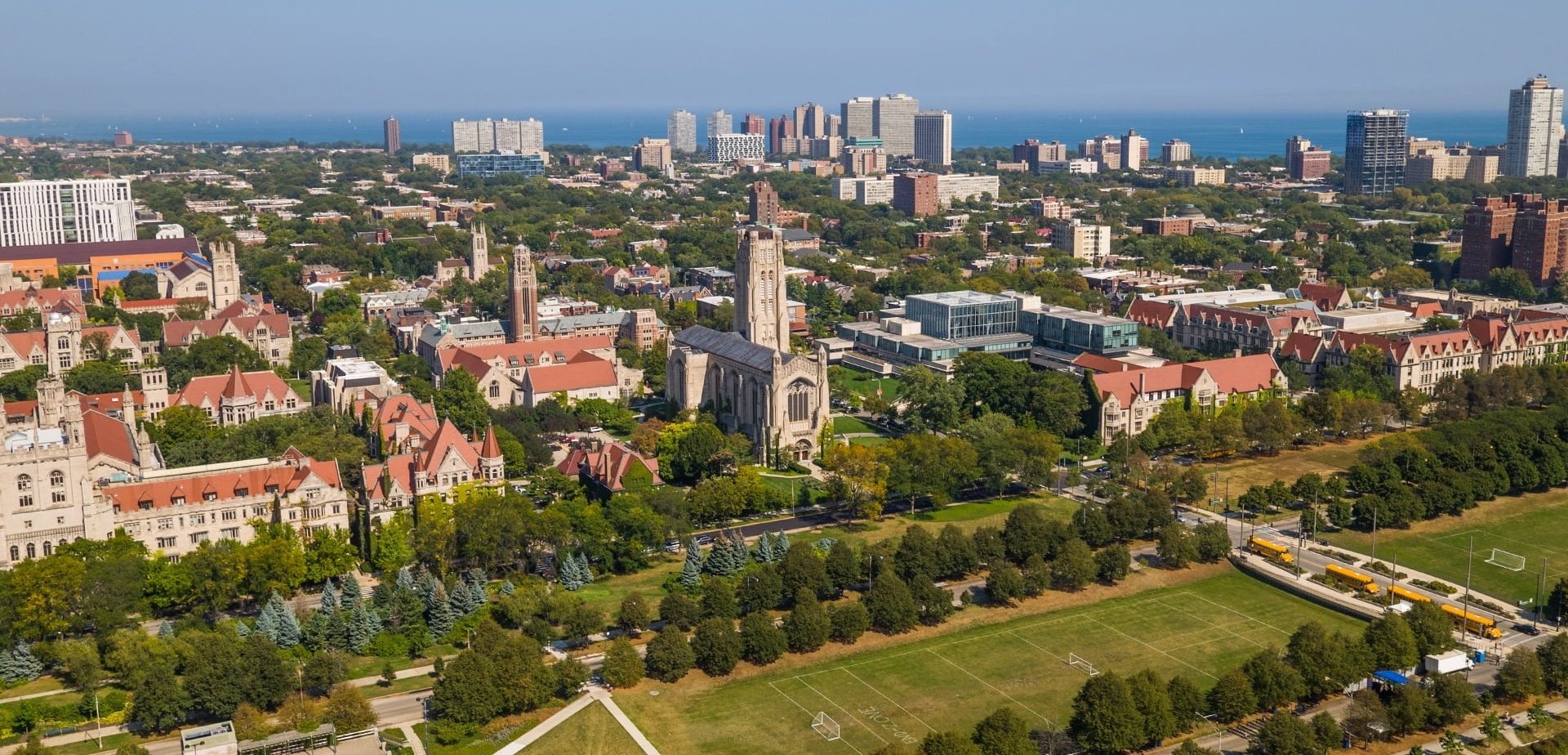
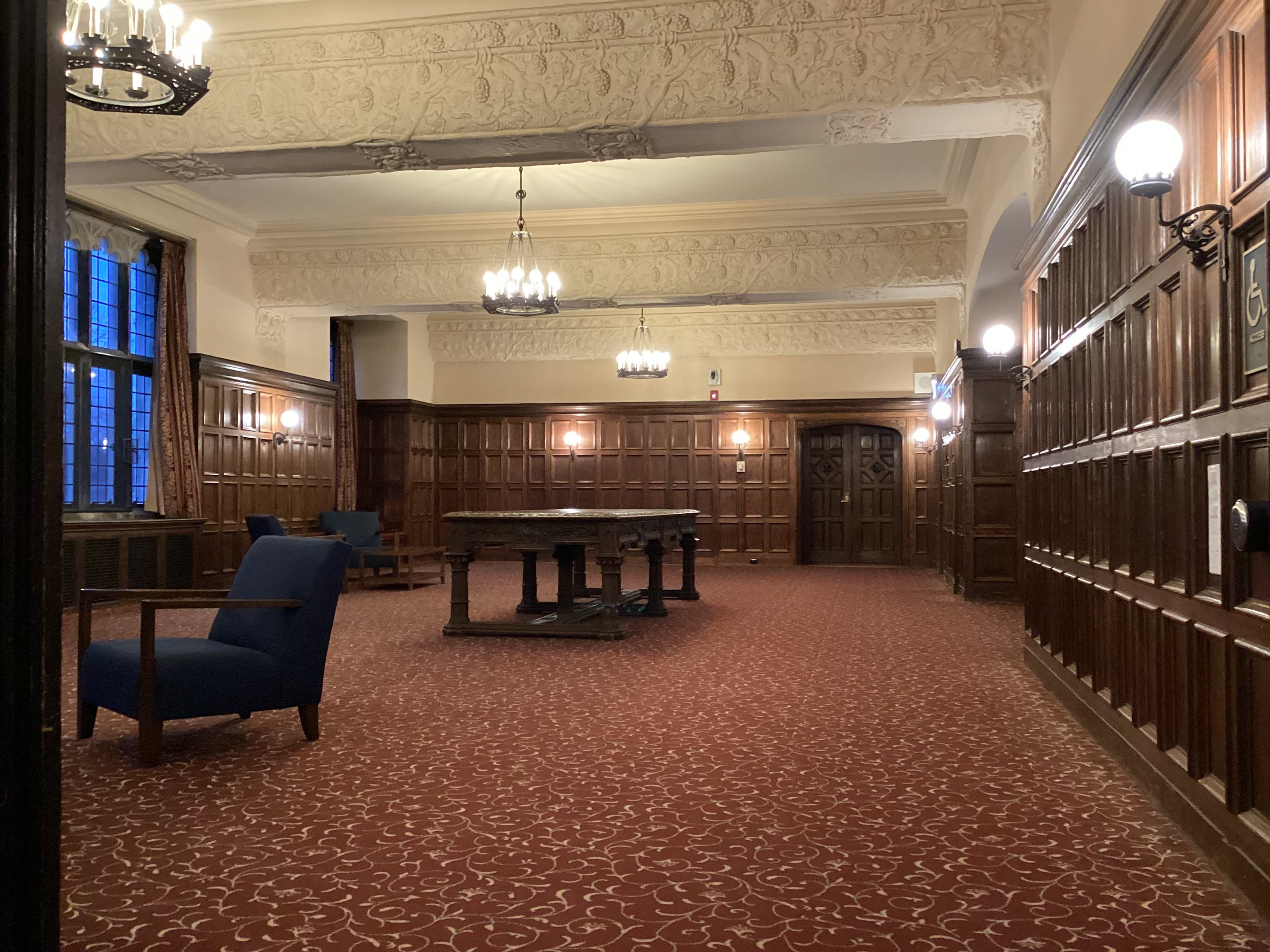
All conference events will take place in Ida Noyes Hall on the University of Chicago’s Hyde Park campus (1212 E 59th St, Chicago, IL 60637)





Schedule At-A-Glance
On mobile devices, swipe left and right to see all sessions in each time slot
Thu, May 29–Sat, May 31, 2025, from 8:00 am CDT
Thu, May 29, 2025, 8:15–8:45 am
Thu, May 29, 2025, 9–10:30 am
Thu, May 29, 10:45 am–12:15 pm
Thu, May 29, 12:30–1:45 pm
Thu, May 29, 2–3:30 pm
Thu, May 29, 3:45–5:15 pm
Thu, May 29, 5:30–10:30 pm
Fri, May 30, 9–10:30 am
Fri, May 30, 10:45 am–12:15 pm
Fri, May 30, 12:30–1:45 pm
Fri, May 30, 2–3:30 pm
Fri, May 30, 3:45–5:15 pm
Fri, May 30, 5:30–8:30 pm
Sat, May 31, 9–10:30 am
Sat, May 31, 10:45 am–12:15 pm
Sat, May 31, 12:30–1:45 pm
Sat, May 31, 2–3:30 pm
Sat, May 31, 3:45–5:15 pm
Sat, May 31, 5:30–6:30 pm
Sat, May 31, 6:30–7:30 pm
Sat, May 31, 7–11:30 pm
Full Schedule
On mobile devices, use your device’s “Find in Page” search function to locate individual presenters or sessions.
Thu, May 29–Sat, May 31, 2025, from 8:00 am CDT
Registration
Main Lobby
Thu, May 29, 2025, 8:15–8:45 am
Welcome and Orientation
Max Palevsky Cinema
Thu, May 29, 2025, 9–10:30 am
Co-creating Participatory Revitalization and Multimodal Pedagogical Strategies for Endangered Languages
Pedagogy Workshop
Library Lounge
Development of learning materials in semantic fields of a minority and/or indigenous language in contexts of displacement and/or endangerment.
Celeste Escobar, Vianey Valdez, and Juanita Montoya
-
This workshop focuses on integrating diverse teaching and learning approaches to support the revitalization of endangered languages. The strategies will draw on various modes of communication, including oral traditions, visual media, digital platforms, and hands-on learning, to create more engaging and sustainable methods for language acquisition and cultural transmission. The workshop activities will be informed by experiences with indigenous languages in native-speaking communities in South America and Mesoamerica, particularly in contexts of displacement. These experiences will serve as a foundation for adapting and co-creating strategies that can be tailored to the specific needs of each participant's displaced language context, providing a hands-on learning experience.
These multimodal strategies offer a comprehensive approach to endangered language revitalization by integrating traditional knowledge with modern tools and methodologies. By co-creating these strategies with community members, the revitalization efforts will remain culturally grounded and relevant, fostering both language proficiency and cultural pride for future generations.
PRESENTERS
Celeste Escobar, M.A., is a PhD student in Linguistics and a Provost Fellow at The Graduate Center (CUNY). She is a native speaker and interpreter of Guaraní from Paraguay. As an adjunct, she teaches Linguistic Anthropology in the Anthropology Department at Lehman College (CUNY). Since 2024, she has been an Ad Hoc member of the 'Education Domains in Indigenous Languages' group of the International Decade of Indigenous Languages (IDIL 2022-32) of UNESCO.
Vianey A. Valdez is in her last year of Master's program of Linguistics at the Department of Indigenous Languages of the University of Sonora in Mexico. Her research focuses on the study of sound symbolism and ideophones in Nahuatl. She has done extensive revitalization work with the Nahuatl community in Milpa Alta, Mexico.
Juanita Ahuehuetzin Montoya holds a BA in Cultural Anthropology from Northeastern Illinois University and is a practicing traditional midwife. In her daily role as a care provider for marginalized populations, she prioritizes language accessibility in maternal health and the decolonization of birth care through linguistically inclusive frameworks. She has worked extensively with indigenous and Spanish-speaking communities to develop participatory strategies that address linguistic barriers in perinatal care.
(Dis)Continuity and the Politics of Forms
Panel
West Lounge
This panel investigates the processes of making continuity and discontinuity. It attends to how experiences of sameness and difference are channeled through the material and discursive linkages by which social actors argue for and naturalize interpretative orders that govern connections across space and time.
-
Making social orders, historical moments, or personhood seem continuous or discontinuous is a complex semiotic process. Arguing for (dis)connections is also a powerful political strategy, particularly in times of social upheaval. This panel investigates the political praxis of continuity and discontinuity. It attends to how experiences of sameness and difference are channeled through the material and discursive linkages by which social actors argue for and naturalize interpretative orders that govern connections across space and time. And it examines how material affordances of such (dis)connective tissues limit the scope of imaginative play in crafting socially salient forms of historicity. Whether nations are enduringly “the same,” languages are broken or pure, political orders such as fascism “then” is the same as fascism “now” have real world implications. The discursive production of (dis)continuity shapes how people imagine themselves as part of mass movements, what counts as participation within those movements, or what is legitimate political or legal authority. In asking how people argue for and project (dis)continuity, panelists will track the semiotic craft of making linkages among the genres, forms and classificatory categories at the heart of modernist political orders and their aftermaths. How do we analytically discern what is the same and what is different, what is new or what is old, alongside or crosswise to others? Are there limits to this process and in what order of semiosis do such limits inhere? Are there empirically observable points at which materially bounded forms break past the point of no return?
Vernacular Forensics and Feral Legal Forms: Moving from Legal to Political Praxis and Back
Jessica Greenberg
Drawing on human rights cases and artistic and community-based evidentiary practices, this paper will analyze the circulation of legal evidentiary forms across different domains of knowledge and aesthetic production (and back). What makes an evidentiary form “the same” or different in circulation, and on what analytic grounds do ethnographers and their interlocutors claim to know the distinction?
-
Increasingly, people are turning to legal forms to imagine new terrains for social justice organizing. Artists and community organizers draw on the channels and forms of legal institutions to advance a host of imaginative, worldmaking projects that paradoxically challenge the very foundations of liberal institutionality in the process. For example, popular forensics movements take up the idea of legal evidence and documentation to hold states accountable in extra-legal fora. And these same movements also rely on legally authorized evidentiary standards to make claims to and within legal institutions, like human rights courts. These arguments rely on simultaneously maintaining connection and disconnection to the law. This raises the question about what is or is not “legal” about those forms, and what their multiple recontextualizations do to boundaries among law and politics so central to rule of law ideologies. If evidence is deterritorialized and reformulated then reterritorialized back into legal contexts at what point does this mobilization break their persuasiveness as authorized legal forms? This paper draws on a comparison of forensic evidentiary practices within human rights cases at international courts and related community-based and artistic representation. It will analyze the circulation of legal evidentiary forms across different domains of knowledge and aesthetic production (and back). I ask: how do different political and legal advocacy strategies rely on the continuity of evidence as a truth-telling form with linkages to empirical ‘reality,’, but discontinuity in the ethical and political orders in which that truth is narrated, witnessed and taken up.
Jessica Greenberg is an associate professor of anthropology at the University of Illinois, Urbana-Champaign
Negative Poesis: Semiotics at a Standstill
Kabir Tambar and Sarah Muir
Semiotic anthropology often asks how interactional coherence is achieved in real-time and how that coherence is made to endure. We propose a different methodological starting point – a negative poiesis that privileges sites of semiotic impasse, instances of deictic dislocation, and chronic conditions of unintelligibility.
-
Semiotics in anthropology is often oriented toward the study of how interactional coherence is achieved in real time and how that coherence is made to endure through the work of institutional orders. In this paper, we propose a different methodological starting point – a negative poesis that privileges histories of semiotic impasse, in which text comes to be misaligned from its co(n)text. We are interested, for instance, in sites where deixis dis-locates the subject from narratives of its historical embedding. Speech in such moments is often dismissed as infelicitous, a token failing in some measure to conform to an institutionally regimented type. By contrast, we seek to examine how such infelicities come to be recognized by interactional participants not as contingent failures but as iterable, emergent indexes of a structural condition of non-identity. Within what logics of recruitment to social roles do such instances of deictic dislocation become especially salient? How do interactional participants come to recognize misalignments of text with stipulated co(n)text and thereby signal a non-identity with the regimenting framework? What political and social entailments can result from these processes of recognizing misrecognition, of identifying non-identity? To explore these questions, we revisit several relatively well-known ethnographic analyses of infelicity, dislocation, and impasse to track the paradoxical modes of collectivity, of temporality and historicity, and of recognition that unfold out of processes of negative poesis. In so doing, we consider how this methodological orientation can help us reevaluate questions of continuity and discontinuity, sameness and difference.
Kabir Tambar is Associate Professor of Anthropology at Stanford University.
Sarah Muir is Associate Professor of Anthropology at the City University of New York.
Form, Imagination, Judgement: The Case of Mass Forensics in India
Francis Cody
The forensic imagination has entered domains where crime is treated as spectacle demanding fast-time analysis. This paper examines contestations over how material captured on CCTV and in mortuary reports that have been leaked to the public should be understood as evidence in news media.
-
Over a decade ago, Thomas Keenan and Eyal Weizman argued for a turn to forensics as a model of evidence that changes not only the epistemology of the courtroom, but also the question of the forum before which one argues. Whereas the Forensic Architecture project focuses on political conflict and they rely on the professional tools of the forensic scientist to make their arguments in the rarified forums of the fine visual arts, the academy, and most importantly the courts, it has become increasingly clear that the ethics and political aesthetics they discuss have even wider significance as forensics have become more public, popular, and indeed, massified. As forensics has overflowed the boundaries of initial forums and into the realm of mass culture, so too have the ethics and political aesthetics driving the will to make material traces of past events “speak” with scientific authority transformed a great deal.
The forensic imagination has entered domains where crime is treated as spectacle demanding fast-time analysis. This paper examines contestations over how material captured on CCTV and in mortuary reports that have been leaked to the public should be understood as evidence in news media. While forensic techniques have been vulgarized, they have also been democratized, allowing communities that have felt the brunt the law’s often opaque power to define criminality to participate in debates that remain wedded to an ideal of factual truth, however slippery a notion this might be in a world of crime infotainment.
Francis Cody is an Associate Professor in the Department of Anthropology and the Asian Institute at the University of Toronto, where he is also the Director of the Centre for South Asian Studies.
A Tale of Four Diacritics: Politics on the Page in Southern Tiwa Language Reclamation Projects
Erin Debenport
This paper follows the use of four diacritics used in Southern Tiwa community language reclamation efforts: the accent mark, the apostrophe, the underline, and the dash. I show how these four signs index, contest, and affirm intra- and inter-tribal political commitments at large and small scales.
-
This paper follows the life of four diacritics used in Southern Tiwa community language reclamation efforts: the accent mark, the apostrophe, the underline, and the dash. During the last 20 years, the three Southern Tiwa-speaking tribes have developed alphabets to document and teach this Indigenous language. Like all alphabetic orthographies, considerable work has to occur to render characters “the same” as the sounds they are designed to represent. This is especially important in contexts where writing is used to support contemporary learners and prepare for a future with fewer speakers. In other words, tribal members strive to design and use precise alphabets that don’t have the same challenges as English, such as “silent” letters and single characters that stand for different sounds. Writing is then used to produce closely-edited language learning materials where the meanings of these diacritics are cemented while the behind-the-scenes discussions about their value are obscured.
Drawing on my experiences with designing Southern Tiwa alphabets I show how these four signs figure in conversations about similarity and difference at scales ranging from small (how a nasal vowel contrasts with an oral vowel) to large (distinctions between settler and Indigenous languages and peoples). I trace how conversations about these signs index, contest, and affirm intra- and inter-tribal political commitments. Finally, I consider situations where the use (or rejection) of these diacritics have led to observable (and perhaps irreversible) language shift, even as they are employed as tools to ensure linguistic accuracy and assert political strength and cultural continuity.
Erin Debenport is an Associate Professor of Anthropology and American Indian Studies at the University of California, Los Angeles.
Revolt Against the Modern World: Syncretic Fascisms and Far-right Semiosis
Catherine Tebaldi
This paper examines Traditionalism, a syncretic philosophy of spiritual order in PhilosophiCat’s YouTube videos. Her narratives of ‘return to tradition’ make tradwives, Grail Quests or Lord of the Rings are coeval with idealized past through opposition to a degraded, meaningless present; this semiosis naturalizes social hierarchy as sacred meaning.
-
This paper explores the digital circulation of Traditionalism, and the semiotic and political coalition building this creates. Traditionalism (Sedgwick 2023) is a spiritual naturalization of interpretative orders, a syncretic philosophy of sacred hierarchy associated with spiritual fascist Julius Evola, popularized by Jordan Peterson and metapolitical influencers he inspires such as Philosophicat, 12 of whose YouTube Videos this paper analyzes. In these, multiple iterations of the ‘return to tradition’ are assimilated to each other and made continuous with an idealized past -- from Burkean conservatives, tradwives and Lord of the Rings -- through opposition to a present imagined degenerate and meaningless.
Speaking to the panel’s interest in the naturalization of interpretative orders across temporally distinct contexts, this paper looks first at traditionalism’s syncretism, the formation of a sacred order of difference through ideologically saturated manufacturing of similarity across political, religious, cultural, and temporal orders. Second, using Ebin’s (2024) prefigurative traditionalism, what the stakes are -- and for whom-- in a future legitimated by imagined connection to a sacred order which from ‘spiritual virility’ to ‘biblical patriarchy’ is shaped by ideological scale making (Gal 2016) naturalized by and naturalizing gendered submission.
Catherine Tebaldi is a postdoctoral researcher at the University of Luxembourg’s Culture and Computation Lab.
(Re)Imagination, Embodiment, and Talk
Panel
Third Floor Theater
We draw on both phenomenology and linguistic anthropology, by examining how individual bodies can become connected to or divided from one another, and how they change. We complicate embodiment by studying bodies as they are (re)imagined, felt and resisted, harmed and cared for while considering their many mediating forces.
-
While the human body is a key component of any anthropological research, it presents a methodological challenge to do justice to the totality of gestures, facial expressions, and movements in any instance of social action, as in multimodal approaches for instance. On the other hand, some scholars turn to phenomenology precisely to get away from language and representation, to avoid restricting their analysis to humans. Embodied practices, as some have argued (Jackson 1989; Downey 2005; Goodwin 2018; Perrino and Reno 2024; Pritzker et al. 2024; Reno 2024), should in fact have a more prominent role in anthropological inquiries. Bodies, they remind us, are not only objects of inquiry, but also (auto)ethnographically (re)imagined, felt, and talked about (Desjarlais 2018; Perrino and Reno 2024). In this panel, we draw on both phenomenological approaches and linguistic anthropological theories and methods, by examining how individual bodies can become connected to or divided from one another, as well as how they change or otherwise become other-to-themselves. We are also interested in approaches from feminist and critical disability studies that foreground the importance of caring for and about bodies (Davis 2002; Piepzna-Samarasinha 2018). We complicate embodiment by being open to the various ways that bodies are imagined and reimagined, felt and resisted, harmed and cared for, and how these processes are mediated by cultural, linguistic, gestural, haptic, and aural frameworks, among others.
“I Feel Like the Elephants in Fantasia”: (Re)Imagining the Body in Fitness Narratives
Sabina M. Perrino
(Re)Imagining human bodies and setting temporal goals about changing them have become prominent. Through an analysis of fitness enthusiasts’ narratives, I examine participants’ senses of being (un)fit and of (non)belonging due to idealized body representations. I examine how gym goers’ ideals are enacted at different scales in their narratives.
-
(Re)Imagining human bodies and setting temporal goals about changing them have become prominent trends as seen in the unprecedented proliferation of gyms, (a)synchronous digital workouts, and an overall emergence of desired fitness goals and healthy eating habits. In gym settings, for example, fitness enthusiasts aim at changing and/or maintaining their body shapes and sizes through rigorous daily training and exercising. American gym goers’ (re)imaginations of their bodies have powerfully surfaced in the narratives that my colleague and I collected before, during, and after the COVID-19 pandemic (Perrino and Reno 2024).
Through a close analysis of fitness enthusiasts’ storytelling practices, this paper examines participants’ stances as they are related to their senses of being (un)fit and of (non)belonging often due to circulating idealized body representations. More specifically, I examine how gym goers’ dreams and expectations are enacted at different spatiotemporal scales (Carr and Lempert 2016) in the stories they shared. To be able to study scalar and spatiotemporal movements in narrative practices, I consider narratives as performances that make sense only if analyzed in their context(s) of occurrence (Ochs and Capps 1996). Through this pragmatic approach to narratives, it is possible to examine how participants scale their perspectives vis-à-vis fitness and wellness, and thus change their stances or positionings, during their storytelling events, in relation to their narrated content, to their surroundings, and to their (re)imagined bodies. Ultimately, this paper bridges linguistic anthropological theories and methods with a novel phenomenological approach.
Sabina M. Perrino, Binghamton University (SUNY).
“Self-portraits Saved My Life”: Embodiment and Enactment in Visual Narratives
Rachael Sebastian
Through a discussion of my own autoethnographic self-portrait series, alongside interview data with other photographers, I explore the ways in which the embodied process of creating portraits of the self and others alters the way one perceives one’s own image, and how one thinks about one’s body differently.
-
While the human body as it is displayed in the visual arts is a prominent topic of discourse, the role of the physical body of the artist performing an artistic practice is often left incidental. Yet, in visual narratives of the self, such as self-portraits, the artist's body is the mechanism doing the creative performance that results in the image. This embodied moment in the act of visual storytelling is where various narrative processes related to identity occur.
Through a discussion of my own autoethnographic self-portrait series, alongside interview data with other photographers, in this paper, I explore the ways in which the embodied process of creating portraits of the self and others alters the way one perceives one’s own image, and how one thinks about one’s body differently. In my ethnographic fieldwork with photographers both using self-portraits or models, it emerged that creating portraits and characters can powerfully impact the way they see and think about themselves. In crafting these visual narratives, they are not only representing themselves as they are, which is powerful in its own right. But they are also enacting and constructing selves in transformative ways (Wortham 2001). Creating visual narratives help to work through complicated and overwhelming thoughts and feelings or create fantastical and empowered characters through the embodiment and enactment of these aspects of themselves. This is done with the goal of integrating those characteristics in their daily lives. It can help rehabilitate their relationship with their own body and facilitate working through traumas.
Rachael Sebastian, Binghamton University (SUNY).
Urgency, Social Justice, and the Capacity to Slow Down: Embodiment, Chronotopes, and the Imagination of a Just Possible Present
Sonya E. Pritzker
Drawing on data collected as part of a global, collaborative, multi-racial ethnography, cross-generational ethnography called The Living Justice Project (LJP), this paper addresses the panel’s call for considerations of the ways that bodies are variably imagined and lived as both interaction and phenomenological experience.
-
Drawing on data collected as part of a global, collaborative, multi-racial ethnography, cross-generational ethnography called The Living Justice Project (LJP), this paper addresses the panel’s call for considerations of the ways that bodies are variably imagined and lived as both interaction and phenomenological experience. I attend, here, to the nuanced ways that LJP collaborators theorized the relationship of embodiment to social justice in frequently tentative narrative (re)alignments that nevertheless often challenged some of the core chronotopes characterizing popular definitions of social justice. In imagining the body as a complex network of biological, historical, and political relationships that emerge in and across space and time, I show, collaborators often played with unsettling binary chronotopic castings such as center/periphery, modern/traditional, or un/developed. Their definitions, specifically, (1) rescaled equality as an emergent relational practice enacted within and across bodies in space and time; (2) reconfigured recognition as a continuous and emergent as well as relationally, spatially, and temporally engaged process that disturbs normative distinctions between the past, present, and future; and (3) remapped progress by situating liberation in the possible present as well as the possible future. My analysis overall thus centers the question of how theorizations of social justice or embodiment—as with any other form of (more or less shared) social imaginary—chronotopically situate speakers’ bodies in relation to one another as well as in relation to dominant interpretations of the past, felt experiences in the present, and visions for the (possible) future.
Sonya E. Pritzker, University of Alabama.
We All Just Want Our Kids and Our Families and Communities to be Safe: Positioning Children’s Bodies as Moral Reference Points in America’s Gun Debate
Gillian Faircloth
Through an analysis of online conversations about gun control as well as interviews with key gun violence prevention activists, this paper examines how participants positioned on opposite “sides” of the debate enact “scalar intimacy” as they position themselves in relation to both feared and desired national futures.
-
Gun control in the U.S. remains a heated debate, with some advocating for more stringent gun control and others defending Second Amendment rights. Yet, many agree on one point: everyone wants children to be safe. Using data from both online and in-person conversations about gun violence in the United States, this analysis will focus on how people orient to children’s bodies and their safety as a powerful, shared index of vulnerability. By positioning children as vulnerable, individuals advocating for gun control articulate shared fears, situating events like mass shootings as precedents that endanger all children. Past tragedies/future threats shape these conversations, making children’s safety urgent. There is often a sense of intense anxiety and immediacy. Participants who support 2nd amendment rights, however, also frequently claim to be concerned with protecting children’s safety. Their anxieties seem directed more towards doing so with an increase in access to guns for teachers and other school administrators who might be able to prevent mass school shootings. By engaging in a detailed analysis of online conversations about gun control as well as interviews with key gun violence prevention activists, this paper examines how participants positioned on opposite “sides” of the debate enact “scalar intimacy” as they position themselves in relation to both feared and desired national futures. My analysis thus explores how public discourse on guns in the U.S. situates bodies, particularly children’s bodies, as moral reference points that connect personal and collective experiences of past loss, present urgency, and aspirations for a safer future.
Gillian Faircloth, University of Alabama.
“Does anyone else…?” Navigating Authenticity and the False Dilemma of Faking Tourette’s
Joshua O. Reno and Rae Jereza
By analyzing findings from a year-long-digital-ethnographic study of a youth-led Discord-server, we show how tic sufferers trouble the binary between authenticity/artifice as they try to make sense of how performance fits into their daily experiences. We show how users must learn how to talk/write about/perform their tics to access services/support/sympathy.
-
Some medical experts in the US and UK have recently suggested that TikTok usage is causing young people to fake or to imitate bodily tics they witness online and, possibly, leading to misdiagnoses of Tourette's Syndrome (TS). By analyzing findings from a year-long digital-ethnographic study of a youth-led Discord server for people who struggle with tics and their peers, we show how tic sufferers trouble the binary between authenticity/artifice as they try to make sense of how performance fits into their daily experiences. In exploring youth experiences with TS through digital ethnography, we resist biomedical experts’ treatment of social media as merely spaces where “inauthentic” behaviors are performed either deliberately, for more likes, follows, and income, or merely reactively or mimetically, as part of a mass sociogenic illness. More to the point, we see these spaces as in some ways supplementing, in some ways amplifying the politics of self-representation that exist “offline.” We show how the users of this server are savvy actors who must learn how to talk about, write about and, yes, perform their tics in order to access services, support and sympathy from others on and especially offline. Accusations that youth are deliberately faking or are misled to think they have TS must be understood within a broader context where patients’ experiences and self-understandings are routinely dismissed, especially when framed as experience influenced by the internet and social media.
Joshua O. Reno, Binghamton University (SUNY).
Rae Jereza, FrameWorks.
Discussant: Michèle Koven, University of Illinois, Urbana-Champaign
Scandal as Semiotic Achievement
Panel
East Lounge
This panel proposes scandal as a generative site for semiotic analysis. We present four papers which examine events of scandal situated in distinct historical and cultural contexts, yet threaded through by a family resemblance of social and discursive logics.
-
In this contemporary historical moment–marked by generalized political-economic crisis, existential precarity, and persistent uncertainty–the prevailing “atmosphere of doubt” (Masco and Wedeen 2024) is routinely punctuated by the recurrent eruption of scandal. On the one hand, we are so immersed in scandal that “The most daring provocations and the most shocking scandals have lost all power to provoke and shock” (Girard 1971). And yet, scandal perdures; we simply cannot exhaust ourselves of the “pleasure of unmasking” (Strassler 2020).
Drawing upon the anthropologies of corruption, conspiracy, and critique, this panel eschews a hermeneutic of veracity—one which sees in scandal the revelation of that which is hidden behind the curtain of appearances (Muir 2021). Instead, we foreground the question of scandal’s productivity: what does it make possible – socially, materially, affectively, and ideologically? What are its conditions of possibility, and what are the conditions of its legibility qua scandal?
Our panel brings together four papers which interrogate ‘scandal’ as it unfolds across distinct cultural, historical, and political-economic contexts. Through these papers, we unsettle the “given-ness” of scandal as an intuitively recognizable category of event, and instead look towards the concrete discursive and semiotic processes through which scandalous happenings emerge, circulate, and address their various publics (Warner 2002). What are the signs, genres, and registers through which scandalous events are spoken and heard (Agha 2005)? How are scandalous events scaled up—or down—to scandalous proportions (Carr and Lempert 2016)? And who are the (listening) subjects interpellated by scandalous discourses and discourses on scandal (Inoue 2003)?
“What Kind of Person Fakes Their Voice?”
Nikhil Sood
This paper centers on a semiotic analysis of a scandal surrounding the “fake voice” of disgraced billionaire entrepreneur, Elizabeth Holmes. I examine the collective anxieties and aspirations underpinning the fixation with Holmes’ vocal fraudulence, and consider how the ritual of unmasking her fake voice constitutes new publics and political subjectivities.
-
In March 2019, the online fashion magazine The Cut published a widely popular article titled, “What kind of person fakes their voice?” The subject of this exposé was the disgraced Silicon Valley CEO, Elizabeth Holmes, whose health-tech startup, Theranos, had become infamous for swindling investors of over nine billion dollars, misleading medical regulatory authorities, and lying to vulnerable cancer patients. And yet, over a year after these malpractices first came to light, the tabloid article was far from unique in eliding the gritty details of the corporate conspiracy, fixating instead on what had become the most enticing aspect of the Theranos saga: the ostensibly fake voice of its charismatic founder. Indeed, the fake voice of Holmes has been a staple index in the plethora of dramatic reenactments through which she has been portrayed. Building upon this panel’s orientation to scandal as essentially productive of new social imaginaries, this paper centers on the following inquiries: What kind of social and historical juncture produced the collective predisposition to hear the scandalous fakeness in the voice of a disgraced billionaire CEO? What were the collective aspirations and anxieties voiced through this citational gesture, and what does the enchantment with vocal inauthenticity reveal and obscure? And finally, what kind of (new) political subject is constituted by the socially mediated ritual of hearing, unmasking, and citing the fake voice of Elizabeth Holmes?
Nikhil Sood is a PhD student in linguistic anthropology at the CUNY Graduate Center.
How Can You Blackmail the Prime Minister?
Abdullah Jawad
Through attending to the unconventional communicative structure of the 2021 Hazara protests in Balochistan, Pakistan, this paper poses a set of questions about how minoritized communities deploy new forms of political instrumentality in light of the failure of traditional legal and political institutions to deliver justice or recognition.
-
This paper analyzes the 2021 Hazara sit-ins in Quetta, Balochistan, and the distinctive effect accorded by the structure of addressivity within which the protest unfolded. Following two decades of targeted attacks on their community by anti-Shia Islamist militants in the Pakistan-Afghanistan borderlands, an attack on Hazara coal miners in January 2021 erupted in a mass protest movement which refused assimilation into the routinized state mechanisms of mourning characteristic of the Pakistani martial-state’s post-War on Terror politics. The families of the victims refused to bury the bodies of their kin, blockading Quetta’s central road and agreeing only to end the blockade (and the violation of Islamic burial rites) if and when the Prime Minister came to visit the protestors in person. The Prime Minister responded after 5 days, by which point the protest had become an international crisis, only to refuse and accuse the protestors of ‘blackmail’. Whereas previous attempts by the community to make their plight newsworthy failed to achieve the scale they demanded, this paper analyzes the unconventional communicative structure of this protest, and its role in re-introducing a sense of urgency into their demand for recognition. I argue that attending to the structure of addressivity of the protest renders legible the minority Hazara community’s attempt to find a ‘footing’ on which to make a claim on the majority (Tambar, 2019). I accordingly ask whether we can imagine the nature of the Pakistani polity through the structure of addressivity within which one can speak and be addressed.
Abdullah Jawad is a PhD student in anthropology at the CUNY Graduate Center, working on histories of legal reform in Britain and Pakistan.
Fort Night: Chronotopes of Racialized Violence in Police Challenge Coins
Kyle Fraser
This paper is a semiotic analysis of NYPD “challenge coins.” Despite claims of “morale- boosting” invoked to justify these “commemorative tokens”, these unifying measures are nested in self-authorizing as well as racialized othering discourses, serving as a material trace of the promotion of racism and sadistic violence on an institutional level.
-
In August 2020, the NYPD defended officers of the 67th precinct in East Flatbush after an internally circulated “challenge coin” surfaced on an auction site, gaining public attention and outrage. The challenge coin, and several others which were soon discovered, used the nickname “Fort Jah” to refer to the precinct situated in a largely West Indian neighborhood, and featured overtly racist and violent imagery and language. One such coin included a cartoon of a dark-skinned figure with locks being “hunted” by white police officers with the text “Let the Games Begin” and a reverse side that featured an Ernest Hemingway quote on the virtues of “the hunting of man” printed over the Jamaican flag. The scandal which ensued was readily quelled by the NYPD spokesperson’s invocation of the coins’ “morale-boosting” purposes. This paper is a semiotic analysis of NYPD “challenge coins.” The forms of unity that these “commemorative tokens” claim to recognize, though justified on the basis of increasing collective morale, are nested in self-authorizing as well as racialized othering discourses, serving as a material trace of the promotion of racism and sadistic violence on an institutional level. The paper traces how police tokens serve as (1) material evidence for anthropological/forensic/archaeological studies of police ideologies; (2) a particular form of private network currency that traffics in tropes of dominance through violence, (self-authorized) authority and the presumed value of an always erased whiteness against a devalued (and subservient) otherness as constituted by racialized notions of social inferiority.
Kyle Fraser is a PhD candidate in linguistic anthropology at the CUNY Graduate Center, and co-chair of the Language and Social Justice (LSJ) committee at the SLA.
Holocaust Denial Discourse: A Conspiracy/Theory
Yasmine Eve Lucas
This paper examines Holocaust denial discourse (HDD) through anthropological theory on conspiracy, viewing it as both propaganda and meaning-making idiom. Based on fieldwork at North American Holocaust museums, as well as discourse analysis, it argues that HDD serves neoliberal and Zionist ends while also being driven by affective, banal phenomena.
-
Despite widespread claims of a rise in Holocaust denial as a moral and historical “scandal,” empirical evidence indicates that such denial has been in decline and remains a fringe belief. Drawing on fourteen months of fieldwork at Holocaust memorial museums in the United States and Canada, and a literature review of scholarly, archival and popular sources, this study examines Holocaust denial discourse (HDD) through the lens of anthropological theory on conspiracy theory. This literature frames conspiracy theories as both propaganda tactics and meaning-making idioms. Drawing on these insights, the paper argues that HDD functions as a political tool—serving both neoliberal and Zionist ends—and is also motivated by banal and affective phenomena that invoke and sediment collective imaginaries having to do with postwar anomie and Jewish-American assimilation. Through this critical semiotic approach, the essay examines the socio-political structures HDD supports and argues that, despite its arguably unwarranted scandalized tone, it cannot be simply dismissed as paranoid or “Zionist.”
Thu, May 29, 10:45 am–12:15 pm
Imagining Linguistic Anthropology Beyond the U.S.
Panel
West Lounge
Panelists explore the state of linguistic anthropology beyond the U.S. by highlighting existing projects and resources, discussing resources that are still needed, and imagining possible futures for growing linguistic anthropology institutionally on an international scale.
-
Who are linguistic anthropologists? How does one become a linguistic anthropologist? Where does one become a linguistic anthropologist? This panel invites participants to respond to these questions and to critically examine the state of linguistic anthropology today. By ‘state’, we mean both the current praxis-based commitments and trends in the sub-field as well as within what nation-states and other geopolitical entities linguistic anthropology is taught and practiced. In the U.S., anthropology is a four-field discipline, including archaeology and biological, cultural, and linguistic anthropology, yet few departments offer training in all four sub-fields. Linguistic anthropology—the study of language as social action—is unique to American anthropology and has rare presence outside the U.S. In some regions of the world and languages, no training programs exist. Instead, scholars are trained in sociolinguistics or sociocultural anthropology and pursue research using terms such as linguistic ethnography or linguistic landscapes. Who does this include and preclude from participation in linguistic anthropology? What kinds of projects does it invite and discourage for linguistic anthropological practice? What kind of infrastructures do we need to build a linguistic anthropology beyond the U.S.? Thinking beyond the research of individual scholars, our focus on this panel is on creating institutional frameworks, networks, training programs, and communities to grow a linguistic anthropology outside of the U.S. Papers will highlight examples of existing and imagined projects in the U.S., Canada, Mexico, Japan, Taiwan, the UK, other parts of Europe, and the Middle East.
The State of Linguistic Anthropology in Japan: Challenges and Future Pathways
Makiko Takekuro
This paper explores the landscape of linguistic anthropology in Japan, highlighting challenges but also opportunities for energizing the field. While scholars of language and culture in Japan tend to avoid politically sensitive issues, new collaborations centered on semiotics have begun across fields (with multimodal interaction, cognitive science, and regional sociology).
-
This paper explores the landscape of linguistic anthropology in Japan, highlighting challenges and opportunities for energizing the field. A community of approximately twenty active linguistic anthropologists has engaged in individual research and collaborative activities, such as organizing conference panels and contributing to edited volumes on interaction, identity, and poetics. Due to institutional constraints, many members are affiliated with the Literature, Communication or Law Faculties, teaching English and undergraduate sociolinguistics courses. This limits our opportunities to mentor graduate students in this discipline, hampering the pipeline of successors. The lack of recognition is also a disadvantage in securing government grants. The most crucial challenge is that scholars of language and culture in Japan tend to avoid politically or ideologically sensitive issues such as race and gender. Rather than critically examining existing inequalities, they emphasize the creation of an inclusive and harmonious society, which is ideological in its own way. By contrast, North American linguistic anthropology has become significantly political in recent years. Politically charged topics, not to mention demanding writing styles, distance the Japanese audience further from the discipline. Despite these challenges, there are opportunities to grow the field. We have started an online reading group and it is imperative to expand this initiative. Furthermore, we plan to organize regular data sessions and lectures, inspired by successful practices of conversation analysts. Most importantly, centering on semiotics, several collaborations have begun across fields (with multimodal interaction, cognitive science, and regional sociology). This will offer more creative and imaginative pathways for linguistic anthropology.
Makiko Takekuro is a Professor in the Faculty of Law at Waseda University, Tokyo, Japan.
Linguistic Anthropology et/ou Anthropologie Linguistique: The View from Canada
Eric Henry
This paper considers the history of linguistic anthropology in Canada, highlights theoretical insights that derive from its national context, and proposes steps towards the creation of a more inclusive, more multilingual, and more international discipline.
-
Edward Sapir penned his seminal Language: An Introduction to the Study of Speech while at the University of Ottawa, highlighting the longstanding prominence of linguistic anthropology in Canada. But while Canadian anthropology is often seen as a (perhaps rather pale) reflection of the American four-field tradition, national, academic and cultural factors have led to the development of a dynamic and thriving sub-field north of the border. In particular, this paper will focus on how official bilingualism (and francophone contributions to the discipline), Crown-Indigenous relations, and national histories have shaped the questions, approaches and teaching of linguistic anthropology in Canada. It proposes steps towards the creation of a more inclusive, more multilingual, and more international discipline.
Eric Henry is an Associate Professor, Department of Anthropology, Saint Mary's University - Halifax, Canada.
Imagining a Linguistic Anthropology of the Middle East: Theoretical and Institutional Challenges
Idil Ozkan
This paper critically examines the promises and challenges of applying linguistic anthropology’s core theoretical tools to the Middle Eastern contexts in light of institutional and sociopolitical differences.
-
Linguistic anthropology offers rich tools for understanding language and culture across diverse geographies, yet its US-centric formation can sometimes impose limitations when analyzing Middle Eastern contexts. While foundational concepts such as heteroglossia, indexicality, and language ideologies are broadly applicable to global settings, their development has been significantly shaped by the sociolinguistic and political conditions prevalent in the United States—conditions that differ fundamentally from those in the Middle East. Furthermore, as linguistic anthropology emerged from the four-field approach of U.S. anthropology, it often occupies a marginal or even non-existent position in Middle Eastern scholarship, where disciplinary boundaries are drawn differently across academic traditions. This paper offers preliminary reflections on the promises and challenges of applying linguistic anthropology’s core theoretical tools—many of which are rooted in contexts such as Native American language revitalization and U.S. linguistic ideologies around race—to the Middle East, in light of these institutional and sociopolitical differences. For instance, this paper questions whether the core theoretical frameworks in linguistic anthropology can account for the Ottoman imperial formation, a historical phenomenon that profoundly shaped the linguistic realities of the Middle East and is markedly distinct from the legacies of European colonial empires. This paper therefore seeks to reimagine ways to develop linguistic anthropology towards centering the Middle East as both a site of inquiry and a locus for theoretical innovation. It emphasizes the importance of building academic infrastructures, fostering global networks, and prioritizing collaboration with local scholars and communities to co-construct theories that reflect the unique sociolinguistic and political dynamics of the region.
Idil Ozkan is a Ph.D. candidate, Department of Anthropology, Northwestern University, Evanston, IL, U.S.A.
Charting Paths: Linguistic Anthropology beyond the US through Scholarly Trajectories and Future Horizons
Jenanne Ferguson and Laura Siragusa
Across five countries, this paper’s co-authors ask why linguistic anthropological traditions in different countries seem so distinct and disconnected, despite their overlapping or complementary research questions and methodologies; examine how the socio-political, cultural, and economic frameworks of academia across different countries influence practices and international engagement; and propose future pathways.
-
Interwoven with our personal international journeys as linguistic anthropologists, we explore how we reimagine linguistic anthropology—and ourselves as scholars—across borders. We address the issues that have shaped our own scholarly trajectories (we both completed PhDs in Social Anthropology in the United Kingdom), and ultimately inspired us to establish ELAN (EASA European Linguistic Anthropology Network) in 2018. Together, we have experience with studying and working within linguistic anthropology in five countries, in multiple different departments. We ask why linguistic anthropological traditions in different countries seem so distinct and disconnected, even when their research questions and methodologies overlap or complement one another; we then examine how the socio-political, cultural, and economic frameworks of academia across different countries influence practices and international engagement. We share our experiences with European academia, which increasingly depends on external funding sources like the European Research Council and discuss the implications this has for employability and sustainability of national and international collaborations. This framework ends up also prioritizing different publication strategies that can impact how scholars’ productivity is viewed. Additionally, we consider the effects of academic mobility, which—while initially fostering opportunity—can often hinder long-term collaborations and impact the well-being of scholars and the academic ecology. By contrast, in the US and Canada, such challenges are often less pronounced. We highlight the flexibility and resilience demonstrated by many scholars in navigating these challenges. Through this discussion, we aim to inspire greater empathy and mutual understanding, and conclude by proposing potential pathways for dialogue and collaboration.
Jenanne Ferguson is an Associate Professor, Dept. of Anthropology, Economics, and Political Science at MacEwan University in Edmonton, Alberta, Canada.
Laura Siragusa is a Senior Lecturer, Faculty of Arts and Sciences at the Ohio State University, U.S.A.
Introducing Language Ideologies, Finding the Domain of Semiotics: How Does Linguistic Anthropology Work in the Mandarin-dominated Language Landscape among Multilingual Taiwanese College Students?
Tzu-kai Liu
Integrating Taiwanese students’ experiences of multilingual learning with the theoretical concepts of linguistic anthropology is an instructional effort and provides a discursive and critical way to underscore and understand the semiotic workings of dominant/dominated language ideologies in multilingual and super-diversified Taiwan.
-
Most theoretical concepts in linguistic anthropology originate from non-Asian linguistic and sociocultural contexts. In Taiwan, even though English is the language of instruction, translating these concepts in university classrooms, where Mandarin Chinese is the dominant language, has become a challenging task. Drawing on my teaching experiences of the seminar course of linguistic anthropology, I will explain the instructional design to introduce the theories of language ideology and semiotics by taking the insights from the application of translanguaging into educational efforts to use Taiwanese students’ personal and familial histories of multilingual learning as a way to explain the semiotic formation of linguistic differentiation and hierarchical scaling. The challenge I faced is that at present a high proportion of Taiwanese college students cannot use their native or first languages (e.g., Taiwanese, Hakka, aboriginal languages and others). They even need to use Chinese to communicate with their family’s elderly who are often not fluent in speaking Chinese. Only a few students have a strong critical awareness of their inability to speak their native or first languages fluently, and try to put their lost mother tongue skills into action and regain them through language learning. The personal and familial histories of multilingual learning, for me as an instructor, provide not only the dialogic voices to develop a linkage with the theories of linguistic anthropology but also a translanguaging lens to, critically and reflexively, review the positions of multilingual Taiwanese students.
Tzu-kai Liu is an Assistant Professor, Department of Ethnology, National Chengchi University, Taiwan.
El Lenguaje Vivo: Introducing Linguistic Anthropology to Spanish-Speakers
Catherine R. Rhodes
This paper reports on original research on differences in teaching and learning in higher education in the U.S. and Mexico and the creation of an introductory Spanish-language linguistic anthropology book, and it synthesizes best practices for cross-cultural and bi-national higher education in and between these countries.
-
This paper reports on original research on differences in teaching and learning in higher education in the U.S. and Mexico and synthesizes best practices for cross-cultural and bi-national higher education efforts in and between these countries. It shares efforts to produce the first, Spanish-language introductory book in linguistic anthropology and the results of pilot testing this book in the classroom in Mexico. Currently, no linguistic anthropology degree programs exist in Spanish; instead, in Latin America language as social action is studied via sociolinguistics. This new Spanish-language book presents linguistic anthropology to Spanish speakers and draws heavily from Spanish-language sociolinguistic scholarship from Latin America. Further, the insights from this research are being used to develop a Collaborative Online International Learning course that will be taught binationally between the U.S. and Mexico. Students in the U.S. and Mexico will be able to access the course via Spanish, English or translanguaging via the online platform and will collaboratively conduct bi- national projects. This paper not only highlights the work to make linguistic anthropology available to Spanish speakers, but it also models how to incorporate Spanish-language scholarship in the teaching of research on language use and how to teach said scholarship in a cross-cultural, bilingual, and binational way.
Catherine R. Rhodes is an Assistant Professor of Anthropology and affiliated faculty in Educational Linguistics; the Latin American and Iberian Institute; and Organization, Information and Learning Sciences at the University of New Mexico (Albuquerque, NM, U.S.A.); currently a Fulbright U.S. Scholar research and teaching fellow in Mexico (Yucatán).
Chair: Laura Ahearn
Imagining Mobilities
Panel
East Lounge
(De)coding the Linguistic Landscape: A New Geosemiotic Approach for the South Asian Diaspora
Suganya Schmura
This study introduces a novel coding framework based on ethnolinguistic repertoire (Benor 2010) and indexicality (Silverstein 2006) to conduct a geosemiotic analysis (Scollon & Wong Scollon 2003) of how the South Asian diaspora uses semiotic assemblages and spatial repertoires (Pennycook 2018) to socially produce their cultural identity in the linguistic landscape.
-
This study explores how the South Asian diaspora constructs their cultural identity in the linguistic landscape (LL) of Rochester, New York by answering these research questions: 1) To what extent and in what ways is the South Asian diaspora made visible in the linguistic landscape?, and 2) How do South Asians index their ethnic and linguistic identities in public spaces?
Linguistic landscape studies (LLS) bridge sociolinguistics and linguistic anthropology by investigating language use within specific temporal and spatial contexts to uncover structures within sociolinguistic systems (Blommaert 2013). While LLS started as a quantitative analysis of written language in public places (Landry & Bourhis 1997), it is expanding to examine how semiotic assemblages and spatial repertoires (Pennycook 2018) contribute to the social production of identity within a space.
To address the methodological challenge of English being the lingua franca in the South Asian diaspora, I propose a new coding framework for LLS based on ethnolinguistic repertoire (Benor 2010) and indexicality (Silverstein 2006). I employ Scollon and Wong Scollon’s (2003) geosemiotic approach which theorizes that space is a social agent which influences how meaning is constructed and conveyed in signs. Unlike current LLS methods that link language visibility to the presence of an ethnic group, this approach offers a more nuanced analysis of how language and symbols are used to signal specific ethnic or linguistic identities. This quantitative analysis will be complemented by interviews and multisensory ethnographic observations to capture the richly contextualized linguistic landscape of the South Asian diaspora in Rochester.
University of Rochester.
Privileged Outsiders: Imaginations of (Im)mobility in Narratives by Expatriates in Taiwan and Thailand
Gareth Price
This paper examines (im)mobilities of a specific, and often understudied, group of migrants: migrants from the global north, who are conventionally, though problematically, known as expatriates or expats. It does this through ethnographically-informed interviews with migrants themselves, 80 of which I conducted between 2019 and 2024 in Taiwan and Thailand.
-
This paper examines (im)mobilities of a specific, and often understudied, group of migrants: migrants from the global north, who are conventionally, though problematically, known as expatriates or expats (Cranston and Duplan 2023). Expatriates are often privileged outsiders: they may avail themselves of privileged positions through advantageous capital accumulation and conversion, yet simultaneously be precarious and marginalized in their destination societies in other ways. They may leverage capitals such as ethnicity, language, wealth, or occupation in transnational contexts, but they may also face barriers to socio-cultural, political, or linguistic integration, and they are still subject to biopolitical bordering and visa regimes designed to court certain migrants and deter others, often through limiting political claims.
As such, northern migrants are not a homogenous group, but multidimensional individuals with complex biographies, desires, and aspirations that constitute bumpy subjectivities. This paper explores these subjectivities through ethnographically-informed interviews with migrants themselves, 80 of which I conducted between 2019 and 2024 in Taiwan and Thailand. By way of thinking through notions of privilege and precarity and their interplays in complex marginalizations, I apply discourse analytical approaches to the narratives of northern migrants to address two interrelated research questions. How, through language and discourse, are (im)mobilities experienced and navigated? And how are social, political, and economic categories, structures, and processes imagined, contested, and resisted as they shape and are shaped by (im)mobility?
Gareth Price is a sociolinguist and political sociologist who teaches in the Linguistics Program at Duke University, USA.
Four Families On the Move: Imagining, Constructing, and Negotiating Identities Across Languages and Communities
Nadxieli Toledo Bustamante, Alejandro Zamora, Murat Rodriguez-Nacif, and Susana Cerda
This paper analyzes the autobiographical narratives of four parents from middle-class immigrant families with common origins in Mexico who are currently living in urban centers across three different countries (United States, Canada, and Austria) to explore their own and their children’s processes of identity imagination, co-construction, and negotiation.
-
Immigrant families and their children live their lives across different languages as well as across different real and imagined communities, both distant and local. For some of these families, the languages and the communities in which they participate change at least once, if not more, while they are raising their children. How do parents in these families understand the effects that these changes in languages and communities have on their everyday lives, their childrearing decision-making practices, their children’s and their own linguistic and cultural identities and, ultimately, on whether each of them become and remain (or not) speakers of those languages and members of those communities? To explore this process of identity imagination, co-construction, and negotiation, this paper analyzes the autobiographical narratives, focusing on their language and migration stories, of four parents from middle-class immigrant families with common origins in Mexico who are currently living in urban centers across three different countries (United States, Canada, and Austria). These narratives are part of a larger collaborative autoethnography (Heewon et al., 2016) that explores the interrelation between language(s) and family-making by drawing from and contributing to research about multilingual families across Language Socialization (Ochs and Schieffelin 1984), Family Language Policy (K. A. King & Fogle, 2016), and other ethnographically oriented approaches (Van Mensel and De Meulder 2021).
Nadxieli Toledo Bustamante is Assistant Professor of Child and Adolescent Development at California State University, Sacramento.
Alejandro Zamora is Associate Professor of Hispanic Studies and Community Narratives at York University, Glendon.
Murat Rodriguez-Nacif is Teaching Associate Professor of Spanish at University of Denver.
Susana Cerda is an Independent Researcher.
(Re)imagining Elite Mobility and the End of “Passport Apartheid” in the Marketing of Citizenship-by-Investment
Joseph Comer
This paper offers multimodal critical-sociolinguistic analysis of marketing within citizenship-by-investment (CBI), the trade in ‘golden passports’. CBI advertising frames ‘Plan B passports’ as licit subversions of an oppressive bureaucratic imaginary. Examining them gleans insight into how elites ease their idealized (self-sovereign, selectively borderless) alternative lifeworld into being through discursive practice.
-
Critical scholarship on wealth highlights how it subsists on imaginaries of what is valuable in the present, and what is anticipated as valuable over the horizon (Rakopoulos and Rio 2018). High-net-worth individuals (HNWIs) are adept, well-practiced, and sufficiently well-resourced to mediate lifeworlds through claims on the future: discourse-ideological representations of potential future/s as intrinsically rational, legitimate, virtuous, desirable and/or innovative.
A relatively-recent, highly contentious (growing) commodity situation demonstrates this well: the trade in citizenship-by-investment (CBI), aka ‘golden passports’, through which states offer citizenship in return for lump-sum contributions to government revenue or real estate development. Despite its clear imbrication with shady, intensely-secretive offshoring practices whereby HNWIs conduct jurisdictional arbitrage, CBI’s communicative practices are spectacular and heavily-mediatized in contrast. Firms’ explicit, glossy advertisements for offshore citizenship frame ‘Plan B’ citizenships and ‘passport portfolios’ as visionary subversions of current bureaucratic/sociotechnical imaginaries: a licit key to unlocking idealized futures.
Undergirded by ethnographic insights from industry events/interlocutors, this paper offers multimodal critical-sociolinguistic analysis of CBI marketing – apprehending how this unique commodity and industry is (re-)imagined and (re-)constituted for (i.e. sold to) prospective clients and other audiences. I focus on media heralding ‘previously-unimagined’ opportunities available to investor-citizens and CBI as a corrective to the privileged mobility rights ‘unimaginable’ to non-Western passport holders. CBI’s metadiscursive ‘acts of citizenship’ (Isin 2012), problematic claims-making and talismanic display of passports glean insight into not just what elite ‘HNWIs’ imagine as their ideal (self-sovereign, selectively borderless) future, but how they and intermediary brokers ease it into being through discursive practice.
Dr. Joseph Comer is an associated researcher with the Centre for the Study of Language and Society at the University of Bern, Switzerland. Until January 2025, he was a SNSF Postdoc Mobility Fellow and visiting research scholar at the CUNY Graduate Center, New York.
Language, race, and perspective
Panel
Third Floor Theater
This panel examines how linguistic anthropology might engage with research that rejects traditional structures of knowledge production. We consider how the notion of perspective can help us reconcile activist goals, complex relationships between researchers and their sites, and the understanding that there is no view from nowhere.
-
Linguistic anthropologists have noted that indexicality necessarily presupposes some perspective of listening or perceiving and that any assignment of meaning is necessarily a situated political act (Inoue 2006, Flores & Rosa 2025, Gal and Irvine 2019, Lo 2021). Perspective-taking can be considered from many angles– those who are present in an interaction vs. those who are external to it; disciplinary stances; alignment with philosophies of action and the self; as well as the multitude of orientations that often get flattened into “emic” vs. “etic” perspectives (Jacobs-Huey 2002; Narayan 1993).
In this panel, we consider the intersections between research on language and race and the dilemmas of perspective taking, We consider how we, as researchers who may be considered “insiders” to some extent with regard to the communities that we study, engage with research that urges us to reject traditional structures of knowledge production (Garcia et al 2021; Grosfoguel 2007; Mignolo 2000). Given the long standing skepticism of linguistic anthropology towards “secondary explanations” (Boas 1910), “folk theories” (Hill 2008), and the distortions of language ideologies, how do we align with paradigms that urge us to take participants’ perspectives seriously? Is the epistemology of linguistic anthropology compatible with work that is committed to justice, equity, and decoloniality? We specifically reflect on data pertaining to language and racialization, addressing how we might analyze or conceptualize African American Language, anti-racist language statements, representations of Jews and antisemitism, decolonial research on South Korea, and Indigenous reclamations in Puerto Rico and legal bureaucracies in the US.
Researching African American Language and Culture as an African American Scholar
Kendra Calhoun
I discuss two research projects that have highlighted how my perspective as a Black American shapes my research on Black language and culture. I offer questions I’ve faced about why certain linguistic practices are salient and how to reconcile my status as a community member and an academic.
-
In this presentation I’ll reflect on how my positionality and perspective as a Black American has shaped my approach to analyzing race, identity, and African American Language in two recent projects. The first project, a collaborative analysis of Ali Wong’s performance in her first stand-up special Baby Cobra, required my co-author and I to explicitly acknowledge how our training as scholars of language, race, and identity shaped our interpretation of Wong’s racial performance. Why did we notice the linguistic and embodied practices that we noticed? Why did we interpret them as features of African American Language? How do we meaningfully account for other possible interpretations of the same discourse without undermining the clarity of our own assertions?
The second project is my ongoing research in the digital community Black TikTok. One aspect of the project is examining representations of African American Language: how Black TikTok creators use it as well as how they talk about it. A tension that has arisen in this work is how to situate Black TikTok discourses about African American Language within sociolinguistic/linguistic anthropological theory without appearing to prioritize the latter when they’re not aligned. As a Black scholar who knows the cultural value of African American language within African American communities, how do I critically analyze discourses, for example, that valorize African American Language as “inherent” to Blackness without seeming to position my Black perspective as more important by nature of emerging from U.S. academia?
Kendra Calhoun is Assistant Professor of Linguistic Anthropology at the University of Illinois, Urbana-Champaign.
Anti-racist Statements and Theories of Linguistic Racism
Elaine Chun
This paper examines competing, and often conflicting, semiotic theories of linguistic racism that are entailed and presupposed in performances of the “language statement,” a public-facing genre posted in U.S. academic spaces as a form of anti-racist action.
-
This paper examines the relationship between semiotic theories (cf. Keane 2018) of language and racism adopted by language researchers and those adopted in U.S. public space. While Hill (2008) notes that “critical” and “folk” theories of racism are often different, convergences across them are important to understand, given the overlapping domains in which these theories circulate (e.g., in public-facing scholarship) and the fact that academic theories are as perspectival any other (Lo 2021). I examine divergent semiotic theories of linguistic racism that are entailed and presupposed in genre performances of the “anti-racist language statement,” a digital document that some academic organizations and units in the United States have publicly posted on their websites to reflexively acknowledge how academic institutions are implicated in the linguistic reproduction of racist structures. By analyzing over 30 tokens of such statements—specifically, the verbs that denote the epistemic, affective, and moral status of statement-makers and that produce interdiscursive connections and gaps between genre tokens (Briggs & Bauman)—I illustrate how this public discourse straddles a seemingly hybrid space between “critical” and “folk” ideas about linguistic racism. I specifically show how public assertions that align with a structural theory of racism (e.g., “linguistic racism is a problem of institutional norms”) cannot preclude (and thus presuppose) competing personalist theories that are invited in their interpretation (e.g., “linguistic racism is a problem of immoral actors or their immoral words and beliefs.”)
Elaine Chun is Associate Professor of English and Linguistics at the University of South Carolina.
Constructions of the “Jew”: A Frame Analysis
Elise Berman
This paper analyzes a set of documents for how tokens of “Jew” and “antisemitism” are discussed, made, marked, and framed. Analysis reveals that these documents create an indexical relationship between “Jew” “oppression” and “privilege”, with the negative effect of marking Jews as people who are never themselves racialized.
-
One central concern in linguistic anthropology is analyzing how language can index and reproduce stigmatized identities and exclusion. Empirical applications of such theory has shown how mock Spanish reproduces stigmatized perceptions of Spanish speakers as lazy or jovial, pronunciation changes can stigmatize Afro-Cubans, or the glossiness of a textbook can mark English as superior to indigenous languages. Interestingly and ironically, despite research into how Jews themselves use language as well as high-profile debates about if and when forms of language should be called antisemitic, linguistic anthropologists have largely failed to investigate how language constructs, indexes, or stigmatizes Jews. This paper analyzes a set of publicly available anthropological documents for how tokens of “Jew” and “antisemitism” are discussed, made, marked, and framed. Analysis reveals that these documents create an indexical relationship between “Jew” “oppression” and “privilege”, with the negative effect of marking Jews as people who are never themselves racialized. The language also delegitimizes “antisemitism” as a discursive frame, making the phenomenon impossible to talk about in not just policy but also scholarship. These findings raise questions about whether structural and discursive understandings of race and racism are unsystematically applied or even, potentially, conceptually flawed. I conclude by reflecting on my own complete lack of education in scholarly analyses of contemporary antisemitism, despite my religious education in synagogues as a Jew and my academic education in universities as an anthropologist.
Elise Berman is Associate Professor of Anthropology at the University of North Carolina at Charlotte.
On Decolonial Approaches: Research on Language in South Korea
Adrienne Lo
This paper examines how research from varied traditions considers participants’ beliefs and the relationship of scholarly constructs to those held by participants. I look at what kinds of actions get taken up as aligning with oppressive language ideologies and the implications this has for research on language and race.
-
This paper examines how research in sociolinguistics, language ideologies, and language and social justice considers participants’ beliefs and the relationship of scholarly constructs to those held by participants. I look at what kinds of actions by scholars get taken up as aligning with oppressive language ideologies and what gets enregistered as “colonial” and “decolonial”, with reference to research on South Korea. For example, while scholarship in language ideologies generally takes a skeptical stance towards participants’ beliefs about language, some work in language and social justice argues that these should be validated, not discredited (Garcia et al 2022). Likewise, in some scholarly traditions presenting binary oppositions, data that reifies deficit ideologies, or hegemonic understandings of “native speakerism” is understood as aligning with such ideologies. Instead, we should be actively engaged in highlighting other perspectives on language and the social world. For others, describing the workings of power is not the same as legitimating them. I consider how these varied epistemological perspectives align with disciplinary orientations. For example, recent work by historians of South Korea has delighted in proving how many things that South Koreans themselves think of as emblematically “Korean” (e.g. taekwondo, bbq, kimchi, K-pop) are actually, from a historical perspective, foreign imports (Jackson et al 2021). This approach has been criticized by scholars who do not paper considers the epistemological and methodological implications of such research for work on language and race.
Adrienne Lo is Associate Professor of Anthropology at the University of Waterloo.
Ethnographic Indeterminacies: Race, Language, and Power and the Researcher’s Perceptual Gaze
Sherina Feliciano-Santos
Drawing on research projects in Puerto Rico and the United States, I ask: how do attempts to achieve mutual orientations and shared perspectives in our research, analyses, and writing intersect with the multiple potential discourses, different perceptual possibilities, and the resultant indeterminacies that lace intersubjective dynamic encounters and interactions.
-
Given my own shifts in positionality between different research projects (on Indigenous resurgences and reclamations in Puerto Rico and on legal bureaucracies in the US), where different levels of insiderness/outsiderness were attributed to me and my role as a researcher, I reflect on the limitations of the concept of achieving “insider” and “insiderness” as a way of knowing “the field” (Jacobs-Huey 2002; Narayan 1999; Villareal 2023). I draw on Meek’s (2024; 2011) discussion of sociolinguistic disjuncture to consider how mutual orientations and shared understandings with those we conduct our research are not always aligned nor on the same footing. With specific attention to the interpretation of the relations between race, language, and sociocultural context, I ask: how do attempts to achieve mutual orientations and shared perspectives in our research, analyses, and writing intersect with the multiple potential discourses, different perceptual possibilities, and the resultant indeterminacies that lace intersubjective dynamic encounters and interactions? In doing so I revisit themes in the literature on ethnographic practice to consider the range of ways that our field/homework, analytical methods, and writing practices might engage with indeterminacies, ambiguities, incongruities, and ambivalences at different scales— not as a lack of achievement of an insider perspective or of the identification of institutional hegemonic gazes and pressures, but as a reflection of the dynamism, debate, multiplicity, refusals, engagements, and power relations in any home/field.
Sherina Feliciano-Santos is Associate Professor of Anthropology at the University of Michigan, Ann Arbor.
The Role of Storytelling in Ethical, Community-Engaged Research–Imagine That!
Panel
Max Palevsky Cinema
This panel imagines stories and storytelling as both an analytic object and methodological tool for ethical, community-engaged research, with a focus on ethics, expertise, connection, value, ideology, and reclamation through community-engaged linguistic anthropological case studies focused on global health, collaborative filmmaking, language translations, verbal art, and partnership tensions.
-
This panel imagines stories and storytelling as both an analytic object and methodological tool for ethical, community-engaged research. Linguistic anthropologists have long examined myths, legends, and verbal art, as well as narrative in everyday life, theorizing how speakers (re)imagine social worlds through the linguistic and communicative practices of storytelling. Linguistic anthropological scholarship has also analyzed storytelling and creative processes in the process of ethnographic representation (i.e., how ethnographers represent cultural and linguistic practices in texts, documentaries, and other genres). This panel contributes to and expands on these bodies of literature with a particular focus on ethics, expertise, connection, value, ideology, and reclamation through community-engaged linguistic anthropological case studies from a range of ethnographic contexts. Through explorations of global health, collaborative filmmaking, language translations, verbal art, and partnership tensions, panelists will engage with questions such as: How might we reconceptualize anthropological approaches to stories and storytelling when researchers and research participants are viewed as differently-positioned actors working in dialogue with one another? How can methodological approaches incorporating storytelling help to create ethical, collaborative forms of community engagement? How might linguistic anthropologists rethink mentorship, expertise, relationship, and research process with these perspectives in mind? How does the process of shaping stories shift when a broader range of audiences and publics are the primary target, and when collaborative action is the primary focus? What tensions may arise in reconceptualizing stories and storytelling in these ways? And what role does the imagination play in this array of approaches to stories and storytelling?
Paying Attention to the Tension to Set Intention: Reimagining Storytelling + Storylistening in Central California Community-Engaged Partnerships
Netta Avineri
This presentation focuses on relational tensions involved in processes of “radical redistribut[ing] of expertise” in community-engaged storytelling projects in Central California. I will share approaches for reimagining allocation of roles and responsibilities, creatively acknowledging and mobilizing the various forms of expertise involved in these partnerships moving forward.
-
Linguistic anthropologists have become increasingly focused on engaged, applied, and public approaches to their social change-oriented research and engagement (see Avineri & Ahlers, 2023; Avineri & Baquedano-Lopez, 2024; Garcia-Sanchez & Avineri, forthcoming). This work connects in meaningful ways with publicly engaged scholarship (Eatman et al. 2018), knowledge democracy (Hall et al. 2015), and ‘enactments of expertise’ (Carr, 2010). Engaged linguistic anthropology (Avineri & Ahlers, 2023) is embodied by four hallmarks, explicit attention to relationships between language and social inequities, ‘radical redistribution of expertise’ (Rymes 2021), iterative reflexivity, and accountability (to oneself and others). Foregrounding conflict in these approaches can contribute to transformation at the macro, meso, micro, and ‘me-cro’ scales (Avineri, 2024; Avineri & Baquedano-Lopez, 2024; Lederach, 2003).
This presentation focuses on relational tensions involved in processes of “radical redistribut[ing] of expertise” in community-engaged storytelling projects in Central California. I will share about three specific university-community partnerships, focused on migrant farmworkers and climate justice, Mesoamerican Indigenous language access, and Indigenous communities’ land use. The presentation will highlight the role of tension in offering expertise, assuming expertise, and enacting humility in these storytelling and storylistening processes. We will explore tensions through the following questions: Whose stories are (not) being invited? Who is (not) collecting those stories? What relationships are created through these processes? Who are the intended audiences of these stories, when advocacy is the ultimate goal? Lastly, I will share approaches for reimagining allocation of roles and responsibilities, creatively acknowledging and mobilizing the various forms of expertise involved in these partnerships moving forward.
Institutional Affiliation: Middlebury Institute of International Studies at Monterey.
Restoring Dignity to Language Translations of the Jicarilla Apache: The Retranslations of Goddard Texts
Mariann Skahan
This presentation focuses on a team of native-speaking Jicarilla Apache elders who undertook the process of examining Pliny Earle Goddard’s Jicarilla Apache Texts (1911) in order to re-transcribe the stories into accurate Jicarilla Apache, and then translating them, both in English and Apache. In the process of re-translating the stories, the Jicarilla elders reclaimed the narratives.
-
This presentation focuses on a team of native-speaking Jicarilla Apache elders who undertook the process of examining Pliny Earle Goddard’s Jicarilla Apache Texts (1911) in order to re-transcribe the stories into accurate Jicarilla Apache, and then translating them, both in English and Apache. Dr. Veronica Tiller, Jicarilla Apache, explains “we are trying to correct the misinterpretations, the stereotyping of our language and our people, and trying to add more to the cultural context to create a more accurate interpretation of our stories.” Jicarilla elders found the original Goddard materials inaccessible without the help of linguists and anthropologists. In the process of re-translating the stories, the Jicarilla elders reclaimed the narratives in order to explicate the broader ontological meanings, a focus that was lost in the original Goddard documentation. During the translation sessions, elders invited Tribal leaders and community members to participate in the work sessions and comment on the process and the products. Differing translations were documented in the final stories. The elders feel strongly that this project is a way to rebuild and strengthen the community by highlighting the social ties and familial knowledge. The team produced a new body of literature including reading materials for language learners and community members along with a new orthography that they felt was easier to learn.
Mariann Skahan is a Project Manager for the Feminist Decoloniality as Care (FEMDAC) at the University of Illinois Champaign Urbana and Research Associate at the University of New Mexico.
Narrative Refusal: Dialogism and Ideological Transformation in Kichwa Verbal Art
Georgia Ennis
In the Ecuadorian Amazon, many Kichwa elders claim that they “do not know” traditional narratives when asked to share. This talk explores the ethical implications of collaboratively documenting Kichwa stories, as well as how such documentation reconfigures narrative practices and ideologies of private and public speech.
-
In the Ecuadorian Amazon, the narratives and other verbal artistry of Kichwa-speaking communities are central to the transmission of collective memory and tacit social ontologies. Amazonian stories of material and social transformation have also fascinated outside observers, particularly linguists and anthropologists, leading to multiple collections of texts and other forms of documentation. In the context of ongoing language shift towards Spanish, Kichwa narrative and verbal art have become a major focus of cultural reclamation projects, featured on the radio, in public oratory competitions, and in other mediated contexts. Yet, many Kichwa elders claim that they “do not know” or “do not remember” traditional narratives when asked to share—a form of narrative refusal that stems in part from their deeply held ideologies about the proper transmission of narratives and knowledge within families. By highlighting the dialogic construction (Mannheim and Van Vleet 1998) of Napo Kichwa narratives across audiences, this talk considers the ways narrative practices and language ideologies may also be transformed through well-meaning linguistic documentation and collaboration. What are the ethical implications of collaboratively documenting Kichwa narratives in the Ecuadorian Amazon for wider circulation? How does such documentation reconfigure narrative practices and ideologies of private and public speech? As narratives are increasingly recontextualized beyond face-to-face interactions, the ways speakers of Kichwa imagine future audiences for their stories can have a significant impact on what and how they are willing to share.
Georgia Ennis is an Assistant Professor of Anthropology in the Department of Anthropology and Sociology at Western Carolina University, where she leads the Multimodal Ethnographic Learning and Design (MELD) Lab.
Imagination, and Collaborative Filmmaking: Chasing Images of Connection between Black-Native-Latinx Worlds
Rubén Flores
An analysis of collaborative filmmaking across lines of racialized difference provides a template for linguistic anthropologists interested in community research methods. Grounded in a semiotic understanding of images (Nakassis 2023, 80) and “connection,” this method, “chasing images,” can make research more rigorous, serve marginalized communities, and create new communities.
-
In August 2024 I began to work with Dr. Ramona Charette Klein (Turtle Mountain Chippewa), a survivor of the Fort Totten Indian Boarding School, to create a documentary film, chronicling her relationship with Miss Thelma Daggs, Fort Totten’s only Black teacher. Miss Daggs acted as role model for Ramona, providing brief moments of safety and “connection” under the harshness of the boarding school. Collaborative filmmaking with Dr. Ramona Klein allowed the two of us to imagine a connection across racialized categories and transform that imagination into a cultural production and a longer-term social relationship.
Our work models a methodology of chasing “images” (Nakassis 2023, 80). An image, not a “picture,” embodies a “virtual shape of [the] temporal process” of entextualizing discourse in the phatic and poetic senses of “connection.” In this paper, I analyze unedited footage, and personal communications during the filming production to show how shorter and longer moments of connection might serve members of distinctly marginalized communities.
Consequently, I argue that in addition to linguistic anthropology’s analysis of structure, use, and ideology (Silverstein 1985), linguistic anthropologists interested in community work must integrate imaginations of connection into our research agendas. Doing so not only has the potential to benefit marginalized peoples, but also make our studies of communication and language more rigorous by foregrounding communication’s practicality as an anthropological practice. While chasing images across Black-Native-Latinx worlds is fraught work, it has the potential to produce research as not only community serving, but community producing.
Rubén Flores is a third year doctoral student in the Department of Anthropology at New York University. He works at the nexus of Semiotic Anthropology, Media Anthropology, and Critical Ethnic Studies.
Trying to Engage while “Studying Up” in the Global North: Imagining Values into Being Through Storytelling in Global Health
Steven P. Black
In this presentation, I theorize connections between storytelling and value, discussing community engagement in contexts that involve “studying up.” This is based on research in which I focused on understudied spaces of the global North–specifically the Atlanta metropolitan region–where health interventions are often planned and funded.
-
In this presentation, I theorize the connections between storytelling and value, discussing community engagement in fieldwork contexts that involve “studying up.” This is based on research for the Global Health Discourses Project, in which I focused on understudied spaces of the global North–specifically the Atlanta metropolitan region–where health interventions are often planned and funded. Here, research participants occupy positions of relative power and see few advantages to consenting to the kind of intensive opening-up of one’s life to a researcher that is usually part of ethnography. In my research, I faced two challenges: how to creatively respond to the difficulties of gaining research access to professionals working in this “global health capital”; and how to present my research findings in a way that attracted the interest of and was actionable by this community. I have found solutions to both of these challenges in storytelling.
Anthropologists are often critical of global health, aligning with calls to decolonize the field. The vast majority of these critiques are based on fieldwork and experience in the global South. Yet many of these calls for change go unheeded by the centers of global health power in New York, Seattle, Geneva, and Atlanta. In this presentation, I discuss my ongoing efforts to bring the analytic toolkit of linguistic anthropology into my research in the global North in ways that are comprehensible to non-specialists–to engage with global health communities and communicate my findings through discussions of global health storytelling–to contribute to efforts toward health equity.
Steven P. Black is a professor in the Department of Anthropology at Georgia State University.
Sociophonetics for Anthropologists: Exploring Social Worlds Through Sonic Detail
Professional Development Workshop
Library
This panel will demonstrate how sociophonetic methods can enrich ethnographic inquiry. We present data from four different ethnographic contexts to highlight how phonetic forms mediate ideology , and provide hands-on introduction to spectrographic analysis at different levels of sound, equipping participants to integrate phonetics into their own ethnographic projects.
Anna-Marie Sprenger, Robert Xu, Alma Flores-Perez, and Yin Lin Tan
-
Though acoustic analysis has historically been relegated to quantitative sociolinguistics, recent anthropological work explores its potential in understanding how phonetic forms mediate between ideology and the embodied experience of the sonic (Harkness 2017, Eisenlohr 2018), and complicate the investigation of qualia (Gal 2013) and discussions of multi-modal semiotic styles (Calder 2017). Acoustic analysis allows anthropologists to consider how granular details of language relate to identity and ideology as an enhancement to explicit metadiscourse. This panel brings together researchers to demonstrate how sociophonetic methods can enrich anthropological inquiry into the sonic dimensions of social life.
We will present data from four ethnographic contexts: (1) variation in /s/ pronunciation among queer women in Eastern Romania, (2) phonetic anglicization and “spanishification” among Latinx speakers in Texas, (3) prosodic variation in the construction of characterological figures in Beijing, (4) metapragmatics about the qualia in house dancing in Singapore. Together we will demonstrate how acoustically investigating phonetic detail enables anthropologists to analyze non-denotational meaning in the sonic realm in a way that doesn’t require the quantification associated with traditional sociolinguistics .
The panel will then introduce sociophonetics methods tailored for anthropologists with no prior technical experience. Participants will learn about spectrographic analysis and resources to integrate these tools into their own work, as well as the opportunity to workshop ideas of how they might integrate phonetics methods into their work. By emphasizing the sensory and semiotic dimensions of sound, this panel highlights the interdisciplinary potential of sociophonetics for anthropological research on soundscapes, language ideology, and identity.
Anna-Marie Sprenger, UChicago, PhD Candidate in Linguistics.
Alma Flores-Perez, UT Austin, PhD Student in Anthropology.
Yin Lin Tan, Stanford University, PhD Candidate in Linguistics.
Robert Xu, Harvard University, Lecturer in Linguistics.
Thu, May 29, 12:30–1:45 pm
2024 SLA Gumperz Graduate Student Prize Panel
Panel
Library Lounge
*Limited capacity, pre-registration required for this session*
The annual Gumperz Essay Prize of the Society for Linguistic Anthropology recognizes outstanding work by graduate students in the field. This session brings together the five finalists for this year's prize. All are invited to come hear about exciting, cutting-edge research from emerging voices in linguistic anthropology.
Alienable Gesture
Robyn Holly Taylor-Neu
This paper explores gestural mediation through an ethnographic engagement with the practices and works of Berlin-based auteur animation filmmakers. To understand how these filmmakers de- and re-contextualize embodied gestures, Taylor-Neu engages linguistic anthropological writings on gesture and contextualization and proposes the concept of "gestural alienability" to underpin the potential of mediated gestures in visual and audio-visual channels.
“Who am I Talking To Now?” Scaling Identity in Dissociative Identity Disorder
Ayden Parish
Using ethnographic interviews with nine people with dissociative identity disorder (DID) from the United States, Parish explores how individual selves are indexed as distinct speakers and interlocutors in interaction. Individuals with DID engage in multiple levels of conversation in which more or less of a body's actions and speech are attributed to a single person, hence, Parish suggests that the construction of each speaker is a scale-making project.
Pride and Profit: The Commodification of Mystic Persian Poetry
Zia Khoshsirat
In this essay, Khoshsirat examines the nuanced interplay in which medieval mystical Persian literature functions as a conduit for the cultivation of ethnolinguistic pride among Iranians living in Los Angeles. She examines the linguistic transformation through which mystical Persian literature assumes the status of a commodified object. Khoshsirat focuses on the "intertextual gap" in the context of Erfān classes, which creates a perceived esoteric language with class connotations.
Linguistic Crossing as a Demystifying Practice
Manuel Ariel Soldevila
In this paper, Soldevila analyzes the semiotic processes that support and are transformed by "crossing," "slang," "multiethnolectal speech," or "polylanguaging" in the "superdiverse" Francophone "super-diverse" neighborhoods in Montréal. To this end, the author compares two registers frequently used in multiethnic intersections in Montreal: Franco-Canadian "sacres" and Arabic divine phrases. These two registers, Soldevila explains, are indexically linked to specific identities in Montreal, because of their histories and their mythically naturalized conventional usages.
Walking the Language: Entanglements of Language and Land Reclamation within the N’dee/N’nee/Ndé Nation Explored Through Teacher-Student Narratives
Denisse Gómez Retana
In this essay, Gómez Retana investigates the intricate relationship between the N’dee/N’nee/Ndé Nation’s language reclamation and land reclamation, exploring how these processes are interwoven with identity formation and historical connection to the environment. The core elements of the N’dee/N’nee/Ndé Nation’s resistance, Gómez Retana explains, involve language revitalization, virtual community building, and challenges to conventional settlement notions, countering narratives of extinction imposed by the Mexican state.
Discussant: Charles “Chip” Zuckerman, Assistant Professor, Carolyn A. and Peter S. Lynch School of Education and Human Development, Boston College
THU, May 29, 2–3:30 pm
Linguistic Spectres and the Public Sphere
Panel
Max Palevsky Cinema
We consider how different discursive phenomena get taken up as threats to an idealized public sphere, and how various actors are imagining solutions to these linguistic spectres. We ask how ideologies of what language is and does collide with contemporary imaginations of democracy and diversity.
-
This panel considers how different discursive phenomena get taken up as threats to an idealized public sphere, and how various actors are imagining solutions to these linguistic spectres. From the global spread of English, to software engineers’ experiments with using AI, to swear words in sacred contexts, we ask how ideologies of what language is and does collide with contemporary imaginations of democracy and diversity.
Building on classic work in linguistic anthropology, such as the role of languages in creating the public sphere (Gal and Woolard 2001) and moral panics (Cameron 1995), we ask how these classics can apply to, or are challenged by, current crises. Are new forms of language ideological work emerging to address the contemporary moment? Or are familiar language ideologies taken for granted in the imagination of new worlds?
Anxieties of Representation: US Democracy in Crisis
Elise Kramer
In this paper, I analyze popular media discussions about polling during the 2024 presidential election. I argue that the concept of “representativeness” is at the center of contemporary US political panics, which focus on a disconnect between “reality” and the signs that stand in for it in communication.
-
In this paper, I argue that the concept of “representativeness” is at the center of contemporary US political panics. Whether we look at concerns about armies of internet bots creating false consensus, social media algorithms creating “bubbles” that radicalize users, biased news media devoting airtime or column space to particular issues and not others, or “cancel culture” warriors treating “momentary slip-ups” as irredeemable sins, the most commonly cited threats to American democracy hinge on a disconnect between “reality” and the signs that stand in for it in communication.
Previous historical and anthropological work (e.g. Gustafson 1992, Bauman & Briggs 2000) has documented a longstanding Euro-American concern with the notion of representation. What is new, I suggest, is the outsized role that technological mediation plays in nearly all contemporary political activity, and thus the way that concerns of representation infuse every aspect of political practice. I focus specifically on popular media discussions about polling in the run-up to and aftermath of the 2024 presidential election. Political polling, which has the goal of constructing a diagrammatic icon of the American voting populace, has been the target of increasing suspicion since the 2016 Presidential election, which revealed stark issues with polls’ “representativeness.”
Finally, I suggest that this obsession with representation, manifested in concepts like “electability,” creates a hall of mirrors in which the very objects ostensibly being represented may cease to exist.
Elise Kramer is an Assistant Teaching Professor in the Anthropology department at the University of Illinois, Urbana-Champaign.
Echoing Voices: LLMs and Public Opinion in Deliberative Democracy
Janet Connor
This paper asks what kinds of language ideological work emerge through engineers’ imaginations of the possibilities that LLMs offer to deliberative democracy. While engineers reproduce common ideologies of language and the public sphere, their experiments also create new relationships between individual voices and public opinion.
-
LLMs are frequently seen as a threat to democracy—they will flood the internet with disinformation, manipulate public opinion, erode trust in institutions, and give power to private tech companies. Yet for some software engineers and data scientists, LLMs have the potential to in fact save democracy by finding points of agreement between seemingly antagonistic positions, identifying public opinion and digesting it in a way useful for government officials, and scaling deliberative democracy projects up beyond the local communities where they most commonly take place. Although these imaginations have not yet been put into practice, they still reveal the sometimes-contradictory ways that LLM developers understand the relationship between language and public opinion. Through an analysis of pilot experiments using Anthropic’s Claude and data from the participatory discussion platform Polis, this paper asks what kinds of language ideological work emerge through engineers’ imaginations of the possibilities that LLMs offer to deliberative democracy.
On one side, engineers reproduce many common ideologies of language and the public sphere, including a conceptualization of language as a representing device through which strangers can share in a marketplace of ideas, rationally finding commonality between their individuated mental states. Yet, at the same time, their experiments are also re-configuring the relationship between the individual and the public. In their vision, LLMs can re-individuate public opinion as machine-generated statements that can circulate within public deliberation in the same way individual human voices do. Moreover, these experiments present contradictory understandings of what makes an individual voice human.
Janet Connor is an Assistant Professor at the Centre for Linguistics at Leiden University (the Netherlands).
Speaking in Democracy: Questioning the Ideal Dialogism of Democratic Public Spheres
Salomé Molina Torres
In this paper, I seek to question the communicative idealizations upon which Habermasian public spheres are conceptualized: namely rationality, inclusion, and dialogism (Habermas 1987 [1981], 2006 [2001]). This proposition is based on ethnographic research within two Colombian activists’ groups in Paris (2018-2021), seeking to participate in the Colombian political space after the Peace Agreement (2016).
-
In this presentation, I seek to question the communicative idealizations upon which Habermasian public spheres are conceptualized: namely rationality, inclusion, and dialogism (Habermas 1987 [1981], 2006 [2001]). This presentation is based on ethnographic research within two Colombian activists’ groups in Paris (2018-2021), seeking to participate in the Colombian political space after the Peace Agreement signed in 2016 between the government and the FARC-EP. This peace agreement is indeed profoundly inspired by the possibility of creating a public sphere where all citizens could participate in the construction of peace by speaking to each other. Indeed, one of the political projects enunciated in the agreement is the desire to abandon “violence as a tool for political participation”; violence shall instead be replaced by dialogue. From the beginning of the peace negotiations (2012), many forums of dialogue were created. However, Colombian political space, as well as every idealized democratic exchange, implies the exclusion of some citizens (Calder 2011). For instance, activists, implicated in my ethnography, feel that they are not being heard by the government. They try to create alternative public spheres in Parisian spaces, hoping to be a legitimate participant of Colombian peace building. From an interactional analysis, I will show how these activists seek to make their political authority: what discursive and communicative strategies are they using to address different kinds of publics (Gal et Woolard 2001)? This analysis will also build up on questioning what linguistic forms are considered to be legitimate in French public space.
Salomé Molina Torres is a Lecturer at Université Paris Nord and Associated researcher at Lacito and Clesthia (Université Sorbonne Nouvelle) and ICM (Institut Convergence Migrations) in Paris, France.
Linguistic Diversity and the Illiberal Public Sphere
Hannah McElgunn and Britta Ingebretson
In this paper, we grapple with how to rethink linguistic diversity in our increasingly illiberal environment. Arguing that contemporary calls for linguistic diversity presuppose a hegemonic and idealized public sphere, we ask what kinds of linguistic and political action become possible when a liberal public is not presupposed.
-
Over the last twenty years, linguistic anthropologists and linguists have critiqued the rhetoric around linguistic diversity (Hill 2002, Davis 2017, Leonard 2023), noting that such appeals are more often put forth by academic and cultural institutions like UNESCO rather than language communities themselves. While this critique is robust, we argue that it can be taken further by paying more attention to how calls for linguistic diversity are tied to a particular notion of the public sphere. As institutions become less liberal in this current political climate and liberal commitments to universal proceduralism become less effective, we grapple with how to rethink linguistic diversity in our increasingly illiberal environment. Surveying contemporary calls for linguistic diversity, we find that they presuppose a hegemonic and idealized liberal public audience in ways that constrain both political and linguistic imaginations. This leads, for instance, to solutions that are focused on procedure over substance and which are rooted in notions of legalistic rights-based frameworks. After tracing the origins of contemporary notions of linguistic diversity back to Herder and Boas, we look to genealogies outside of these traditions to ask whether linguistic diversity exists beyond liberalism, and what kinds of linguistic and political action become possible when a liberal public sphere is not presupposed.
Hannah McElgunn is an Assistant Professor in the Department of Languages, Literatures and Cultures at Queen’s University in Kingston, Ontario, Canada.
Britta Ingebretson is an Assistant Professor of Linguistics and Chinese in the Department of Languages and Cultures at, Fordham University in New York, New York.
Echoes of a Language: Performing to Speak Mongolian in Inner Mongolia, China
skylar kaat
What happens when an endangered language itself is not actively spoken yet otherwise survives? In what forms beyond simple restoration to daily conversational use can language survival manifest? What happens when an endangered language is not actively spoken yet otherwise survives? This project tells the story of a group of elderly Mongolian Chinese in Inner Mongolia, China learning their heritage language, not for communication, but to use it in performance and as a performative act.
-
On a scorching hot afternoon, in a cramped classroom tucked away at the end of a hallway in a community center in Inner Mongolia, China, twelve modestly-dressed elderly people come together to learn Classical Mongolian. It was the language of their parents and grandparents, but one that they never had the chance to learn due to over seventy years of state-led assimilationist agenda promoting Mandarin Chinese (Curdt-Christiansen and Gao 2021). One might imagine that they strive towards fluency or hope their dedication ignites a broader revitalization for future generations. However, from six months of preliminary research, I found that learning Mongolian in their case has shifted in meaning from mastery of the language to its use in performance (Bauman 1993) and as a performative act (Austin 1962). The elderlies focus their daily meetings on cultivating the feel of speaking Mongolian, through repeating basic phrases and singing Mongolian songs to tourists, without understanding most of the Mongolian they utter. What can we learn from a case where language survival does not seek fluency or revival in the strict sense, but is about learning to do things with it in public to ensure its presence endures without threatening the dominant language, Mandarin Chinese.
skylar kaat is a third-year Ph.D. student in Anthropology and Education at Columbia University.
Discussant: Kathryn Woolard, Professor Emerita of Anthropology at the University of California, San Diego.
Lightning Talk Session 1
Project Incubator
West Lounge
Role Language and the Making of Neoliberal Cats: Selling Heteronormativity, Affective Labor, and Parasocial Relations
Crystal Gong
Role language used on the social media of one Japanese rescue cat cafe contains marked sociolinguistic features that personify cats. Such language propels cats as neoliberal agents and enables them to perform affective labor that sells heteronormativity among parasocial relations with customers.
-
Cat cafes are spaces that allow people to enjoy the company of cats in person. One rescue cat cafe, where cats are up for adoption, publicizes themselves through Instagram posts. In these texts, cats are personified using yakuwarigo ‘role language’, a style of speech utilizing linguistic stereotypes to create recognizable characters (Kinsui 2003). For example, to characterize an older male cat, it may use the first-person pronoun washi ‘I’ (as opposed to watashi/watakushi/watachi) in addition to the mimetic nya(n) ‘meow’. This research investigates the usage of yakuwarigo by cats in Instagram posts of the rescue cat cafe, wherein yakuwarigo operates within a neoliberal market, framing emotional labor in the politics of care and reproduction of heteronormativity. Human staff incorporate marked sociolinguistic features (e.g. first-person pronouns, sentence-final particles, and certain consonant/vowel substitutions) that index age and gender to personify cats which enact certain gender norms. These practices are further shaped by the material conditions of the cafe, where language ideologies superimposed upon and commodified as linguistic materiality (Shankar and Cavanagh 2012). Thus emerges a hybrid relationship between humans and non-humans, where cats are neoliberal agents performing affective labor and amplifying parasocial relations (Robinson 2019; Galbraith 2013), which is further enhanced by semiotic practices like ‘handshake’ events and individual cat ‘business cards’. This research aims to underpin how yakuwarigo is used to personify cats and the adoptive, capitalist, and emotional consequences are there for the cats and their human interlocutors as receivers of the cats’ affective labor.
Promising Docile Futures: The Politics of Promising in Diversion Programs for At-Risk Youth
Joon-Beom Chu
This project explores juvenile courts and private agencies in Pennsylvania administering diversionary programs for youths at risk of criminal delinquency. It explores the extent to which youth restoration is tied to a particular way of speaking about past, present, and future. Restorative justice is political in nature, promising docile voices.
-
Many recent criminal justice initiatives across the United States have promoted restorative justice as an alternative for retributive justice. This project explores juvenile courts and private agencies in Pennsylvania administering diversionary programs for youths at risk of criminal delinquency. It shows how these entities enact restorative justice as a moral bargain, where social reintegration is exchanged for “promising to stay on the right path.” Through the metapragmatic labor of keeping promises, diversion programs carve imaginary pathways of responsibilized future action. This research explores the extent to which youth’s imagined restoration and growth is tied to how they adopt a particular way of speaking about past, present, and future selves. Yet because talking about self-reformation casts aside political economic considerations of violence affecting their lives, youths in diversion programs are discouraged from social commentaries and gradually lose their ability to critique institutions. Because the fostering of responsible restoration among at-risk youth takes place in the context of extreme power inequalities, this research seeks to show that diversionary programs are powerful normalizing sites where youths have little choice but to represent themselves in ways that support existing sociocultural hierarchies. By mobilizing dominant cultural ideas about language, restorative practices in the juvenile justice system are thus thoroughly political in nature, promising docile voices.
Bridging the Gap: D/deaf Refugees, Dual Language Acquisition, and the Development of D/deaf Futures in the Classroom
Aseel Abulhab
To achieve a higher quality of life in the United States, refugees are expected to learn spoken English. They resettle with knowledge of different spoken languages, and they acquire spoken English in the U.S. Adult D/deaf refugees, however, resettle with different linguistic backgrounds, including national sign language instruction, homesign systems, or no language use whatsoever. They are then faced with the monumental task of acquiring American Sign Language and English in the U.S. in informal classrooms. My doctoral research examines the pursuit of this task.
-
To achieve a higher quality of life in the United States, refugees are expected to learn spoken English. They resettle with knowledge of different spoken languages, and they acquire spoken English in the U.S. Adult D/deaf refugees, however, resettle with different linguistic backgrounds, including national sign language instruction, homesign systems, or no language use whatsoever. They are then faced with the monumental task of acquiring American Sign Language and English in the U.S. in informal classrooms. My doctoral research examines the pursuit of this task. I ask, how is dual spoken language/sign language pedagogy designed and executed? How do learners experience acquiring two new languages simultaneously? How is this learning process linguistically and semiotically mediated between students and teachers and among students? Considering the context of U.S. imperial intervention in Iraq in 2003, how do these experiences align with national and international politics of migration? These questions will be interrogated through ethnographic and linguistic anthropological fieldwork, including participant observation in the classroom, video recordings of classroom interaction, interviews, and pedagogical material analysis. I will conduct my fieldwork at Deaf Refugee Advocacy in Rochester, New York, one of a few D/deaf-run organizations in the U.S. that focus on resettling D/deaf migrants.
Negotiating Care in Western North Carolina after Hurricane Helene
Ashley McGraw
Western North Carolina, marketed as a climate refuge in the recent past, faced significant hurricane damage which caused tensions in land relations. This presentation provides context for the power of visual representation of crises in Appalachia, but seeks to grapple with the complications of research when loss is ongoing.
-
As climate change increasingly causes severe weather patterns, natural disasters reframe how community members in an area engage with land and live on it and with each other. Over the last several years, I have been interested in how unhoused individuals and social services communicate about resources and establish authority and trust in Western North Carolina. However, after Hurricane Helene devastated the region, as well as other parts of Southern Appalachia, I have made a turn to investigate how relations with land, community, and housing are affected, discussed, and documented post-disaster in the area, as well as how community members plan to move forward. For the purpose of this presentation, I briefly focus on how Western North Carolina has been viewed as a therapeutic landscape and simultaneously a restrictive one, and how this perspective has been shaken since the hurricane. I describe how critical visual representation of the region has been, and how powerful images and video still remain for discussing the landscape and those living on it. However, I seek to conduct research sensitive to current practices of disaster tourism, and develop ethnographic methodologies that are sensitive to the great loss that occurred and is still ongoing. In this talk, I consider the tensions of completing research that simultaneously contextualizes and complicates land and human relations, grapple with questions about complex reactions to loss and methods for analyzing stories of loss, and contemplate systems for documenting the effects and possible human futures of climate change in an enduring way.
Decolonizing Global Health and the Semiotics of Elite Capture
Daniel Krugman
Decolonization is a word of the moment in anthropology and beyond. Through closely examining the “decolonizing Global Health” movement and the usages of the word within it, I begin to explore when, and how, particular issues become categorized as “colonial” and their solutions framed as “decolonial” and what it means.
-
For the past three years, I have been following the word “decolonization” within the technoscientific field called Global Health. In line with broader reckoning with global inequalities of knowledge production in the academy—including anthropology—the sign “decolonization” has been deployed to name and make sense of largescale changes to organization, actions, thinking, political economic relations, and more connoting myriad and often underdetermined kinds of social change. Using the pragmatic usages of the word in Global Health as a window into this broader moment, I ask how has this word that once dominantly connoted revolutionary action become a signifier for largely liberal modes of social change? When, and how, do particular issues become categorized as “colonial” and their solutions framed as “decolonial”? What does it mean politically that this word has shifted in these ways? Examining the different ways the word is used and the social arenas it is used inside through ethnographic exploration at an elite American school of public health and an up and coming African-owned, African-led public health center in Nairobi, Kenya, my project examines the wide range of semiotic processes to mobilize contemporary concerns and long histories of exploitative and violent systems by casting them as “colonial” (or not) and solutions to them as “decolonial.” My lightning talk asks what would developing a semiotics of “elite capture” of a word, or “buzzwordification” of a powerful, value laden sign through this project look like and ponders if these would be useful frames.
Aging While Queer: Networks of Kinship Among Gay Men in Midlife
David Divita
This project explores the experience of gay men in midlife, specifically those who came of age sexually in the shadow of AIDS. How does this experience in the past inform the networks of kinship that they forge in they present, given that they lack a clear model for doing so?
-
This project explores the experience of gay men in midlife, specifically those born in the 1970s who came of age sexually in the shadow of AIDS. Their lives may not have been directly affected by the epidemic – that is, their immediate communities were not devastated by the virus – but their sexual identities were indelibly shaped by ideas about “safeness,” risk, and mortality. How does this experience in the past inform the networks of kinship that they forge in they present, given that they lack a clear model for doing so? I am conducting interviews with individuals who fall into this demographic category as a means of illuminating, among other things, how the social and political conditions in which we are socialized shape the communicative values that we carry across the life course. What are the discursive effects of living in time, of living through a particular time? How do we make sense of age and aging through various kinds of talk? Much of the literature I’ve read thus far from psychology, public health, and popular cultural criticism tends to approach the experience of queerness in generational terms; it also makes claims that many gay men understand their experience in part by situating it generationally. How are ideas about generations circulated, and what is their effect? What does the notion of “generation” make visible with regard to queerness, and what does it obscure?
Chair: Colleen Cotter, Professor in Media Linguistics, Queen Mary University of London
Imagining and Implementing Better Medical Care
Panel
East Lounge
Interaction in medical care often causes harm in the process of treating disease. Ameliorating this issue requires imagination, critique of existing practice and innovation. This panel documents entrenched and new discursive practices in health care, pushing the boundaries of what can and should happen in the clinic.
-
Discursive practices in medical care often cause harm in the process of treating disease. Ameliorating these issues requires imagination, critique of existing practice and innovation. Authors on this panel, all of which feature in a forthcoming volume on language and health, include practitioners who are committed to imagining and providing better care. Their papers explore a range of discursive practices in clinical medicine. Two papers document and critique discursive practices in the clinic that materialize and reinforce discriminatory gender norms and racializing stereotypes. Two papers and panel discussion focus on imagining and implementing new models that push the boundaries of what can and should happen in the clinic. The panel illuminates language practices in medicine that systematically shape the quality of information, care, resources, and options provided to patients. Practice settings span from emergency rooms to medical school. Specializations span from nursing to psychiatry to cardiology. Practice models span from intercultural medicine to relational medicine. Noblewolf and Wolf discuss how maternalism in emergency medicine is increasingly consequential in light of post-Dobbs legal obstacles to reproductive healthcare in the US. Keeney-Parks illuminates how medical students in psychiatry are socialized to perceive Black ways of speaking as pathological, reproducing the clinic as white public space. Saravia and Gutierrez document imaginative forms of communicative care by Mapuche intercultural facilitators in Chilean clinics. Goodwin, Raia, and Deng tell the story of one cancer patient’s last year of life, demonstrating how relational medicine supports patients in living towards death.
Everyone is ‘Mom’: Speaking Maternalism in U.S. Emergency Departments
Hannah Noblewolf and Lisa Wolf
This paper explores the relationship between maternalist ideologies, language use, and emergency medical care for pregnancy capable people. Drawing on interviews with emergency nurses in states with abortion bans, the authors assert that maternalist ideologies manifest in the care provided to pregnancy capable patients and pregnant patients.
-
This paper explores the relationship between maternalist ideologies, language use, and emergency medical care for pregnancy capable people. Drawing on data collected in interviews with emergency nurses practicing in states with abortion bans, the authors assert that maternalist ideologies manifest in the way that care is provided (or, sometimes, not provided) to both pregnancy capable patients and pregnant patients. The exceedingly common utilization of “Mom” (or some variation thereof) to refer to patients that may not see themselves as mothers, some of whom were grieving a lost pregnancy and others who were actively trying to end a pregnancy, reflects how healthcare providers are perceiving and constructing their patients. Everything from triage, to treatment, to bedside manner is influenced by what are often subconscious beliefs reflected in language use. In turn, healthcare providers are subconsciously eliciting desired behavior from their patients with their own language use, using interpellation to call on pregnant and pregnancy capable patients to embrace and embody the role of “Mom” – selfless and concerned with the health of their children (real or imagined) above all else.
Hannah Noblewolf (M.A., PhD(c)) is a doctoral candidate in anthropology at the State University of New York at Albany.
Lisa Wolf (PhD, RN, CEN, FAEN, FAAN) is an associate professor at the University of Massachusetts Amherst in the Elaine Marieb School of Nursing.
Autism Diagnostics as White Public Space in US Clinics
Stephanie Keeney Parks
In this presentation, I explore how the scoring of an autism diagnostic test is a subjective assessment impacted by the clinician and how they understand the patient’s behavior, which is shaped by underlying anti-Black logics about race, language, and disability. Color-evasive linguistic practices inform and reinforce these ideologies.
-
Color-evasive language practices and ideologies are central to the creation of clinical spaces as white public spaces (Page and Thomas, 1994), which are inherently dangerous for non-white people. In this presentation, I explore how race, language, and disability are shaped by color-evasive logic taught to medical students through linguistic practices within autism diagnostic processes that actively try to avoid the topic of race and, at times, culture. In the case of color-evasive practices, culture can index race in a way that is socially acceptable, as it allows individuals to talk about race without talking about race. In this clinical vignette, a Black child’s use of Black linguistic norms is seen as a disability. It is indexical of non-white behavioral ideals and is talked about as being “inappropriate, disruptive, and echolalic.” This is reinforced by the clinician teaching his students that scoring an autism diagnostic test is “not about culture, it’s about the response.” The data presented in this talk explores how the scoring of the diagnostic test is grounded in the subjective assessment of the clinician administering the test and how they understand the patient’s behavior in front of them, which is shaped by underlying anti-Black logics about race, language, and disability. Dr. X’s response shows us that despite his production of a color-evasive framework, he perceives and hears the patient as a racialized other. I argue that color-evasive ideologies create white public space where clinicians police non-white bodies and conflate a Black child’s use of Black language with disability.
Stephanie Keeney Parks is a University of California Chancellor's Fellow at the University of California, Los Angeles, Department of African American Studies.
Asymmetric Realities and the Struggles to Translate the Invisible: Community and Intercultural Medicine in Chile
Paula Saravia and Jorge Tibor Gutierrez
We examine the challenges faced by intercultural facilitators and their strategies to empower themselves and Indigenous patients by speaking Mapuzungun and engaging in various forms of communicative labor. We highlight their importance in advocating for Mapuche medical models and resisting colonial influences as they support patients in their healing journey.
-
We discuss the asymmetric realities shaping the care-work of intercultural facilitators and their strategies to empower themselves and the people they serve by speaking Mapuzungun and engaging in various forms of communicative labor while assisting Indigenous patients in biomedical spaces in Central and Southern Chile. We underscore the significant role of intercultural health facilitators, who translate both language and illness experiences—often invisible to conventional medical providers. Intercultural facilitators act as ngen kutran (keeper of the sick) when needed and offer safe spaces for patient interaction, facilitating communication between patients and healthcare providers at the clinic.
By using Mapuzungun and advocating for the legitimacy of Mapuche medical models, facilitators actively resist colonial influences in Chilean clinical settings, promoting culturally sensitive and inclusive healthcare that allow patients in their healing process. Rather than merely translating medical terms or lists of symptoms, intercultural health facilitators make Indigenous ways of being-in-the-world possible by connecting patients with vital energy (newen) and ancestral spirits (gnen), thus bringing balance to patients and communities while reproducing ancestral knowledge. In their daily care work, intercultural facilitators defy the entrenched biomedical space of the clinic and empower themselves and their communities by making visible what cannot be seen. Bringing these invisible possibilities to life through Mapuzungun makes all the difference for Indigenous patients, offering a different way to navigate health challenges while encountering multiple perspectives and ways of being otherwise.
Paula Saravia (Ph.D) is a medical anthropologist and assistant teaching professor in the Department of Anthropology, University of Washington, Seattle
Jorge Tibor Gutierrez is a medical anthropologist and health activist for Red Nacional de Pueblos Originarios (RENPO) and member of Adkin Tulen Mapuche Organization in Lampa, Chile.
Learning to Experience Dying as a Part of Living: One Man’s Journey
Marjorie Harness Goodwin, Federica Raia, and Mario Deng
This ethnographic research project examines the lived practices through which an American cancer patient inhabits an important transition -- the end of life. We ask how the patient, with the assistance of his heart doctor, considered a “healer” by the patient, learns to accept death as a part of living.
-
Within an ethnographic and participatory research project, we examine the lived practices through which an American cancer patient inhabits an important transition -- the end of life. We ask how the patient, with the assistance of his heart doctor, considered a “healer” by the patient, learns to accept death as a part of living. We address our concerns by examining audio and video recordings, email exchanges, and interactions at informal events. We examine the multimodal resources (Goodwin 2000), including touch, used by participants in an encounter between a patient, his wife, a doctor, and a nurse practitioner. We utilize the Relational Ontology framework (Raia 2020) to understand how caring-for-the-Other catapulted into an unfamiliar world of facing uncertainty, and death is possible and unfolds within a dialogical activity. We show how carefully listening and recruiting what is relevant in the patient’s life, the clinician’s talk engages in an activity that helps the patient build a narrative anchored in the patient’s life of purpose, of mattering, and a meaningful sense of the path of being this person facing death as part of living. Through examining storytelling in email exchanges between the patient and his students, we find the patient unwittingly becomes a “mentor in dying” for his students. In this sense, we challenge neoliberal biomedical myths of death as necessarily solitary, individuating, or heroic, in favor of a focus on “the communal and ongoing process of dying” (Craig, 2018, p. 4).
Marjorie Harness Goodwin, PhD, is Distinguished Research Professor of Anthropology at UCLA.
Federica Raia, PhD, is Associate Professor of Education at UCLA.
Mario Deng, MD, is Professor of Medicine at UCLA School of Medicine.
Discussant: Jennifer R. Guzmán, Associate Professor of Anthropology at SUNY Geneseo
Politics of scale (and scales of politics): Linguistic anthropological approaches orienting to semiotics underlying scalar political processes
Panel
Third Floor Theater
This panel explores how political discourse simultaneously operates at and appeals to differential scales, examining (inter)semiotic practices used by institutional actors and members of the public. Examining political situations in India, the U.S., and Greece, panelists adopt diverse methodologies showcasing linguistic anthropological approaches for analyzing semiotic practices underlying political processes.
-
Humans construct their worlds in scalar terms (Blommaert 2007; Carr & Lempert 2016), including political worlds comprised of politicians, political campaigns, grassroots actors, and everyday discourses perceived as (a)political (Arnold-Murray 2024). This panel explores how political discourse simultaneously operates at and appeals to differential scales: local, national, and global; ‘personal’ and ‘political’; and mismatched timespaces. The individual papers examine a variety of (inter)semiotic practices by institutional and public actors in political situations operating at different scales, with topics spanning chronotopic constructions of a right-wing Indian prime minister (Henry) and U.S. presidency (Visonà), sustainability initiatives on the Greek Island of Astypalaia (Zenović), COVID-19 and Diversity-Equity-Inclusion education debates in Florida (Grothues), and the marketing of a U.S. presidential candidate as a celebrity akin to Taylor Swift (Arnold-Murray). Panelists focus on language emanating from politicians, corporations, and their campaigns as well as how community members and grassroots volunteers take up semiotic practices to negotiate emerging issues and identities. The panelists combine diverse approaches with linguistic anthropological theory, among them multimodal critical discourse analysis, political ethnography, and conversation analysis, to analyze semiotic practices that underlie political processes and power in both digital and in-person contexts. The panel highlights the power of verbal and visual language at different levels of interaction and its potential impact on local and global audiences, from media coverage of politicians to daily White House emails to emblems of fandom like friendship bracelets to contested phrases such as “DEI”.
Everything to Everyone: A Critical Chronotopic Examination of “Omnipresent” Representations of Narendra Modi
Jacob Henry
In leveraging methods of multimodal discourse analysis to interpret the covers of a government-produced newsletter, this study examines how Modi’s image is frequently embedded in a semiotic bricolage comprised of opposing or contradictory elements. I argue that this continual re-entextualization creates a political persona of omnipresence and universal appeal.
-
This paper utilizes methods of multimodal discourse analysis to examine the portrayal of Indian Prime Minister Narendra Modi as he appears on the cover of the government-produced newsletter New India Samachar. As a public political figure, the topic of Modi’s “image” and the ways in which it shifts have been studied, often with an understanding of how he orients to specific voter bases (e.g., Chakravartty & Roy 2015, Jaffrelot 2015, Jaffrelot 2016, Sen 2016, Hall 2017, Rao 2018, Chatterjee 2020). These studies - whose scholarly orientations cross such disciplines as pop culture studies, communication, South Asian studies, and political science - work to show how Modi shifts and changes his mediated characterization to serve specific needs in the political moment. However, I propose a more comprehensive understanding of Modi’s portrayals that leverages multiple and multi-valent chronotopes in the aims of creating a persona who is perplexingly every “when and where.” In continuously invoking disparate time-spaces, Modi (and his supporters in the media), construct a persona of omnipresence (and by extension, omnipotence) that cuts across scales of modernity and traditionalism, while still creating an exclusionary vision of India. I argue that these portrayals of Modi create a powerfully hegemonic discourse of who the ideal Indian Prime Minister is, who he isn’t, and who he cannot possibly be.
Jacob Henry is a PhD student in the Department of Linguistics at the University of Colorado Boulder.
Graduation and Chronotopes of American Greatness in Official Emails from The White House from 2017-2020
Mark Winston Visonà
I analyze lists of newsbites in emails sent by the official U.S. government account of The White House under President Donald Trump from 2017-2020. I examine how multimodal and textual elements graduate events in these emails and thus connect headlines to positive, non-normative chronotopes of living in an idealized America.
-
This paper analyzes curated lists of newsbites (hyperlinked headlines accompanied by ledes or images) (Belmonte & Porto 2020) in government emails sent by the official account of the White House (info@mail.whitehouse.gov) during the first administration of U.S. President Donald Trump (2017-2020). Encompassing traditional (e.g., New York Times, CNN) and newer online media (e.g., The Daily Signal, Cincinnati.com), five to ten newsbites appeared in each email under the official presidential seal of the U.S. or an illustration of the iconic facade of the White House often under a banner reading “REAL NEWS PRESIDENT TRUMP DOESN’T WANT YOU TO MISS.” Building on Martin’s critical discourse analyses of how evaluative language constructs power (2000) and organizes sociality by telling us how to feel especially in journalistic contexts (2004), I examine how multimodal and textual characteristics of these emails graduate (turn up the semantic volume of) events highlighted by these emails (Martin & White 2005). I show that intensifying and specifying lexis bolsters positive, non-normative imaginings of American progress in newsbite headlines, suggesting that the heteroglossic nature of these emails both distances individual journalists from responsibility for news content and aligns readers with partisan notions of “real news” indexing scalar chronotopes (Bakhtin 1981; Blommaert 2015) of living in an idealized American present (Arnold-Murray 2024) despite impeachments, social unrest, and a pandemic. This study questions how political actors can use such strategies to manipulate news “consumption communities” (Talbot, 1995) in creating imaginings of national progress influencing both their own supporters and society at large.
Mark W. Visonà is an Assistant Professor in the Department of Comparative Literature, Languages, and Linguistics at Hofstra University.
Negotiating Sustainability: The Semiotics of Discourse Circulation in Astypalaia
Nikolina Zenović
This paper considers different discourses of sustainability in Astypalaia and interactions between discourses on the island and on social media. With attention to language ideologies, voicing, and semiotic circulation, this paper explains how discourses of sustainability interact both locally in Astypalaia and regionally with larger European Union sustainability efforts.
-
Discourses of sustainability have a history of circulation in and around Astypalaia, Greece. Most recently, this small Aegean Island has further become a hotspot of sustainability talk. In 2020, Astypalaia was selected as the site of the “Smart and Sustainable Island” project, a smart mobility and sustainability venture organized by the Greek government and Volkswagen. Since then, the island, and its local politics, have seen a reinvigorated interest in all things “sustainability.” This paper considers different discourses of sustainability in Astypalaia and interactions between discourses on the island and on social media. The municipality of Astypalaia has an active Facebook page that both disseminates local information and attracts conversation, and sometimes debate. Through an analysis of Facebook posts and comments pertaining to sustainability initiatives in Astypalaia, this paper comments on the various mediated politicized discourses of sustainability in and around the island. Focusing on user engagement with a Facebook post pertaining to the statements of the local mayor at a regional economic and environmental impact event and local sustainability-oriented signage on the island, the following considers the linguistic and semiotic alignment of sustainability discourses on social media and around the island. With attention to language ideologies (Woolard 1998; Irvine and Gal 2000), voicing (Bakhtin 1981 [1934- 1935]), and semiotic circulation (Angermeyer 2005; Blommaert 2010; Mendes 2020), this paper explains how discourses of sustainability interact both locally in Astypalaia and regionally in relation to larger European Union sustainability efforts.
Nikolina Zenović is a PhD candidate in the Department of Anthropology at Indiana University, Bloomington.
“With All This Talk Of … Achievement Gaps”: An Interactional Analysis of Resignification and Contestation in an American Public School District
Natalie Grothues
The resignification and contestation of the phrase “achievement gap” in the school board meetings of an American public school district demonstrates how such processes of resignification in extemporaneous talk are interactional devices that rely upon their resemblance to opponents’ prior talk to create an intentional polysemy.
-
Between July 2021 and January 2022, members of a suburban public school district in Florida engaged in a monthslong debate over the nature of an “achievement gap” among students. While the phrase was originally used by those in support of diversity, equity, and inclusion (DEI) policies to refer to disparities in standardized test scores for marginalized students, members of the far-right organization Moms for Liberty (MFL) co-opted the phrase in support of arguments against COVID-19 mitigation policies, with many reanalyzing the phrase to refer to students who had purportedly fallen behind in their schoolwork due to these policies. In conducting an interactional analysis of references to the “achievement gap” in this district’s school board meetings, I examine the reanalysis and resignification of this phrase not as a linear process but as an emergent interactional achievement shaped by the sequences constructed within and between meetings, providing a novel perspective of such processes as carried out in extemporaneous spoken interaction. Comparable to instances of ‘grafting’ in these meetings (Gal 2018, cf. Borba 2022), MFL members’ reanalysis of “achievement gap” relied upon its citation of prior uses by authoritative figures, namely the school board. However, the reanalysis of “achievement gap” was inconsistent across these meetings, as MFL members occasionally utilized the original usage in response to pro-DEI speakers. Such polysemy is not a failure of rhetoric but rather an interactional asset to MFL members, who take advantage of this polysemy to leverage a greater variety of attacks against the school board.
Natalie Grothues is a PhD candidate in the Department of Linguistics at the University of Colorado Boulder.
The “Swiftification” of Kamala Harris: How 2024 Democrats and the “Swifties for Kamala” Campaign Marketed Harris as a Celebrity Candidate
Katherine Arnold-Murray
This paper draws on four months of in-person and digital ethnographic observation of the 2024 “Swifties for Kamala” campaign to carry out a multimodal discourse analysis of how US Democratic campaigns created semiotic ties between Taylor Swift and Kamala Harris to market Harris as a celebrity candidate to young voters.
-
This paper performs a multimodal discourse analysis of how US Democratic campaigns created semiotic ties between Taylor Swift and Kamala Harris in the 2024 election to appeal to voters. Drawing on social media data, recordings of Taylor-Swift-themed political events, interviews with fans and political organizers, and participant observation in the “Swifties for Kamala” campaign, I show how emblems common within Taylor Swift fandom such as friendship bracelets, cats, and disco balls were adopted by Democratic campaigns this past election to market Kamala Harris to young (women) voters. I employ Wortham & Reyes’ (2021) approach to the data as multimodal sign use to fill a gap in the research on campaign strategies on the political Left in this era of heightened celebrity politics (Arnold-Murray 2024).
Examining a wide range of intersemiotic data, this project builds on previous work in linguistics and anthropology on digital media and fandom (Baruch 2021; Bednarek 2017; Brandt 2024; Gray et al. 2022; Kusuma et al. 2010) and celebrity politics (Arthurs & Shaw 2016; Brockington & Henson 2015; Dean 2017; Hall et al. 2016; Moon 2020; Wodak 2009) to examine how Taylor Swift fans were mobilized to support Harris by semiotically “marrying” Taylor Swift and Kamala Harris, scaling the “Swiftie” fanbase onto the U.S. electorate. In demonstrating how fan identity, age, and gender intersect with political identity through the prominent uses of cat and friendship-bracelet motifs and repurposed music and lyrics, this analysis raises implications for how fandom can be leveraged by grassroots actors for political gain.
Kate Arnold-Murray is a PhD student at the University of Colorado Boulder.
Thu, May 29, 3:45–5:15 pm
Adventures in the Moral Imagination
Panel
West Lounge
Webb Keane’s new book, Animals, Robots, Gods: Adventures in the Moral Imagination, hopes to expand the lay reader’s moral imagination and ask what it means to imagine today. This panel explores the interpretations Keane offers as well as the manner in which he has engaged the public.
-
Webb Keane’s new book, Animals, Robots, Gods: Adventures in the Moral Imagination, brings insights from ethnography, semiotics, and the study of social interaction to expand the lay reader’s moral imagination and ask what it means to imagine today. The book shows how people project, establish, and act on moral relations in their encounters with loved ones in vegetative states, as they face animals they hunt, sacrifice, or train, in their dealings with avatars and shrines, and as they anthropomorphize robots, and generative AI. Keane argues that, although some of the panic and exhilaration around new technologies comes from the assumption that what we are encountering is wholly unprecedented, certain ways of responding to new technologies are variations on practices familiar to linguistic anthropologists. The overarching claim is that when people treat near-humans as moral subjects, especially through second person address, they are taking responsibility for what their own lives require and assuring that the world is not ethically neutral.
While it should be clear to any linguistic anthropologist that we can learn from the ethnographic record that Keane’s book re-presents, the book will strike many philosophers, ethicists, and data scientists, let alone lay readers, as radical in form and argument. This panel explores both the interpretations Keane offers—the most pressing topics he touches upon and his broad reading of the anthropological record to understand them—as well as the manner in which he has engaged the imagination of the public and the stakes of that engagement for the field.
Models Of, Models For, and Model’s Collapse: Externalizations of Selves and Social Orders
Courtney Handman
Taking off from Webb Keane’s framing of AI as one among many kinds of non-humans with which we create social relations, this paper contrasts different ways that people have theorized projects of externalization, in particular Geertz’s model of religion with contemporary critiques of people’s interactions with chatbots.
-
In Animals, Robots, Gods, Webb Keane convincingly argues that, contra the current era of AI hype, we have a lot to learn about how people create ethical relations with AI others by looking at how people create ethical relations with all kinds of less recent non-humans. Working within this comparative framing, one potentially productive space of juxtaposition might be found in the way people theorize non-humans as externalizations of the social order or the self. How do different kinds of non-human act as reflections of social orders and selves? Geertz defined religion as a model of the social world that comes to be seen subsequently as an externalized and autonomous model for the social world. People demand of themselves (in the guise of models-for gods) that they conform to particular categories of subjects and social relations, and this oscillation between models of and models for was generative of culture. In this paper I want to contrast this with critiques of the ways that people, especially young men, engage with chatbots as romantic partners. Chatbot characters are reflections of human users, externalizations of their own desires in avatar form. But rather than seeing this as a productive process, many of the people who comment on this kind of externalization talk about romantic chatbots as externalizations that damage the selves of their creators. Like the large language models that experience “model collapse” when they are trained on their own previous output, romantic chatbots provoke fears of something like a human model collapse.
Courtney Handman is Associate Professor of Anthropology at the University of Texas at Austin.
Hey, What About Mini-humans?
Graham Jones
If the capacity to relate empathetically with more-than-human others defines the horizon of “moral imagination,” an average human child has more ample moral capacities than many adults. Yet throughout the developed West, children are actively socialized out of the practice of engaging in conversation with more-than-human others. Why?
-
Webb Keane does an amazing job applying insights from the anthropological record to illuminate emerging “ways to be in conversation with near-humans, quasi-humans, and superhumans” (141), but gives mini-humans short shrift. If it is the capacity to relate empathetically with morethan-human others that defines the horizon of the “moral imagination,” then an average human child has more ample moral capacities than many adults. Reflecting on the power of a stick figure drawing to evoke the impression of a person, cartoonist and Professor of Creativity Lynda Barry remarked that the unique human power to “create characters” is nowhere more apparent than in small children’s play with dolls and stuffed animals. Yet throughout the developed West, children are actively socialized out of the practice of engaging in conversation with more-than-human others. When I was a small child playing pretend, my father would yell from the other room, “who are you talking to in there?” Talking with non-human others, he admonished, could lead to mental illness. Keane helps remind us that many perfectly sane adults, throughout history and across cultures, cultivate the capacity to converse with non-human others. Yet why, today, in our culture, do adults like us need reminding of something we knew perfectly well as kids?
Graham Jones is Professor of Linguistic Anthropology at MIT and holds an MFA in Writing for Young People from Lesley University.
Imagining Artificial Common Sense
Nicholas Harkness
Webb Keane’s Adventures in the Moral Imagination shows how diverse societies and their specialists have interacted with non-human agents on human terms. My paper examines some of the human terms used by AI specialists in South Korea and the United States to engineer non-human agents. Specifically, I discuss some of the semiotic presuppositions and constraints shaping AI engineers’ quest for artificial common sense.
-
Webb Keane’s Adventures in the Moral Imagination shows how diverse societies and their specialists have interacted with non-human agents on human terms. My paper examines some of the human terms used by AI specialists in South Korea and the United States to engineer non-human agents. I begin by asking: what do an 18th Century French enlightenment philosopher, a 20th century American symbolic anthropologist, and a 21st Century South Korean computer scientist working in the US have in common? They share an interest in “common sense.” Voltaire famously quipped, “common sense is not so common.” For Clifford Geertz, “common sense is not what the mind cleared of cant spontaneously apprehends; it is what the mind filled with presuppositions...concludes.” This “network of practical and moral conceptions” is a good problem for “anthropology, that most foxlike of disciplines,” but “could be, for philosophy, that most hedgehoggish, a plenary jolt.” For Yejin Choi, the “curious case of commonsense intelligence,” once ridiculed and dismissed in AI, is now the frontier. For Choi, common sense is necessary for explaining “why AI is incredibly smart and shockingly stupid” and for answering the question, “what would it take to teach a machine to behave ethically?” This paper discusses some of the semiotic presuppositions and constraints shaping AI engineers’ quest for artificial common sense.
Nicholas Harkness is Modern Korean Economy and Society Professor of Anthropology at Harvard University.
Theaters of In/Security
Merav Shohet
Attending to the repeated conjuring of no-longer human beings by older adults approaching the end of their—and possibly their community’s—life alone, while facing illness or war, I explore how they indict or affiliate with their states’ infrastructures and technologies of care that produce theaters of in/security.
-
Webb Keane ends his marvelously accessible book with the reassurance, “You’re not alone,” having made the case that “inhabiting the tangled way of life that places us in the world helps make ethics compelling” (2025, 147). Plus ça change, we might conclude, plus c’est la même chose, since seemingly unprecedented technological innovations to our modes of communication and apprehension of the world and even ourselves—for example through generative AI—in actuality share continuities with earlier and contemporaneous challenges to our humanity, or the question of “what is a human being?” and the ways people around the world distinguish humans, say, from animals, robots, or gods? Armed with these insights, I inquire in this talk about the moral and phenomenological concerns of older adults approaching the end of their—and possibly their community’s—life alone, facing war, illness, or both, while blind, perhaps, to the suUering of others. How does their state (not) provide a measure of security, through infrastructures and technologies of care, and what have we to learn from them, and their repeated conjuring of no-longer human beings, about in/humanity and their moral imaginary?
Merav Shohet is Associate Professor of Anthropology at Boston University.
Discussant: Webb Keane, George Herbert Mead Distinguished University Professor in the Department of Anthropology at the University of Michigan
Collective organizational form: Imagination’s semiotic infrastructure
Panel
Third Floor Theater
The papers in this panel explore the semiotics of collective organizational form. These forms are eminently portable and contour social life, lived-experience, and subjective self-understanding. As such, collective organizational form may be understood in terms of a capacity to shape the human imagination, as its enabling and constraining infrastructure.
-
The papers in this panel explore a relatively new terrain for linguistic anthropology: the semiotics of collective organizational form. Everywhere people organize together to achieve collectively identified ends in entities such as corporations, political parties, and communes, through activities such as projects, meetings, and social movements, and by means of enabling technologies of data management and scheduling, as well textual genres such as plans and flow-charts. These forms of collective organization are fundamentally semiotic in so far as they are models (Peircean thirds), instanced or replicated across a wide-range of circumstances. As models, they may involve, as in the case of the corporation, semiotic analogies or imputed iconicities (e.g., corporate personhood). As forms, they are eminently portable and traverse linguistic, ethnic, social, and political boundaries. They are also semiotic in their internal composition, involving constitutive acts of description or proclamation. Finally, such forms of collective organization are often capable of semiotic action themselves, whether as speaking or listening subjects. Collective organizational forms pervasively shape and contour social life, lived-experience, and subjective self-understanding, often in complex combinations (e.g., a cover letter, an employment contract, a CV). Indeed, the papers in this panel suggest that these various forms of collective organization constitute both the enabling conditions and the constraining limits, i.e., the infrastructure, of the human imagination. It is then, perhaps, the reigning set of forms of collective organization that, as Fredric Jameson has noted, make it “easier to imagine the end of the world than to imagine the end of capitalism.”
QR Codes and the Digital (DIS)-Organization of the Post-Pandemic Present
Aurora Donzelli
QR (Quick Response) codes have become ubiquitous graphic artifacts within our post-pandemic cityscapes, mediating a great variety of activities and reconfiguring routine practices and daily interactions. Drawing on a series of ethnographic observations, the paper describes new (QR code-mediated) forms of (DIS)-organization of everyday conduct in post-pandemic global cities.
-
QR (Quick Response) codes have become ubiquitous graphic artifacts within our post-pandemic cityscapes, mediating a great variety of activities and reconfiguring routine practices and daily interactions. Drawing on a series of ethnographic observations on the use and display of QR codes collected in dijerent global cities (Milan, New York, Jakarta, Toronto), I explore the ideological and semiotic infrastructures underlying the contemporary trope of the ‘Smart City’ and the role of digitally encoded data in organizing information and conduct in our post-pandemic present. Suspended between dystopic visions of digital surveillance and techno-optimist fantasies of cyber-metropolitan lifestyles, the actual encounters with QR code-mediated infrastructures are, in fact, the theatre of a new post-pandemic techno-corporeal regime wherein new forms of ideological and sensorimotor compliance are interspersed with unintended glitches and artful acts of defiance. Through a series of examples, the paper describes new (QR code-mediated) forms of (DIS)-organization of everyday conduct in post-pandemic global cities and shows how the new machine-readable data encoding standard called QR code is embedded in a complex history of remediation and repurposing. At once infrastructures of consumer’s desire and statecraft surveillance, QR codes can be enthusiastically embraced, openly contested, or occasionally remediated into alternative digital textualities and thus used to unsettle expected outcomes and redirect users to innovative forms of political action and aesthetic intervention.
Aurora Donzelli is an associate professor of anthropology in the Department of History and Cultures, at the University of Bologna, Italy.
Contracts as a Classic Liberal Form
Ilana Gershon
Contracts are a genre shaped by a relationship to explicitness – claiming a proleptic form of explicitness that in practice is typically undercut or ignored. Contracts often presuppose a participant structure that condenses some of the perennially repeated dilemmas of classic liberalism, while entailing hierarchy and underdetermined guidelines for conflict resolution.
-
In this talk, I take contracts to be a paradigmatic form – a ubiquitous form in many contemporary monthly lives – that ensures people regularly experience some of the foundational dilemmas of classic liberalism around free will and compulsion, explicitness and implicitness, equality and hierarchy. Contracts are genres that enable putatively stable explicitness (with particular patterned forms of implicitness always accompanying them) geared towards managing relationships that can often involve ordering others to do something under conditions of stranger sociality. Contracts shape how forms of hierarchy and equality are performed and interpreted. They also shape how people join communities of practice, and the ways people experience the process of leaving these communities. Contracts shape what people consider possible when they want to respond to a perceived injustice, and just as importantly, what they decide isn’t possible to address. The freedom presupposed by contracts’ participant structure is a strong undercurrent in so much of the political talk in the contemporary US around committing to or preventing social change. In addition, contracts undergird the ways in which a foundational dilemma in the United States is experienced—how to balance individual freedom with the common good. In short, the contract form encourages many to consciously engage with how classic liberalism relies on an explicitness (that vanishes), free choice and compulsion, and equality always co-constituted alongside hierarchy.
Ilana Gershon is Herbert S. Autrey Chair in the Department of Anthropology at Rice University.
Republics without Peoples: Corporations and Meetings
Matthew Hull
This paper explores the semiotic role of shareholder meetings in constituting corporations from the 16th century to today. Originally requiring physical presence to ensure individual rights, modern proxy voting has shifted this practice, undermining shareholder voices while maintaining the formal tradition of annual assemblies.
-
This paper gives a semiotic account of the enactment of corporations in membership/shareholder meetings. From the sixteenth-century to the present, Anglo-American corporations have been legally constituted through two organizational forms: incorporation creating corporate persons and meetings of members/shareholders. In the early history of corporations, annual assemblies were both a privilege and an obligation. The work of constituting a “body corporate and politick” was accomplished through the physical co-presence of the members/shareholders who collectively made up corporations. These corporate assemblies were the forerunners of republican government in the American colonies. Today’s annual meetings, still required under corporation law and security exchange regulations, descend from early modern public assemblies of members. To exercise voting rights, shareholders are still required to be physically present or to designate a proxy who will appear in person to vote for them. The paper argues that the requirement of physical presence, originally aimed to ensure the political rights of individuals through the fusion of person and voice, has, through the modern mechanism of proxies, become a means of depriving individuals of their effective voice in corporate affairs.
Matthew Hull is a professor in the Department of Anthropology at the University of Michigan.
Assembling the Social: The DIY Collective of Japanese Court Stenographers
Miyako Inoue
Since 1995, Japanese court stenographers have occupied a liminal space: their organizational status is no longer formally recognized yet they remain indispensable to the everyday functioning of the court. Within this tertiary space, court stenographers have created a unique “DIY collective,” a “political society” that coalesces around stenographic technology itself.
Reporting Harms: Institutional Listening as Ethical Infrastructure on a University Campus
Michael Lempert
Reporting systems shape moral dispositions at scale, forming an ethical infrastructure. Drawing on an ethnography of institutional “listening" on a university campus, I spotlight a system that receives and responds to reports of misconduct. Ethical infrastructures not only shape interaction but also constitute interaction itself as an ideological site.
-
In 1995, the Japanese Supreme Court suspended its recruitment and training of court stenographers, citing the anticipated—yet ultimately unsuccessful—introduction of a digital speech recognition system. The Supreme Court offered the remaining court stenographers a transfer to the court clerk position, which offered better pay and higher status, but the majority chose to stay in their current role, awaiting its end and with no chance of promotion. Their choice created a unique liminal space: where their organizational status is no longer formally recognized by the Supreme Court as part of the official structures of the judiciary, and yet they remain indispensable to the everyday functioning of court procedures. It is in this tertiary space where the court stenographers created a unique “society.” This paper explores how court stenographers, lacking organizational support and recognition, have formed a DIY collective to modernize the over three-decade-old manual model, interface with a personal computer, repair and maintain their stenographic typewriters, and engage in peer-to-peer teaching and sharing of more efficient keystrokes and stenographic notes. The DIY society also serves as a political forum for the reinstatement of the court stenography program. Drawing on Partha Chatterjee's concept of the “political society,” this paper offers a semiotic analysis of how the court stenographers’ “social” emerges through a collective commitment to the repair, maintenance, and modernization of their stenographic typewriter, creating a “political society” that coalesces around the technology and its materiality itself.
Miyako Inoue is an associate professor in the Department of Anthropology at the Stanford University.
-
Organizations of various kinds use reporting systems—from telephonic hotlines to online forms—to shape moral dispositions at scale, forming what we may term an ethical infrastructure. Drawing on a team-based ethnography of institutional “listening” on a US-based university campus, I spotlight one such system that receives and responds to reports of misconduct, especially (but not exclusively) sex and gender-based misconduct (SGBM), which falls under Title IX federal protection statutes. This system is designed to function in concert with educational workshops and training modules that teach people how to interact well. It seeks to catch and address failures of socialization in respect of ethics, standards, and the law--or what is termed “compliance.” This infrastructure is contested on several fronts. In terms of SGBM, many critics question the earnestness of institutional commitment, charging that compliance exists to mitigate the risk of legal, financial, and reputational harm; others charge that mandatory reporting obligations run counter to the ideals of survivor-centered, trauma-informed care. The scope of this reporting system has recently been expanded to include mandatory Title VI reporting, which has spurred some critics to fear that reporting will be weaponized to silence dissent. Ethical infrastructures—which are, at once, contested communication infrastructures that rely on logistical media—are of interest not simply because they shape interaction. More deeply, they also constitute interaction itself as an ideological site: they delimit, configure and ethicalize ‘interpersonal life’, fashioning it into a—if not the—privileged domain for ethico-political flourishing.
Michael Lempert is a professor in the Department of Anthropology at the University of Michigan.
Discussant: Gregory Urban, Arthur Hobson Quinn Professor of Anthropology in the Department of Anthropology at the University of Pennsylvania
Patterns of indexical misrecognition
Panel
East Lounge
Indexical misrecognition (Barrett and Hall 2024) focuses on instances where language users do not share the same set of indexical meanings, and how individuals orient towards hegemonic norms for interpreting indexical meanings. This panel uses the framework of indexical misrecognition to analyze a variety of linguistic and cultural contexts.
-
This panel uses the framework of indexical misrecognition (Barrett and Hall 2024) to analyze a variety of linguistic and cultural contexts. Indexical misrecognition focuses on instances where language users do not share the same inventory of indexical meanings. Because indexical knowledge depends on individual life experiences, indexicals may not be recognized by interlocutors. Speakers may challenge hegemonic language ideologies through indexical disjunctures (Barrett 2017) that place indexical signs in contexts where they would not be normatively expected. Speakers may also actively promote potential indexical meanings through indexical inoculation (Silverstein 2017). Misrecognition may result from a failure to recognize normative interpretations of indexicals, but it is also possible for individuals to deny knowledge of specific indexical associations (as in cases of sexual harassment where perpetrators often claim to lack awareness that their actions were objectionable). The panel uses this model to consider misrecognition in a variety of contexts. Garcia and Horton discuss misrecognition associated with a public processional celebrating a wedding proposal by Maya immigrants in a small town in Ohio. Brewster discusses shifting indexical links between language and land in the displacement of Shehret speakers in Oman. Kosse uses indexical misrecognition to discuss the semiotics of “dogwhistles” in American politics. Aljuran discusses the disjuncture resulting from the shifting portrayals of religious minorities associated with the “cosmopolitan” turn in Saudi state media. McGowan discusses the implication of indexical inventories for the invariance problem in phonetics. Barrett discusses the place of indexical denial in Mayan language revitalization in Guatemala.
How to Get Married in Ohio: The Politics of Indexical Recontextualization
Maria Luz García and Laura Horton
This paper considers various speech acts that comprised an Ixil Maya engagement ceremony in rural Ohio and responses to it in terms of indexical recontextualization (Barrett 2024) as speakers navigate the form of Ixil engagement ceremonies in new US contexts and contest or affirm the politics of this indexical reconfiguration.
-
On an unseasonably warm afternoon in October, 2024, an Ixil Maya young man processed with his extended family, friends, and neighbors through town to ask his beloved’s family for her hand in marriage. A long line of Ixil women, in brightly colored woven shirts and skirts carried baskets of food on their heads through public streets to make the entire community witness to the proposed union. Nothing is remarkable about this process in Guatemala. But this engagement ceremony took place in a small, rural town in Ohio that is almost entirely white except for 8,000 Mayas from Guatemala whose communities began to expand in the early 2000s. It also took place weeks before a divisive presidential election in which immigration had been a major issue. Furthermore, like many Ixil events in Guatemala and the U.S., this event was videoed and shared widely on Facebook, the transnational media of choice.
The engagement ceremony itself, as well as the recording and its subsequent circulation online, illustrate the interplay of the Ixil, English, Spanish, and K’iche’ languages in this community and provide a microcosm of the language use patterns through which Maya immigrants negotiate their identities for different publics. In this paper, we consider the various speech acts that comprised this engagement ceremony and responses to it in terms of indexical recontextualization (Barrett and Hall 2024) as speakers navigate the form of Ixil engagement ceremonies in new US contexts and contest or affirm the politics of this indexical reconfiguration.
Maria Luz García, Eastern Michigan University.
Laura Horton, University of Wisconsin.
Displacement and the Indexical Link Between Language and Land in Oman
Jarred Brewster
Among speakers of Shehret in Oman, local sectarian contentions, rather than being resolved over the course of these social transformations, have been increasingly displaced into the domain of language. This paper looks at how transformations in the community’s relationship to tribal others and to land has led to acts of misrecognition.
-
Since the 1970s, the Dhofar region of southern Oman has undergone rapid development and widespread urban resettlement of its Shehret-speaking rural pastoralist population. Local sectarian contentions, rather than being resolved over the course of these social transformations, have been increasingly displaced into the domain of language. This paper looks at how spatial displacement of Shehret speakers from the mountains (call shayr in Shehret) has been a major impetus for local language politics. One particularly emblematic point of contention revolves around the misrecognition of the ecumenical topographic name of the language, Shehret (‘of the shayr’), as instead denoting one of the several Shehret-speaking tribes, the Shaharah. Accompanying this is the erasure of multilingualism and the incipient naturalization of the relationship between people, language, and land. This research deals with instances of indexical inoculation, indexical presumption, and indexical denial (Barrett and Hall 2024) that occur in intra-community interaction, as well as between the Shehret community and academic researchers.
Jarred Brewster, University of California, Los Angeles.
Re-contextualizing Religious Identities in Saudi Political Discourse
Aidah Aljuran
This talk explores how Saudi Arabia’s ‘cosmopolitan turn’ redefines terms like ‘Isma‘ili’ and ‘Shi‘i.’ Recent reforms shift discourse from Islamic monoculture to ‘moderate Islam,’ integrating previously excluded minorities. Using indexical disjuncture and indexical inoculation, this talk analyzes how state media re-define these identities within a modernized national narrative.
-
In this talk, I analyze how religiously and socially value-laden terms like ‘Isma‘ili’ and ‘Shi‘i’ are re-contextualized within Saudi state media’s ‘cosmopolitan turn.’ In recent years, Saudi Arabia has introduced unprecedented top-down social, economic, and political reforms in preparation for the anticipated decline of the fossil fuel economy. These reforms have been accompanied by a significant shift in national discourse and policy, moving away from a rigid emphasis on a pious, orthodox Islamic monoculture to promoting a modern Saudi national ideal—one that prioritizes economic development, technological innovation, and emphasizes ‘inclusivity’ and ‘moderate Islam.’ Religious minorities, such as the IsmaꜤili and ShiꜤa communities, who were previously excluded from the parameters of the pious nation, are now being incorporated into a newly imagined Saudi national identity (e.g., “We believe we have, in Saudi Arabia, Sunni and ShiꜤa.”). This redefinition can be understood as a tactic of indexical disjuncture and indexical inoculation (Barrett, 2017; Barrett & Hall, 2024; Silverstein, 2017)—a process where marked signs, previously associated with contradictory or divergent indexical frameworks, are reconfigured to produce new meanings. This new political discursive strategy disrupts the dominance of earlier national religious ideologies by creating new indexical associations. By redefining terms like ‘Isma‘ili’ and ‘Shi‘i,’ the Saudi state re-contextualizes these identities within a modernized national narrative, aligning them with its broader cosmopolitan agenda.
Aidah Aljuran, University of Pittsburgh.
The Heterogenous Speaker-Listener: On the Paradox of Non-convergence in Social Speech Perception
Kevin B. McGowan
People seem to perceive highly variable speech sounds as “the same”; while remaining sensitive to meaningful patterns of variation (Docherty and Mendoza-Denton, 2012). This paper construes perception as a private act of interpretation (Babel, 2025) within one’s own indexical inventory resulting in a manifold percept that complies with public expectations.
-
The project to explain how people understand speech has long had, at its heart, a puzzle: the lack of invariance problem. How do listeners arrive at such consistent, unitary percepts given the tremendous variation intrinsic to spoken language? This problem only becomes more vexing when we consider evidence from exemplar models that listeners are sensitive to meaningful patterns of variation (Docherty and Mendoza-Denton; 2012; Pierrehumbert 2006a). Babel (2025) identifies a parallel paradox in the social perception literature: studies find both that social information can erase fine phonetic detail (Hay and Drager, 2010; McGowan & Babel, 2020; Niedzielski, 1999) and that listeners are sensitive to socially-meaningful patterns in that same detail (Strand & Johnson, 1996; Walker & Hay, 2011) often despite mismatches in indexical inventory (Barrett and Hall, 2024). Babel draws on Peircean semiotics (Peirce, 1955; D’Onofrio, 2021) to argue that this paradox is evidence of processes of recursive meaning-making and listeners’ dynamic mediation of signs through the interpretation of signals that are at once external and internal; perceived and remembered. I apply Babel’s framework to speech perception more broadly to argue that the lack of invariance problem all but disappears entirely if we understand the percept to be, not unitary, but manifold. Drawing on my own work and classic findings like the McGurk Effect (McGurk and MacDonald, 1976), there is abundant evidence that the multifold qualia of speech perception need not be internally-consistent for perception to appear publicly successful.
Kevin B. McGowan, University of Kentucky.
Register Shibboleths
Panel
Library
Whitewashed Spanish and Latina Valley Girls: Raciolinguistic Ideologies in Perceptions of California Dialect Variation
Anna Bax and Itxaso Rodríguez-Ordóñez
This paper provides an updated account of the perceptual dialectology of California, focusing on Latinx respondents’ ideologies about Spanish and English. We examine the ideological role of whiteness as both a hegemonic source of English “correctness" but also, counter-hegemonically, as a reason for both the “worst" and “least cool” Spanish.
-
The sociolinguistic subfield of perceptual dialectology (PD) (Preston 1989) is fundamentally a study of language ideology: laypeople’s spatio-linguistic imaginaries about the relationship between social categories such as race, geographic areas, and “types” of language users. While California is the US state with the most Latinx residents, previous studies of the PD of California over-focused on white residents’ perceptions, and mainly discussed attitudes toward English (Bucholtz et al.2007,2008). This paper provides an updated account of PD in California, focusing on Latinx respondents’ ideologies about Spanish and English. We present a language-ideological analysis (Woolard 2008) of a “map task,” in which 100+ participants drew mental language maps of California, including perceptions of the “best/worst” and “coolest/least cool” Spanish and English. As in previous studies, NorCal English is seen as the “best” due to ideological linkages with whiteness, and SoCal the “worst” due to associations with immigration. Notably, the opposite is observed for Spanish: NorCal Spanish is stigmatized as “whitewashed” and “uncool," whereas SoCal Spanish is the “best” and “coolest" because of its proximity to the Mexican border. Crucially, respondents overtly call out whiteness, thereby making it more “audible" than in previous studies: while whiteness continues to be a source of hegemonic English “correctness,” reflecting a raciolinguistic ideology of languagelessness (Rosa 2016) that questions the linguistic competence of Californian Latinxs, whiteness is also explicitly named as the reason for both the “worst” and “least cool” Spanish, a counter-hegemonic move that decenters whiteness from its normatively powerful place in Californian dialect perception.
Anna Bax is Assistant Professor, Department of Linguistics, California State University Long Beach.
Itxaso Rodríguez-Ordóñez is Associate Professor, Department of Linguistics, California State University Long Beach.
The Kathoey Register: Imagining New Ways of Doing Queerness in Contemporary Thailand
Clayton Shuttleworth
This paper highlights the novel ways the Thai “third gender” category kathoey is circulating in contemporary Thai discourse, claiming that the flexibility and multiplicity in identification allowed for by the development of a particular kathoey register allows queer Thai individuals to negotiate tension between local and global forms of queerness.
-
Scholarship on Thai “genders” has traced how the Thai phet imaginary evolved from a system of three categories (man, woman, kathoey) to one of at least six by the 1970s (man, woman, kathoey, gay, tom, dee), incorporating aspects and language from Western conceptualizations of gender and sexuality. However, the claim by scholars such as Peter Jackson and Dredge Kang that Thai people who identify as gay do so to distinguish themselves from feminine-presenting kathoey are not supported by contemporary Thai discourse, where the term kathoey is claimed and celebrated by many groups that include both masculine- and feminine-presenting queer AMAB individuals. This paper highlights novel ways that the term kathoey is circulating in Thailand today. Analysis of social media content and user interactions from platforms such as YouTube, Facebook, Instagram, and Twitter, elucidates a particular kathoey register, characterized by a shared set of vocabulary (“kathoey language”), vocal and gestural excess, and references to popular media. Thai social media users explicitly define and demonstrate this register, which they perceive as definitively “over-the-top” (ver) and is recognized as a “kathoey demeanor” regardless of the phet identification of the speaker. Deployment of the kathoey register allows Thai people to align themselves with (or distance themselves from) the category of kathoey, regardless of what phet, gender, or sexuality terms they may claim in other circumstances. Allowing for flexibility and multiplicity in identification, the kathoey register helps queer Thai individuals negotiate tension between local and global forms of queerness and feelings of queer belonging.
Clayton Shuttleworth (he/him) is a first-year doctoral student in Linguistic Anthropology at Northwestern University.
Now That’s Kailoma Style: The Formation of the Kailoma Persona Through Skirting of Linguistic and Cultural Tradition
Steven Castro
This work analyses the Kailoma, as a construction of mixedness in the Fijian racial imaginary. The Kailoma persona is established through linguistic and cultural practices seen as non-traditional from the point of view of the iTaukei listening subject, where their participation is seen as authentic and inaccurate.
-
In thinking about how race is imagined and who is doing the imagining, we should examine groups who exist at the boundaries of racial conceptualization. Mixed-race individuals often complicate, the rigid imagined categories of race, establishing themselves as a salient additional category. This research examines who and how mixedness is imagined in the context of Fiji through the establishment and performance of the socially salient Kailoma persona.
The Kailoma, is a representation and mediation of mixedness in the Fijian racial imaginary. The Kailoma persona is established actively and via a listening subject, using racial fluidity and concepts of mixedness and authenticity. They accomplish this through a breaking of various forms of tradition including linguistic and cultural participation. I examine what speakers understand to be a Kailoma style and the iTaukei (mono-racial) listening subject, with respect to both linguistic and cultural participation. The Kailoma persona is established through linguistic practices seen as non-traditional such as: cursing, directness, taboo topics, code-switching, and accents from the point of view of the iTaukei listening subject. With respect to cultural participation, they are seen as participating at the periphery, either intentionally or accidentally participating inaccurately. In doing so, they are often excused as in-betweeners, thus linking these linguistic and cultural performances to a concept of mixedness via raciolinguistic enregisterment. The Kailoma persona stands out as one that exposes the instability of racial categories in the Fijian imaginary, while simultaneously creating and solidifying a position within it that allows for fluid movement.
The Author is a Ph.D. candidate in Linguistics at the University of Chicago. I work on topics in raciolinguistics, sociolinguists, and linguistic anthropology to examine the intersection of language and identity among mixed-race individuals.
Linguistics Style is Dialogical: Timing Variation in the Performance of Characterological Figures
Robert Xu
This study examines the timing variation in the stylistic performances of prominent characterological figures in Beijing. The results demonstrate that the different timing profiles of these figures are motivated by their conversational strategies in the specific interactional frameworks they participate in, evoking social relationships and power dynamics in their interactions.
-
Characterological figures are abstractions of salient and performative personhood enregistered with linguistic features (Agha 2003). This study highlights three such figures in Beijing - Bureaucrat, Neighborhood Grandma, and Childish Girl. In analyzing the stylistic performances of these figures, I challenge a speaker-centered view of sociolinguistic style, and show that the social distinction emerging in stylistic practices (Irvine 2001, Eckert 2008) are inherently dialogical. The results show that all character types are packaged with unique timing profiles that vary in speech rate, rhythm, and lengthening. I contextualize these timing profiles in the conversational strategies that typify these figures. The Childish Girl, who uses cuteness and flirtation strategically for demands, adds discourse particles to facilitate extra final lengthening to call for attention and response to her requests. The Bureaucrat and the Neighborhood Grandma employ opposite strategies to perform floor holding, demonstrating the opposite interactional frameworks (Goffman 1974) they participate in. The Bureaucrat uses filled pauses, resulting in specific intonational phrasing, utilizing the speaking time as capital for power. The Grandma uses a fast speech rate sprinkled with syllable contractions to index “smooth” Beijingness (Zhang 2007). They also uses rush through, abrupt join, and modular pivots to eliminate pauses and construct a nosy persona gossiping around the neighborhood by imposing on their equal interlocutors. I argue that what makes the surface timing variation socially meaningful is the underlying conversational strategies that motivate them. The styles enregistered for the characterological figures preserve the specific relationships and power dynamics between the speaker and the addressee(s).
Robert Xu, Harvard University.
The Voices of K Unnie
Carolyn Park
This paper seeks to examine the language ideologies that naturalize occupational segregation in LA Koreatown’s restaurant industry. By unpacking the value systems that ungird my interlocutor understanding of political economy, I will delineate the different figures of personhood that are indexically linked to conceptualizations of the English/Spanish language as symbolic capital.
-
This paper seeks to examine the language ideologies that naturalize occupational segregation in LA Koreatown’s restaurant industry. Drawing inspiration from Jane Hill’s narrative analysis in “The Voices of Don Gabriel” (1995), I will attempt to understand how my interlocutor, K Unnie, conceives of the English and Spanish language as commodified skills in the labor market. K Unnie is not only a close family friend with whom I share a personal history of over 30 years, but also a veteran of the restaurant industry — one who has been both the owner of her own restaurant and a server/cashier within several other Korean-owned businesses. Thus, as she metapragmatically draws attention to the unnatural conceit of the interview as genre (Briggs, 1986), she shifts instead to telling stories with moralistic undertones that are organized along axes of differentiation between first/second generation Korean Americans, Korean/non-Korean work ethics, entrepreneurship/wage labor, and the mainstream/informal economy. By unpacking the value systems that ungird her understanding of political economy, I hope to expand on existing literature on the role of language at/as work, and to delineate the different figures of personhood that are indexically linked to her conceptualizations of the English and Spanish language as forms of symbolic capital.
Carolyn Park is a PhD Student in Linguistic Anthropology at UCLA.
Reimagining Political Futures: Co-Creating a Podcast with the Talking Politics Series
Making and Doing Session
Max Palevsky Cinema
This session features a live podcast creation, reflecting on Talking Politics events while envisioning politics’ future. Topics include the environment, elections, digital governance, and polarization. Participants will explore actionable pathways to social justice, aligning with SLA 2025’s theme of imagination as a catalyst for transformative social action.
Mervenur Çetin, Sydney Giacalone, and Roberto Young
-
This Making and Doing session invites participants to collaboratively reflect on the past year of the Talking Politics events while envisioning the future of politics and non-partisan community-building. The session will be structured around the live creation of a podcast episode, merging personal reflections, audience interaction, and forward-looking discussions. Anchored by Talking Politics organizers, the roundtable will revisit topics from the 2024–25 series, including the environment, electoral politics, digital governance, and political polarization, incorporating personal anecdotes and insights into broader socio-political trends. Following these reflections, the audience will be invited to engage in a collective exercise to reimagine politics in an increasingly fragmented world, exploring actionable pathways toward social justice and political transformation.
This session will be recorded and later edited into a podcast available on Spotify and YouTube. By combining personal storytelling, academic reflection, and interactive dialogue, the session aims to create a participatory and transformative space for political imagination. The format supports the SLA 2025 theme by interrogating how imaginaries of politics shape, resist, and engage with social worlds and offering participants a practical model for using linguistic anthropology to catalyze collective action.Sydney Giacalone, Brown University.
Iris Wu, University of Chicago.
Eliza Ge, Brown University.
Mervenur Çetin, University of Colorado Boulder.
Roberto Young, University of Chicago.
Thu, May 29, 5:30–10:30 pm
Awards Ceremony: 5:30–6:30 pm
Max Palevsky Cinema
Celebrate the recent achievements of SLA members, including the winners of the Undergraduate Paper Prize, the Gumperz Graduate Student Prize, and the Edward Sapir Book Award.
Dinner and Cocktail Welcome Reception: 6:30–10:30 pm
Throughout Ida Noyes Hall
Enjoy food stations featuring Chicago Neighborhood fare (Tacos! Baos! Italian Beef! Pierogies!) and bar stations serving beer, wine, and a Northwestern/UChicago-crafted specialty cocktail, “The Northside-Southside.”
Fri, May 30, 9–10:30 am
Anarchism and Language
Panel
West Lounge
This panel continues the efforts by Slotta (2023) and others to develop a mature understanding of anarchism in linguistic anthropology. Talks in this session build on promising themes within anarchist thought, e.g. mutual aid, solidarity, and prefigurative politics. Common themes include social movements, political tactics, and metalinguistic work.
-
“Anarchism” represents several overlapping ideas, all of them exciting areas for new work in linguistic anthropology and allied fields. We take “anarchism” to broadly describe theoretical and practical efforts associated with acephalous, stateless, non-hierarchical social organization, as well as efforts to bring about such social organization. Anarchism is associated with a number of key concepts, among them mutual aid, solidarity, prefigurative politics, direct action, and self-organization. As argued by one panel member, language and interaction are inherently cases of mutual aid. Looking at language through an anarchist lens provides new and fruitful ways of imagining new relations of and in language, techniques for creating those relations, and approaches for critiquing existing language practices and structures.
Presentations in this panel share the goal of bringing a mature understanding of anarchism into linguistic anthropology. Various presentations apply anarchism (either as theory or action) as a theoretical framework, a method of researcher praxis, and an object of study. Several presentations imagine worlds beyond hegemonic state institutions. These include discussions of language revitalization, reclamation, and emancipation as supported by mutual aid and solidarity outside of the state; tactics for resisting the state as suggested by linguistic anthropological analyses; and undoing language standardization. Other presentations address political uses of language that align with anarchist principles, from Esperanto, to prefigurative interventions in language, to anarchist activists’ communicative practices.
The Martial Arts of Linguistic Anthropology: Anarchist Activism and the Battlefield of Metapragmatics
Yukun Zeng
This paper explores the “martial arts” of linguistic anthropology in activist scenes. Focusing on the metapragmatic interface between state apparatus and anarchist activism, it advances situational connections between anarchist tactics and linguistic anthropology.
-
In the contemporary world, the interrogation and harassment of policemen are extralegal measures that have been massively employed to harass activists, anarchists, and more often citizens. This paper describes the inner workings, communicative politics, and sociopolitical consequences of police interrogation and harassment. This paper argues that, less than denotational interrogation, the communicative violence of interrogation and harassment lies in the multiple ways it imposes a guilty metapragmatics on the harassed. It also disturbs the communicative infrastructure and community relationship that undergird contemporary anarchist activism. This paper also introduces an engaged reconsideration of linguistic anthropology and suggests a useful martial arts-oriented linguistic anthropology. It also sheds light on contemporary anarchism, which claims to “ignore the state” (Graeber 2004). More sophisticated social science-based tactics of communication and community are needed in the current world where “the state never ignores you”.
Yukun Zeng is a Postdoc Fellow in the Lieberthal-Rogel Center for Chinese Studies at the University of Michigan, Ann Arbor.
Speaking with Sobriquets
Gabriella Chronis
Pseudonyms and aliases are ubiquitous in the North American anarchist milieu. Adopted as an anti-repression strategy, naming becomes a verbally artistic practice pursued for its own sake. The most valued performances are those which open up new possibilities of expression for others, building the collective capacity to act.
-
In the North American anarchist milieu, which values opacity and self-determination, public spaces, both online and physical, are populated by creative names: nicknames, monikers, code names, aliases, sobriquets. These chosen names (e.g. ‘Enron Hubbard’, ‘boltcutters’) are usually ephemeral, retired after an action or even a particularly satisfying meal. Several principles for the selection of names can be identified in their poetics, most notably the détournement of mainstream cultural images, which “reveals the wearing out and loss of importance of [old cultural] spheres” (SI 1958).
I discuss two examples of naming practice: users changing their display names on the encrypted messaging app Signal, and an in-person game of name generation played by an affinity group before a direct action. Naming is driven by the imaginaries of conspiracy and antagonism, but is more than a security practice or a mode of cultural critique. These examples illustrate the function of names in building collective power as "power-to”: increasing the group’s capacity to act. In the online group chat logs, name changes contrast with overt speech in debate and information sharing. They perform a phatic backchanneling function that allows the collective to feel itself, even in silence, as a vital force. In the name game, successful players are those who offer morphosyntactic or semantic paradigms for others to build on. A successful performance is not about the virtuosity of the individual, but the successful creation of new possibilities for expression for the collective.
Gabriella Chronis is a PhD student in Linguistics at The University of Texas at Austin on the land of the Plains Tribes.
“¿Por Qué los Anarquistas Usan la X?”: Anarchists’ Prefigurative Politics and Metalinguistic Discourses on Inclusive Language
Mariel Acosta Matos
This paper analyzes Spanish-speaking anarchists’ metalinguistic discourses on gender inclusive language use. I argue that these interventions on language are informed by and represent anarchists’ prefigurative politics—the building of the utopic future in the present. Data are drawn from publications and posts in anarchist online message boards and blogs.
-
This paper explores anarchists’ metalinguistic discourses on gender inclusive language and its use, using data collected through cyber-archaeology (Lopes de Barros 2021) and digital ethnography methods (Varis 2015) found in online message boards and blogs authored by Spanish-speaking anarchist communities of practice (Eckert and McConell-Ginet 1992) between the years 2009 and 2014.
Analyzing metalinguistic discourses can elucidate on the ways in which anarchists negotiate, design and propose these types of micro-level language planning initiatives (Liddicoat and Baldauf 2008) and shed light on how they conceive of forms of language management that prefigure horizontal societal relations. Preliminary findings indicate that anarchists who agree with using gender inclusive language, relate this practice with achieving gender equality and other social justice issues and rejecting hegemonic systems and capitalist patriarchy.
Prefiguration informs anarchists’ practices of building their envisioned future in the present (Breton et al. 2012; Cohn 2015; Fians 2022) or “making utopia real” (Kornegger 1975). Beyond simply idealizing how future society should be, anarchist prefigurative politics require praxis and the change of present conditions through (direct) action. Through intentional practices that seek to challenge and eradicate traditional gender roles and relations, anarchists prefigure a more egalitarian society and the use of inclusive language reflects this possibility in/through language. This study contributes to the understanding of language as a site of struggle, a struggle over political power between “bad subjects” (Althusser 1971) and their “bad examples” (Bucholtz 1999)—those who refuse to become subjects of the state—and the agents of hegemony.
Mariel Acosta Matos is a PhD student of Hispanic sociolinguistics in the Latin American, Iberian and Latino Cultures department at the CUNY Graduate Center.
Mutual Aid and Prefiguration in the Language of Everyday Interaction
Mark Sicoli
This talk sketches a zone of overlap between linguistic theories of everyday interaction and principles of anarchist organization articulated by historical anarchists and practiced in the iterations and critiques of social movements. I sketch Mutual Aid principles of interaction and then describe three modes of Prefiguration in interactional semiotics.
-
Scholars of language from different academic disciplines have converged on principles of cooperation and mutualism to describe the everyday doings of dialogic interaction. Such collaborative principles organize several influential theoretical frameworks including Grice’s cooperative principle, Levinson’s interaction engine, Tomasello’s human cooperative communication, and Goodwin’s co-operative action among others. This paper explores a robust but largely overlooked overlap between our theoretical accounts of the organization of everyday interaction and the principles of anarchist social organization as articulated by historical anarchists like Kropotkin and Malatesta and practiced in the iterations and critiques of contemporary social movements.
This talk first sketches how interactional pragmatics embody anarchist principles of free association, direct action, self-organization, prosociality, and prefiguration drawing from field research on everyday interaction in an autonomous Zapotec pueblo of Oaxaca, Mexico. I then illustrate analysis keying on processes of prefiguration which connect imagination and critique with the creation of possible futures. I apply prefiguration — widely described in anarchist writings as building the new world in the shell of the old — as analytic to relate three phenomena of interactional semiotics: Prefiguring Collapse where multiple potential futures prefigured in the conjuncture of the interactional present collapse to the actuality of history with the next-turn response; Prefigurative Iconicity seen in a front loading of semiotic marking in turn formulation that prefigures an interpretation for an appropriate response; and Grammatical Prefiguration in which a choice of verb inflection in the present prefigures a world otherwise to be brought to being by a next direct action.
Mark Sicoli is Associate Professor of Anthropology and Director of the Interdepartmental Linguistics Program at the University of Virginia on unceded land of the Monacan Nation.
Imagining Abundance: Mutual Aid and Other Anarchist Lessons for Language Reclamation in a World on Fire
Gerald Roche
People engaged in language reclamation and their allies have a lot to learn from anarchist practices and theories of mutual aid. Building on the work of anarchist anthropologists and others, this presentation discusses three practices of mutual aid to support language reclamation: anarchic listening; direct action for disruption; and alliance-building.
-
Indigenous and minority languages have been mired in a slow-moving crisis for centuries: the violently expanding web of colonial and capitalist relations, buttressed by the state, leading to language oppression on a world-wide scale, ruining thousands of individual lives and laying linguistic diversity to waste. Increasingly, this crisis meets the accelerating polycrisis of our times, consisting of climate collapse, democratic decline, rising authoritarianism, and the increasingly apparent systemic contradictions of neoliberal capitalism. In this world on fire, the lessons of anarchist theorizing and practice seem increasingly relevant to the individuals and communities engaged in language reclamation - efforts to exert greater self-determination and autonomy in relation to language. In this presentation, I discuss how the anarchist concept of mutual aid provides insights that might aid language reclamation practitioners and their allies in these troubled times. Situated within a broader framework of anarchist anthropology, this presentation will trace a brief history of the concept of mutual aid, and examine three ways in which it can be deployed to support language reclamation. First, I discuss how anthropologists can participate in mutual aid through practices of careful, anarchic listening. Secondly, I discuss how mutual aid practices can disrupt practices of domination that oppose language reclamation. Finally, I also look at how we might practice mutual aid to form durable but flexible networks and alliances to support language reclamation.
Gerald Roche is a Lecturer in the Department of Languages and Cultures at La Trobe University, on the unceded lands of the Wurundjeri people of the Kulin Federation.
Image and Language Revisited: Anthropology, Politics, and Art
Panel
Third Floor Theater
The papers on this panel take up the invitation to advance a linguistic anthropology of images through case studies on art and political imagination.
-
If linguistic anthropologists and sociolinguists have long been concerned with relationship between words and images in discourse, the latter is often seen as part of the former (the “language in images”). More recent returns to this relationship have tried to chart a new way forward. In a recent review essay on this problem, Constantine Nakassis, for example, calls for a linguistic anthropology of images that eschews “any hard distinction between language and image” and that leverages the “pragmatic poetics of discourse” to theorize the image as such. Others, like Debenport and Webster, retain the emphasis on language, but argue that what we need is a more capacious view of ‘literacies’ that acknowledge a multiplicity of inscriptive practices, embracing a “graphic pluralism.” The papers on this panel take up the invitation to rethink the relationship between language and image by focusing specifically on everyday practices of political imagination, each of which challenges long-held assumptions about the materiality of semiotic systems and their relevance to the work of fashioning of new futures. Our aim, moreover, is to highlight the normative and political stakes of these different conceptions of language and image, including those in which our scholarly practices are embedded.
Imagining a Palestine Otherwise: The Politics and Semiotics of Rana Bishara’s Artwork
Tommaso Milani
This presentation addresses the conference’s focus on imagination by analyzing the artwork of Rana Bishara with the help of Nakassis’ politics of image and Povinelli’s spaces of otherwise. The political ontology of the artwork lies in imagining a Palestine otherwise through the skillful combination of language and maps of Palestine.
-
In this presentation, I analyze Rana Bishara’s installation Roadmap for Elimination, which is semiotically and materially relevant for the topic of this conference because it imagines a Palestine otherwise with the help of skillful combination of language, maps of Palestine, and other key symbolic elements of Palestinian resistance such as cactus leaves. Drawing on concepts from linguistic anthropology such as Nakassis’ (2020) “ontological politics of the image” and Povinelli’s (2012) notion of “spaces of otherwise”, the presentation illustrates how, in Bishara’s artwork, ultimately, the argument mounted in the presentation is that the installation is a defiant act of imagination through which Bishara engenders a momentary space of otherwise. The spatio-temporal elements in the artwork, in turn, activate a plethora of emotions that affectively interpolate a European viewer like me into complex discursive positions of implicated subject vis-à-vis the Israeli/Palestinian conflict.
Tommaso Milani, Penn State University
Contested Images: A Case of Blasphemy Charges by the Hindu Minority in Pakistan
Ghazal Asif
Drawing on a case study of a Hindu blasphemy charge against a Muslim, I consider how religious iconography of other traditions is rendered as blasphemous text in the context of Pakistani law.
-
Pakistan’s blasphemy laws provide stringent punishments for speech acts that “wound” Islam or the sentiments of Muslims, by dishonoring either the Quran or the Prophet Muhammad. Since the 1980s, these laws have policed public religion more in the breach than through the procedures of state, as blasphemy accusations often lead directly to mob violence that never get registered in courts of law. The disproportionate targets of such violence have been religious minorities. “Blasphemous” images, as Naveeda Khan (2010) has noted in the context of the 2009 Danish cartoon controversy, stand somewhat at an angle to the textual and linguistic emphasis of blasphemy in Pakistan. In this paper I take a highly unusual recent case, in which minoritized Hindus successfully sued a Muslim for blasphemy against Hindu gods, by circulating derogatory images. In this paper, I consider how religious iconography of other traditions is rendered as blasphemous text in the context of Pakistani law.
Ghazal Asif, Harvard Divinity School and LUMS.
Gender and Design: Re-Reading Nancy Munn on the Politics of the Pictorial
Andrew Brandel
This presentation returns to Nancy Munn’s classic Walibiri Iconography, to reread her approach to gendered genres of graphic representation both in the light of more recent theorizing of the pictorial, and in the context of her practice of collecting children’s books.
-
Part of a longer project on the ways literary reading has influenced anthropologists, this presentation returns to Nancy Munn’s classic Walibiri Iconography, to reread her approach to gendered genres of graphic representation both in the light of more recent theorizing of the pictorial, and in the context of her practice of collecting children’s books. More specifically, I will examine how, on Munn’s account, women, and men each articulate “rights” to specific designs, and that these are in turn emplotted in what she describes as a “wider graphic art of narration.” This includes a variety of ways that images accompany stories in words to different ends and across different media (for example, on bodies and ritual objects). Ultimately, for Munn, visual elaboration and condensation of meaning reached its “apex” in masculine iconography, reflecting the complementarity of patriarchal social organization and expressed in the themes of semantic codes as well. Drawing on subsequent feminist scholarship in linguistic anthropology and the philosophy of language, I read Munn’s Walibiri ethnography against the grain, by foregrounding the normativity embedded in the contrasting ways women’s and men’s iconography are described as imagining the worlds of children. Finally, I show how Munn’s attention to the movement of visual elements across “discontinuous meaning ranges,” and in fact to the marking of distinct social contexts of use, continues to be relevant to post-structuralist linguistic anthropology of the image.
Andrew Brandel, University of Chicago.
Enregistering Fascist Subjectivity: Visualizing Figures of Personhood in an Alt-right Men’s Magazine
Scott Burnett
Gal’s moments of enregisterment have been productively analyzed in linguistic and spoken materials. This paper turns to the visual, analyzing how fashion photography in the right-wing men’s magazine “Man’s World” pieces together a coherent fascist figure of personhood diverse from diverse genres and chronotopes.
-
In online spaces where white extremism overlaps with the manosphere, young men construct themselves as victims of feminism, diversity, and the “woke mind virus” while asserting their status as imminent victors over leftist degeneracy. The contradictions at the heart of this “characterological figure” (Agha, 2007) are navigated in ways that facilitate identification with a subject that is both powerful and peripheral, invincible and abject, ‘heterodox’ and hegemonic. Gal’s (2018) “moments of enregisterment” (clasping, relaying, and grafting) offer a useful model of how new types of people are “made up” in discourse from existing discourses and semiotic material. Research on enregisterment building on Gal has however tended to focus on how the authority of specific figures is pieced together from linguistic materials and distinct ways of speaking, leaving other modalities underexplored. In this paper, I analyze fashion spreads from the right-wing men’s magazine “Man’s World”. I show how a “new” man is visually pieced together from diverse genres and chronotopes – twentieth century fitness magazines, gay pornography, Golden Age Hollywood, and many others. The man thus imagined is a bricolage figure of nerdy gamer and weightlifter, philosopher and thug, and a hard-baked blockbuster hero still searching for his leading lady.
Scott Burnett, Penn State.
Discussant: Tracey Rosen, University of Chicago
Imagining and Enacting Health/Communicative Justice
Panel
Max Palevsky Cinema
A growing body of linguistic anthropological research centers on the pursuit of social justice in the realms of health and medicine. This panel includes papers that synthesize foundational concepts and papers presenting new findings concerning health/communicative inequities and innovative collaborations to address these problems.
-
Scholarship in linguistic anthropology is increasingly highlighting the importance of communicative interventions for enacting social justice in the realms of health and medicine. Some work in this area critiques ways that health inequities and communicative inequities are mutually reinforcing, opening space to think otherwise. Other work documents creative efforts to address health/communicative inequities with varied kinds of material and discursive interventions. This panel, composed of papers that will appear in the forthcoming volume Language and Health in Action, includes both critical and creative approaches to health/communicative justice. The panel begins with a paper that discusses an academic intervention that aims to make scholarship at the intersection of linguistic and medical anthropology accessible to future practitioners. This paper synthesizes foundational concepts in these two fields in an accessible manner, presenting them as resources for teaching about health/communicative justice in undergraduate and allied-health professional contexts. The remaining papers on the panel present findings from new ethnographic research across a range of national and public health contexts in the Americas. These studies document an innovative community health project with Mayan communities in Kansas, an examination of risk communication concerning water safety in highland Guatemala, and an analysis of unequal power and competing stories about a (potentially lucrative) psychoactive medicinal plant that has thrived thanks to centuries of cultivation and care by Indigenous communities in Mexico’s Sierra Mazateca. Together these papers highlight the importance of linguistic anthropological interventions for imagining and enacting health justice.
Health Care Access for Mayan Communities in Kansas
Rachel Showstack, Raúl Rangel, and Margarita Francisco
This paper examines the healthcare experiences of Akateko and Q’anjob’al Mayan communities in rural southeastern Kansas to illustrate how language interacts with other contextual factors to impact healthcare access, and we describe a coalition that has been working to improve health equity for Mayan communities in the region.
-
Scholars of both linguistics and public health have identified language as a key social determinant of health (SDoH), a condition in the lives of individuals that can impact quality of life and health outcomes (Healthy People, 2030; Showstack, et al., 2019). However, there is no simple correlation between language skills and health outcomes; rather, health communication experiences of linguistically minoritized groups are impacted by factors within the healthcare system, like the availability of same-language care, and factors within communities, such as limited levels of literacy within families (Martínez, 2020; Santos, et al., 2023). Drawing on the syndemic framework (Singer et al., 2006), this paper examines the healthcare experiences of Akateko and Q’anjob’al Mayan communities residing in rural southeastern Kansas to illustrate the complex interactions between language and other SDoH. The region’s healthcare facilities have struggled to provide the qualified language access services in Mayan languages required by federal law. Meanwhile, individuals from the Mayan communities in the region have largely been unaware of their right to receive healthcare in their language and have been hesitant to seek care, due to confusion about required paperwork documentation and uncertainty about whether they will be able to communicate with clinicians. We describe a coalition between university researchers, Mayan community members and healthcare leaders that has been working to improve institutional and community contexts in southeastern Kansas so that individuals from Mayan communities can receive the resources, assistance, and treatment they need to be healthy.
Rachel Showstack, PhD, is an Associate Professor of Spanish at Wichita State University.
Raúl Rangel, MA, is an MA student in English at Wichita State University.
Margarita Francisco is a Family Service Advocate at Cowley County Head Start and the Ark City Community Liaison for Alce su Voz.
Contaminated, Water Everywhere, But is it Safe to Drink?: Anthropology Between Risk Perceptions, Environmental Science, and Public Health
T.S. Harvey
Health inequalities linked to environmental risks (e.g., human exposure to pathogens in contaminated drinking water) are neither natural nor inevitable conditions of the developing world. This paper explores the intersecting roles that environments, structural inequalities, language, and culture play not only in risk perception and communication but in inducing vulnerabilities.
-
In bringing together environmental science and infectious disease data collected on the presence of waterborne pathogens in household waters supplies in Santiago Atitlán, Guatemala with data from the same area on Maya (indigenous) perceptions of waterborne disease, collected using medical and linguistic anthropological methods, the “ethnography of risk communication” that follows maps Maya and public health perceptions of risk and the lack thereof onto the geographical distributions of documented sources of waterborne disease. The research findings promote transdisciplinary approaches to understanding how the relationship between the degradation of physical environments (resulting in contaminated water) and cultural perceptions (like drinkability), based on physical appearance of water, can inform both public risk perceptions, interventions, and health choices. The integration of medical and anthropological tic approaches to the study of waterborne disease can help public health and affected communities alike not only better understand and anticipate vulnerabilities but also reduce risk.
T.S. Harvey is Associate Professor of Medical and Linguistic Anthropology in the Department of Anthropology and the Institute for Global Health at Vanderbilt University.
Imagination as Critique: Repairing the History of Xka Pastora, One of the World’s Newest “Drugs”
Paja Faudree
Using imagination to promote reparations, I provide an alternative history of the psychoactive plant xka pastora (Salvia divinorum). I show how standard narratives of “discovery” perpetuate narrative violence by drawing on ethnographic imagination to augment archival materials, thereby recovering Indigenous people’s central role in making the plant’s very existence possible.
-
Around the world, interest in psychedelic drugs is exploding. Of the many psychedelics derived from plants, among the most recently “discovered” is the psychoactive plant xka pastora (Salvia divinorum). Endemic worldwide only to the Sierra Mazateca, a mountainous region in southern Mexico, the plant has long been used medicinally and ritually by local Indigenous people. Despite that deep history of co-dependence and relations of reciprocal care, standard narratives about xka pastora focus almost exclusively on the plant’s “discovery” by outsiders, its study by scientific researchers, and its ongoing uptake in countries around the world. Narrating the plant’s biography that way radically minimizes the contributions of Sierra people not only to the reservoir of knowledge about xka pastora but also to the plant’s very existence. In other words, such narratives of “discovery” enact forms of discursive violence. In this paper, I use imagination to critique that dynamic and create an alternative history. The narrative I provide aims to correct the tendency to erase Sierra people from the plant’s past and to promote instead what I call “botanical reparations,” by taking the important first step of placing Sierra people at the center of the plant’s story. I draw on ethnographic imagination to inform existing archival materials but also to augment and surpass them, transcending the limits of documentary evidence. Because the narrative dynamics outlined here are not unique, the case of xka pastora calls for a profound rethinking of how we understand histories of scientific knowledge and claims to scientific advancement.
Paja Faudree is Professor of Anthropology and Linguistics at Brown University.
Imagining the Future of Autism: Labor, Communication, and the Ethics of Intervention
Emily Bailey
Through a discussion of ongoing research conducted at an adaptive job training program in Paris, France, I consider how ideologies of communication and personhood are foundational to imaginings of an ideal future for autistic adolescents, perhaps even more powerfully than those of labor.
-
Following its condemnation for the widespread violation of autistic citizens’ rights, the French government launched a National Autism Plan in an effort to “catch up” with the rest of Western Europe. The therapeutic interventions and programming prioritized in this plan contribute to an imagined “rehabilitative future” in which disability no longer exists as part of the broader human experience. Guided by State-level priorities, one special education facility in Paris, France for non/minimally speaking autistic has imagined a particular future of autism in which the ‘problem’ of autism is solved by integrating autistic individuals socially, specifically through their participation in labor. The proposed presentation is based on ongoing ethnographic research conducted at this facility, which has developed an adaptive job-training program in the form of a café, where autistic adolescents, accompanied by their special educators, learn various food service skills including food preparation, dish washing, and customer service. Through a discussion of this research, I aim to examine how the ways educators intervene on the autistic adolescents are often, though not exclusively, in response the adolescents’ communicative practices, particularly those which are viewed by educators as unsuitable or maladaptive, rather than the quality of the labor they perform. In centering these attempts at communicative rehabilitation, I consider how ideologies of communication and personhood are foundational to educators’ imaginings of an ideal future for their autistic charges, perhaps even more powerfully than those of labor upon which the program was founded.
Emily Bailey is a Doctoral Candidate at the Teachers College of Columbia University.
Discussant: Anna I. Corwin, Associate Professor and Co-Chair of the Women’s Spirituality graduate program at the California Institute of Integral Studies
Passing, Avoiding, Indexing: The Language of Caste and Class in Contemporary India
Panel
East Lounge
This panel explores how sign use shapes the experience of caste for both upper and lower-caste subjects and in particular, how socio-economic class shapes and “stands in” for caste. Papers investigate everyday linguistic interactions and imaginaries that inscribe caste distinctions, even as participants often avoid direct reference to caste.
-
Caste has been central to the study of Indian languages. The term “sociolinguistics” was first used by Thomas Callan Hudson (1939) in his paper The Sociolinguistics of India and later developed by Gumperz in a discussion of caste in an Indian village (1958). Since then, descriptivist accounts of caste-related languages have focused on Scheduled Castes, Tribes, and other marginalized groups. However, we argue for a movement away from identifying language varieties to study instead how sign use shapes the experience of caste for both upper and lower-caste subjects, including: the appearance of castelessness (Deshpande 2013, Subramanian 2019), upward mobility and Sanskritization (Srinivas 1952), and the interactional dynamics of recognition (Lee 2021). The papers in this panel attend to the everyday interactions that inscribe caste distinctions; the cultural imaginaries that inform those interactions; and the projects of aspiration and discrimination of which they are a part.
In particular, these papers address a central paradox of caste under conditions of contemporary capitalism and secular politics: socio-economic class, labor conditions, and employment opportunities are shaped by caste logics, even as explicit discussion of caste is avoided. Class can “stand in” for caste identities, even as class mobility is shaped by Brahmanical patriarchy. In this context, these papers explore the ways in which people use speech/semiotic registers, talk of temporality, and other oblique means to index caste, forge hierarchical relations, and reproduce models of personhood deeply rooted in caste ideologies – even as they disavow the casted aspects of social interactions.
Being from a Good Family: Caste Avoidance Registers in International Call Center Job Interviews in India
Kristina Nielsen
This paper describes a caste avoidance register used in and surrounding private sector job interviews, where social class comes to stand for caste labels. Drawing from interviews and observations of the Indian call center industry, I argue that caste avoidance reinscribes caste while creating an illusion of equality.
-
In interviews with call center workers and in observations of call center hiring and training, direct talk about caste is overtly almost non-existent. Call center trainers are told not to talk about caste in training sessions. Human Resources workers are forbidden from asking the caste of job candidates. When asked, call center employees often insist that no one in the industry cares about caste. Conversely, talk about the social class of job candidates or employees is extremely common and caste is often implicated through discussion of class background. Being from a “good family” or being “well-off” is often surmised from a job candidate’s surname, a clear marker of caste. This paper analyzes the discursive link between caste and class in job candidate hiring and training, drawing from ethnographic research conducted between 2015-2019 in the National Capital Region of India. In this paper, I argue that the avoidance register around caste provides a way of “talking around” caste while still relying on caste-based judgments. This register lets the call center industry members participate in claim-making in a secular and modern-capitalist framework. Class discrimination is socially sanctioned in this framework as it is linked to the “quality” of a candidate,but the language of “quality” often directly implies judgments about the caste background of employees. Through avoidance registers, caste is reinscribed while maintaining the illusion of equality.
Kristina Nielsen, Lecturer at Binghamton University Linguistic Program.
Casteless Objects: Misrecognition, Design, and Indian Elite Consumption
Llerena Searle
This paper examines how designers create “casteless” household objects for their wealthy, upper caste Indian clients. Designers semiotically link home decor to models of “exposed” or cosmopolitan personhood and thus formulate them as unmarked and misrecognized upper caste objects. The paper draws out some implications for such “casteless” material worlds.
-
Drawing on ethnographic fieldwork in Mumbai and Delhi with architects, interior designers, and furniture designers who create lush interiors for wealthy clients, this paper examines the semiotic production of castelessness as instantiated in household objects. The paper brings together linguistic anthropological/semiotic frameworks for understanding materiality (Cavanaugh and Shankar 2017) and commodities (Agha 2011) with recent work on caste and castelessness in India (Deshpande 2013, Subramanian 2019). The paper traces designers’ projects of linking objects (pieces of furniture, décor ensembles, brands) to markers of cosmopolitanism in relation to changing modes of globalizing capital. Elite Indian interlocutors use the term “exposure” to express this cosmopolitanism and circulate models of personhood that privilege cultural capital achieved through travel, social mixing, and the breaking of caste taboos. Bringing caste and cultural capital together, I argue that discourses of “exposure” formulate household items (furniture) and architectural designs (homes) as casteless – or as unmarked and misrecognized upper caste objects. Through analysis of interview data and the analysis of particular objects, I investigate the implications of imagining, designing, and inhabiting such “casteless” material worlds.
Llerena Searle, Associate Professor of Anthropology, University of Rochester.
Eating Abuse: Caste, Class, and the Figure of Labour
Adam Sargent
This paper examines how caste distinctions inflect relations of class in the Indian construction industry. It tracks how different workers deploy, evade and reject forms of verbal abuse that they see as appropriate for unskilled labourers. These encounters potentially transform workers into a stigmatized type of person referred to as ‘labour’.
-
This paper takes up the inscription of caste differences in workplace interactions. Specifically, it looks at how workers negotiate a stigmatized social category known as “labour”. On the surface this category appears to be a socio-economic one, referring to one’s position in a division of labour, namely a worker who engages in a range of manual, “unskilled” tasks. Such an account aligns with arguments around the eclipsing of caste by class in contemporary India. In contrast, I argue that the figure of “labour” marks the inflection of class by caste. Following Ambedkar’s (2014[1936]) formulation, I demonstrate how “labour” constitutes not a position in a ‘division of labour’ but rather a type of self in a hierarchical “division of labourers.” Moreover, this figure is mobilized, projected, recognized and resisted through everyday workplace interactions, such as giving and receiving of commands and reprimands. The use of abuse terms (gālī) are central here as they indicate a kind of disrespect indicative of caste hierarchies, but also because their “rough” communicative form was described as being appropriate for the very character of a “labour”. Here “labour” marks a quasi-biologized person-type as well as a particular class. Drawing on fieldwork in the Indian construction industry, I demonstrate how differences between labour and non-labour workers are struggled over in ways that infuse class relations with the logics of caste.
Adam Sargent, Lecturer, School of Archaeology and Anthropology, Australian National University.
How Not to Sound Balmiki
Joel Lee
This paper follows the narratives and insights of Dalits of Lucknow who conceal their origins and adopt advantaged-caste personae in their professional lives, illuminating from a heretofore unexamined angle of analysis how speech relates to caste in the contemporary north Indian city.
-
Rimpi—a pseudonym—is a domestic worker who cleans the homes of advantaged-caste families in the north Indian city of Lucknow. Though Rimpi belongs to a Dalit caste, the families for whom she works believe her to be of a middle-ranking, touchable caste, and hired her on the basis of that understanding. When explaining how she obtained and retained this work situation, Rimpi sketches the contours of a semiotic repertoire that she adopts in order to be perceived as the kind of non- Dalit, middle-caste woman whom employers of domestic labor prefer to hire; the first feature of this repertoire, she specifies, is boli—speech. In employment sectors that are closely tied to caste in the contemporary north Indian city, how do speech forms shape the field of work? This paper follows the narratives and insights of Rimpi and other Dalits of Lucknow—a devotional musician and a software engineer—who conceal their caste and assume advantaged-caste personae in their professional lives. Exceptionally attuned to the indexical function of diverse speech styles, Rimpi and her counterparts illuminate ways in which the linguistic performance of touchability structures employment prospects, earning potential and workplace treatment in north Indian cities.
Joel Lee, Associate Professor of Anthropology, William College.
Timing Hurt: Caste and Language in the Making of a Generation
Bhoomika Joshi
This paper examines the upper-caste attachments to hurt (re)produced through the linguistics of temporality. Based in an ethnographic account of upper-caste male taxi drivers about reservation for other backwards classes in the 1990s, it centres how time is indexed in the ‘hurt’ they claim from the movement for social justice.
-
This paper examines the upper-caste attachments to hurt (re)produced through the linguistics of temporality. Based in an ethnographic account of upper-caste male taxi drivers’ telling of “in our time” (Joshi 2020) while speaking of the introduction of reservation for other backwards classes (OBCs) in public employment and education in 1990, the paper centres how time is indexed in the linguistic repertoire of the taxi drivers who claim ‘hurt’ from these democratic reforms for social justice. How is caste indexed in time? It extends the analyses on caste and language to the linguistics of temporality to understand how the language of nostalgia, memory and revivalism – often embedded in the language of upper-caste ‘attachments to hurt’ – reproduces a generational discourse of hurt in post Mandal neo-liberal India. In Uttarakhand, a upper-caste majority and majoritarian state, educated unemployed upper-caste middle aged men describe the 1990s in North India as “our time” (hamara samay) when, according to them, “everything went wrong”. In doing so, they refer to the alleged loss of opportunities for higher public education and public employment while also referring to a past for the generation(s) “before them” (hum se pehle) when “merit” and “righteousness” were crucial for public eminence and success. Given the introduction of neoliberal economic reforms and reservation for OBCs in 1990s and the formation of Uttarakhand in 2000, this decade of socio-economic churning in North India is a crucial period to examine how a generational hurt is reproduced as an upper-caste attachment through the linguistics of temporality.
Bhoomika Joshi, Assistant Professor in Contemporary South Asia, National University of Singapore.
Discussant: Shalini Shankar, Professor of Anthropology at Northwestern University
Fri, May 30, 10:45 am–12:15 pm
The Figure of Palestine: Shadow Conversations
Panel
Third Floor Theater
This panel explores the range of ways Palestine has been central to the political imaginary across the region from the United Arab Emirates, Lebanon, Israel and Palestine itself. We ask how the Figure of Palestine can shape responsibility and agency for audiences and influence political action through affective speaker alignment.
-
As cries of “Free Palestine” echo around the globe, what type of imagined figure is evoked in the name of Palestine? How do debates in the Middle East regarding colonial repression and anti-colonial response engage this figure in relation to political futures? And how is the extensive history of settler colonial violence and the current genocide situated through this figure? The question of Palestine emerged through the same colonial processes that inaugurated the Middle East and North Africa as a region and saw the Figure of Palestine as central to the region’s anticolonialism after 1948 (Said 1978). This panel explores the range of ways Palestine has been central to the political imaginary across the region from the United Arab Emirates, Lebanon, Israel and Palestine itself.
Following Goffman’s (1974) breakdown of participant speaker roles into Principal, Author, Animator, and Figure, this panel explores how the Figure of Palestine conjures imaginations for different audiences. How does this semiotically complex phenomenon carry shadow conversations (Irvine 1996) that elide, occlude, or distribute responsibility and agency and how does the spectre of Palestine, as a shadow subject (Taha 2017), generate empathy and political action through affective speaker alignment. Finally, we ask where are the voices of Palestinians in this figure as it is used politically by actors living under occupation, as well as those further afield? We endeavour to center Palestinian voices in considering the Figure of Palestine, not as shadow subjects denied agency, but as key actors in the struggle for hope and liberation.
Listening to Shadow Conversations in Lebanese Solidarity Work
In Lebanon, the Figure of Palestine in political discourse is often constructed in the absence of Palestinians themselves. This paper explores the call by Lebanese activists to listen to Palestinian voices, an act that involves a moral and political alignment vital to their call for social justice in the region.
-
In Lebanon, since the arrival of Palestinian refugees during the 1948 Nakba and beyond, the state has taken a formal stance of preventing their integration and denying them basic civil rights under the guise of upholding their right of return. This includes restrictions on owning property, employment in certain jobs, and accessing state healthcare and education, leading to the disenfranchisement and marginalization of Palestinians in the country across generations. Yet, the Figure of Palestine in Arab Nationalist state rhetoric is valorized and often constructed in the absence of Palestinian voices. This paper explores the political act of listening (Slotta 2017) by examining how Lebanese organizers talk about Palestine in recent solidarity and relief work.
Through the case study of “Palestine Week” on the American University of Beirut campus in March 2024, I examine organizers’ efforts to create contexts for listening to Palestinians from both Lebanon and Gaza. I argue that shadow conversations (Irvine 1996), as well as shadow subjects (Taha 2017), populate these contexts of solidarity and draw participants into new moral and political alignments. In addition, I explore how such alignments configure recently displaced Lebanese with Palestinian experiences of the ongoing Nakba and ideas about sumud (steadfastness). Can such a politics of solidarity alleviate tensions of reciprocity through addressing historical inequalities between Lebanese and Palestinians in Lebanon? By focusing on the act of listening, activists project a future which reworks responsibility and agency in the Lebanese political imaginary.
Normalizing the Exceptional: The Abraham Accords in the UAE amid shifting geopolitical and digital terrains
I interrogate the shadow conversations which influenced the UAE’s adoption of the Abraham Accords. In turn, I examine how Emirati influencers, who curate apolitical social media platforms that align with state discourses of tolerance, have negotiated their content since October 2023 amid an increasingly political regional and global digital landscape.
-
In August 2020, the United Arab Emirates signed the Abraham Accords, a bilateral diplomatic and economic agreement, which recognized and sought to normalize relations with Israel. The UAE Ministry of Tolerance, founded in 2016, and its discourse of unity among the Abrahamic religions of Judaism, Christianity, and Islam helped lay the groundwork for this decisive event. This discourse of tolerance marks a historical link with the country’s mitigation of a burgeoning Arab Nationalism in the 1950s, which helped it to carve out a neutral and apolitical position for itself in the region.
As the UAE prepares for a future after oil, I interrogate the shadow conversations (Irvine 1996), and, by extension, shadow subjects (Taha 2017), which have framed its embrace of the Abraham Accords. In turn, through a focus on social media as a neoliberal technology of governance and governmentality (Foucault 1979), I examine how Emirati influencers have negotiated their content creation amid strict social media regulation. Touted as exemplars of new citizenship, Emirati lifestyle influencers have maintained apolitical, self-development platforms that mirror the state’s discourses of tolerance and diplomacy. However, many have had to grapple with a shifting digital terrain as events in Palestine occupied center stage over social media. Through examples of bilingual (Arabic-English) Emirati influencers’ silences, absences, and bursts of political activism, I show how, even in its absence, the ever-present figure of Palestine has framed the way the state and its citizens position themselves before scales of ratified participants and overhearers over social media (Goffman 1981).
The Figure of the Palestinian Journalist in a Time of War
I use Goffman’s analysis of participation frameworks to discern the special role of Palestinian journalists as producers of stories adjacent to their own or as “figures” inserting themselves into the story. Their work transforms our understanding of language, knowledge production, and authority in journalism today.
-
How do siege and war transform concepts of journalistic authority that are always already racialized? This has been the deadliest time for journalists since the Committee to Protect Journalists began collecting data in 1992, with over 90% of the at least 141 journalists killed in Israel, Gaza, and Lebanon being Palestinian (as of Dec. 17). Israel has closed Gaza to independent non-Gazan journalists for the duration of the war, so all reporting from inside Gaza is conducted by Palestinian journalists also suffering under the violence of the genocide. Journalists do not focus on the dangers they face in their coverage, but instead use their microphones to relay the stories and expertise of everyday Gazans, medical workers, humanitarian workers, and others. Often, they tell Palestinian journalists things that journalists already know, seeing journalists as a conduit to larger audiences outside of Gaza, variously accessible via broadcast, print, and social media. Here I use Goffman’s analysis of participation frameworks to discern the special role of Palestinian journalists. Most often they produce stories adjacent to their own, working within the norms of professionalized journalism in which their opinions and experiences are rarely centered. These norms have long diminished Palestinian journalists’ professionalism and expertise due to orientalist assumptions about Arabs. I also analyze when Palestinian journalists from Gaza have told their own stories, becoming what Goffman might think of as “figures”. I explore the different assumptions about language, knowledge production, and authority for Palestinian journalists that emerge from these different arrangements of narration.
Dissident Journalism between the River and the Sea: +972 Magazine and The Figure of Palestine
This paper explores the Figure of Palestine in the dissident, Israeli-Palestinian binational English +972 Magazine, including how it translates from and engages regional public spheres. How does such journalism draw on Palestinian perspectives in consolidating a dissident position against the imperial publics of the North Atlantic?
-
+972 Magazine was born after the first Israeli aerial bombing massacres in Gaza in late 2008. It was officially founded in August 2010, just as English-language journalism was blossoming in the country, by a group of Israeli English-language bloggers who brought a perspective critical of the Israeli state. It has grown into a large dissident voice, now led by both Palestinian and Israeli editors, and it partners with a Hebrew-language organ (Sikha Mekomit), as well as the The Nation in the US—part of a trend where English journalism is cited widely abroad. +972 Magazine opposes the continued expansion of the Israeli settler-colonial project, and reports regularly on growing Israeli militarization and repression. Today, fundraising communication even suggests it is a binational outlet, pointing to a possible future in the land between the (Jordan) River and the (Mediterranean) Sea it terms “Israel-Palestine.”
This paper explores the Figure of Palestine in this dissident English journalism, including how it translates from and engages Israeli, Palestinian and more generally SW Asian public spheres. How does such journalism draw on Palestinian perspectives in consolidating a dissident position against (what I call) the imperial publics of the North Atlantic? How does translating to English play a role in establishing a dissident position based in the Figure of Palestine, and especially how are Goffman’s participant roles configured in these processes? This paper considers several key articles that have been published since the beginning of the current phase of the Israeli destruction of Gaza’s Palestinian life.
Imagined Andean and Amazonian Identities: Discursive Processes of Identity Construction in Western South America
Panel
East Lounge
This panel explores how identity is discursively enacted in several Andean and Amazonian sites, demonstrating how social actors in diverse sociopolitical and historical contexts across a shared geographic region (re)imagine their own identities and those of others, mobilize or contest dominant strains of discourse, and transform their social worlds.
-
In response to the conference call to investigate who imagines and who gets imagined, this panel explores how identity is discursively enacted in several Andean and Amazonian sites. Among other frameworks, linguistic anthropologists have conceptualized identity as a performance, as a co-constructed interactional achievement, and as a perception by the listening subject. This panel asks: How is local identity imagined and enacted in panelists’ ethnographic sites? (How) do local identity practices reproduce and/or disrupt hegemonic value systems and structures, such as colonial logics or the patriarchy? How has the construction and perception of identity changed over time in the Andean and Amazonian region, in response to changing social and historical conditions? What scale-making projects are enacted in the imagining of social identities in these sites? What linguistic anthropological concepts are useful (or not) in the study of language and identity?
Panelists engage with a variety of linguistic anthropological concepts, such as scale (Creighton and Martin), commoditization (Patlan), hierarchy (Huayhua), perspective (Martin), authenticity (Creighton, Patlan, and Zandstra), and project identity (Zandstra). In their studies of sites in Ecuador, Peru, Bolivia, and Chile, panelists analyze data from interviews, face to face interaction, published ethnographies, fieldnotes, social media, and autoethnographic experience. Collectively, these papers explore how particular social actors in diverse sociopolitical and historic contexts across a shared geographic region (re)imagine their own identities and those of others, mobilize or contest dominant strains of discourse, and transform their social worlds.
Scalar Circulations of Indigenous Ethnicities in Colca, Peru
Anne Marie Creighton
This paper examines the (re-)emergence and circulations of Indigenous ethnicities in Colca, Peru. Using data from ethnographic interviews, published ethnographies, and social media, it finds that different actors draw on different sources to scale ethnic categories differently.
-
This paper examines the (re-)emergence and circulations of differently scaled Indigenous ethnicities in Colca, Peru. In the fifteenth and sixteenth centuries, ethnically Collagua people lived in upper Colca and ethnically Cabana people in lower Colca. Twentieth century ethnography, by contrast, revealed that ‘Collagua’ and ‘Cabana’ had little social significance in Colca in the twentieth and early twenty-first centuries. Instead, the important categories of geographic distinction were Colca’s fourteen towns, or even specific moieties within a town (Valderrama Fernández and Escalante Gutierrez 1988; Femenías 2004). More recently, however, ‘Collagua’ and ‘Cabana’ have been undergoing a revival, as people find them useful ethnic terms with which to identify.
Situated in literatures of scale and scaling (Blommaert 2007; Carr and Lempert 2016; Gal and Irvine 2019), analysis reveals contemporary circulation of versions of social-geographic difference scaled both to towns and to upper (Collagua) and lower (Cabana) halves of Colca. Using data from ethnographic interviews, published ethnographies, and social media, this paper considers the (re-)emergence and differential circulation of Indigenous ethnicities. It also compares contemporary dynamics with the historical case of ethnic emergence in central Peru identified in Méndez Gastelumendi (2002). What sources do the language ideologies (Gal and Irvine 2019) different actors hold draw on, and how are they related to the imagination of social identifications?
Anne Marie Creighton is a Ph.D. candidate in Linguistic Anthropology at the University of Michigan.
The Use of Quechua in Everyday Interactions in the Southern Andes
Margarita Huayhua
Over 8 million people speak Quechua in Ecuador, Peru, and Bolivia. However, a “shared” language does not guarantee an equal footing among speakers in everyday interactions. This paper examines how hierarchical relations emerge among Quechua-dominant speakers and Spanish-dominant speakers in community settings.
-
In the Andes, there are more than 8 million speakers of Quechua. It is considered an official language in Ecuador, Peru, and Bolivia along other indigenous languages. Across these countries and within each country Quechua varies; many of these varieties are mutually intelligible as it was my experience speaking Quechua in Riobamba, Potosi, and Cuzco. In everyday face-to-face interactions Quechua-dominant speakers and Spanish-dominant speakers evaluate each other through a pattern of linguistic and paralinguistic behavior and act according to such evaluations. In these interactions, hierarchical relations emerge in which one party subordinates the other. This paper examines how hierarchical relations emerge among Quechua-dominant speakers and Spanish-dominant speakers in community settings.
Margarita Huayhua is an Assistant Professor of Anthropology at the University of Massachusetts Dartmouth.
How to Become Camba: Imagining Inclusiveness in a Lowlands Bolivian Comedy Series
Anita Zandstra
El Camba Chuturubí (2016-2020), a lowlands Bolivian comedy series, was produced at a time of political polarization and interregional conflict. I examine how the series’ protagonist imagines local identity as inclusive, combining discourses of authenticity with the offer of a project identity open to newcomers, and how viewers responded.
-
The mobilization of contrasting social identities has been at the heart of some of Bolivia’s most heated conflicts. During the first two decades of the 21st century, longstanding conflicts erupted between Bolivian highlanders and lowlanders as supporters of Evo Morales, Bolivia’s first Indigenous president, clashed with opposition leaders from the lowlands over the legacy of colonialism and the direction of Bolivia’s future. The burgeoning lowlands department of Santa Cruz captured national and international attention as lowlanders, or “Cambas,” attacked Bolivian highlanders physically and through racist rhetoric (Gustafson 2006; Fabricant 2009; Kirshner 2010). Humorous media productions by Santa Cruz-based comedians, cartoonists, and satirical writers were primary sites for the circulation of harmful stereotypes about highlanders (Swinehart 2012, 2018).
In this presentation I examine the made-for-YouTube comedy series El Camba Chuturubí (2016-2020), which departs from much of this period’s humorous media production by imagining lowlands social identity as inclusive and open to newcomers. I show how the series’ protagonist, performed by Santa Cruz-based comedian Bruno Ferrante, combines discourses of authenticity with the offer of a project identity (Woolard, 2016) available to those born outside the Bolivian lowlands as he teaches aspiring lowlanders to speak like locals. I also examine viewer comments on these videos and point out the limitations of thisspeaker-centered invitation to become Cambas, given the salience of the highlander-lowlander contrast in the early 2000s and lowlanders’ long history of seeing and hearing Andeans as “others.”
Anita Zandstra is a Visiting Professor in Modern Languages and Literatures at Grand Valley State University.
Language, Identity, and Scale-Making in Chilean Feminist Campaigns
Samantha Martin
This paper examines the discursive contexts in which Chilean feminist activists employed the terms ‘las mujeres’ and ‘las feministas’ in meetings and ethnographic interviews. I argue that their imagination of a future society free of violence against women involves a transformative scalar logic counter to those of powerful patriarchal institutions.
-
Activists in the Chilean Network against Violence towards Women view themselves as shapers of public opinion, crafting messages to hold the government and other institutions accountable for perpetuating violence against women. Following Tsing’s (2000) encouragement to attend to projects of scale-making and Briggs’ (2024) model of (in)communicability, I explore how these activists critique the predatory scaling (Carr and Lempert 2016) of the government’s patriarchal representation of violence against women and imagine—and aim to implement in society—a new scalar logic that is feminist and transformative. At the same time, they are implicated in their own scaling project’s comparisons and value judgments, which became salient during my ethnographic fieldwork with the organization in 2023-2024 as I attended meetings in which they developed their public-facing material. Through discourse analysis of interview transcripts and my fieldnotes from the meetings, I examine the discursive contexts in which the activists employed the terms ‘las mujeres’ (women) and ‘las feministas’ (the feminists) using a first-person point of view—not interchangeably, but with the former encompassing the latter, and both in contrast to broader society. I consider the perspective (Gal and Irvine 2019) of the activists in their scale-making project by ‘las feministas’ and for ‘las mujeres’ as they imagine a better future for all women. Studying how the activists ideologically and discursively identify themselves and their campaigns informs conversations in linguistic anthropology about the role that both imagination and language play in cultural transformation.
Samantha Martin is a Ph.D. candidate in Linguistics at the University of South Carolina.
Performing Identities and Narrative Imaginaries
Panel
West Lounge
“People That Bend in Other Ways”: Misrecognition, ‘Misrepresentation’ and Relativized Indexicality as Contextualized Discursive Actions
PraiseGod Aminu
In a metapragmatic discourse of a group of five naturally feminine queer Nigerian men talking about how they hyper-masculinize themselves, I point to how they deploy various acts of misrecognition to regulate indexical inventories to (homo-)sexual ideology. I link the homophobic tensions in Nigeria to colonial Africa, shaped by Euro-cisheteronormativity.
-
Queer language users often navigate the harmful consequences of sexual ideologies by cultivating specialized form-meaning relations that protect against cisheteronormative surveillance. Such relations involve indexical misrecognition or relativized indexicality (Barret-&-Hall-2024). They are not direct; rather, they involve a matrix of indexical signs recognizable only to those associated with similar sexual ideologies. These specialized argots are especially useful in contexts (i.e.-Nigeria) where defiance to cisheteronormativity can have deadly consequences. In Africa, one way of shielding oneself from suspicion is to engage in hyper-masculinity (Halkitins-2019).
In a metapragmatic discourse of a group of five naturally feminine queer Nigerian men talking about how they hyper-masculinize themselves, I point to how they deploy various acts of misrecognition to regulate indexical inventories to (homo-)sexual ideology. Data come from an 8-hour sociolinguistic interview with them, where they discussed how they achieve normative standards of cisheteronormativity through their social and linguistic practices.
Barret & Hall (2024) submit that acts of misrecognition arise at the boundaries of indexical meanings. Findings show that their metapragmatic discourses were replete with indexical (dis)alignment, bleaching, disjuncture, and inoculation. To them, for instance, covert methods of attempting to ascertain an interlocutor's sexual orientation are to look for shared knowledge of particular cultural references, such as asking “How do you bend?”. This routine’s effectiveness depends on misrecognition to filter heterosexual men and to prevent homophobic harms. I further link the homophobic tensions in Nigeria to colonial Africa, which was shaped by Euro-cisheteronormativity. This argument debunks claims that acts of queerness are “unAfrican.”
PraiseGod Aminu, Department of Linguistics, University of Pittsburgh.
“I” in Imaginary Spaces: Quoting Others to Realize Self
Nona Moskowitz
In cosplay, the speaker oscillates between self and other. Moving between real and fictive selves brings an imagined, desired self to life. Using survey data and interviews with cosplayers, I explore the movement between self and other, linguistically and philosophically, in the imaginary space of being and quoting an other.
-
In cosplay, the speaker oscillates between self and other. In some instances of speech, “I” indexes the cosplaying speaker; at other moments, it references the character whose likeness the cosplayer assumes. In other words, the “I” of discourse shifts between an indexical-referential “I” and a metaphoric use of “I” in different speaking moments (Urban 1989). Urban notes that this metaphoric usage requires an imaginative jump on the part of the hearer, whereby the interlocutor makes an anaphoric link from the uttered instance of “I” to a speaker who is not the speaking self. The third-person referent, or in this case the cosplayed fictional character, is to be regarded as an “I.”
This movement between the indexical “I” of the speaker and the metaphoric “I” is seamless in practice and not inconsequential. Moving between real and fictive selves brings an imagined, desired self to life. Here, both the costume as sign of other and the act of verbalizing the words of another constitute a form of quotation. Cosplayers often speak of gaining self-confidence or other qualities they idealize in characters. As such, they experience a betterment of self through these layering acts of quotation. Using survey data and interviews with cosplayers, this paper explores the movement between self and other, linguistically and philosophically, in the imaginary space of being and quoting an other.
Nona Moskowitz is an associate professor of anthropology at Wittenberg University. Wittenberg University is a liberal arts college in Ohio.
Sorcery Stories: Unpacking the Relationship Between Imaginaries of Suspicion and Sorcery Accusation Related Violence in Papua New Guinea
Rachel Apone
This paper considers the relationship between imaginaries and narratives of suspicion and sorcery-accusation related violence (SARV) in Papua New Guinea villages.
-
In PNG villages, people collaboratively imagine and co-construct narratives about the evil doings of other community members. Nowhere is this more prevalent than the period following an unexpected death which people understand to be the result of others’ malevolent actions such as sorcery. We might assume there is a direct link between these imaginaries, narratives, and sorcery-accusation related violence (SARV). That is, by constructing these narratives people are more likely to move towards violent action against a (suspected) sorcery culprit. But is this necessarily the case? My research in coastal Madang suggests a more complicated relationship between these imaginaries, narratives, and instances of SARV. I found that people rapidly cycle between various narratives and culprits, experiencing only bursts of certainty where they feel they know who was responsible. Moments of certainty pass quickly, however, and people return to a state of doubt. Socially distributed, diffuse, and labile suspicion allows people to sustain positive relationships with many different suspects. If suspicion settles on a single suspect and a single narrative that is when people grow concerned about the possibility of violent action. But even in such cases violence is not inevitable— community leaders may elect to use rhetorical doubt-casting techniques to get others to return to a state of doubt and uncertainty.
Rachel Apone is a PhD candidate in anthropology at the University of Virginia.
Discursively Imagining the (Im)possibilities of Trans Life in the Non-urban U.S. South
Archie Crowley
This paper explores the discursive imagining of the (im)possibilities of trans life in the non-urban U.S. South, drawing on interviews and writing reflections from a community-engaged research project with first-year undergraduate students and trans and nonbinary community members living in Alamance County, North Carolina.
-
Despite a breadth of interdisciplinary research that has explored the lives of queer and trans people in the U.S. South (e.g., Howard 1997, Johnson 2008, Gray 2009, Abelson 2019, Rogers 2020), trans life in the region is often imagined as an impossibility. Mainstream representations of trans communities in the United States often reproduce the metronormative narrative that trans people in the U.S. South desire to move to large urban centers in the West and North. The prevalence of these mainstream narratives raises the following questions: Who is imagined as living in the South? And what does it look like to imagine a trans South?
In Fall 2024, my undergraduate writing class of primarily non-Southern first-year students conducted a community-engaged research project in which students interviewed trans and nonbinary individuals living in Alamance County, North Carolina. In this paper, I analyze moments from interviews between students and community participants as well as student writing and reflections, exploring how each group imagined trans life in the U.S. South and its (im)possibilities. I highlight how the social positions of the students and interviewees are imagined and discursively constructed in relation to one another (Ochs and Capps 1996, Bucholtz and Hall 2004), specifically as the narratives of the trans interviewees are perceived through the students’ lens. While most students entered the course operating under the dominant narratives of trans life in the region, these moments of interaction provided space for both groups to imagine creative possibilities for trans life in the U.S. South.
Archie Crowley (they/them) is an Assistant Professor in the English Department at Elon University.
Testimony, Confession, and Apology: Making Political and Moral Subjectivity in Nation-State and Empire
Panel
Max Palevsky Cinema
This panel examines testimony, confession, and apology as heteroglossic rhetorical processes that construct political and moral subjectivity. Drawing on research from across Latin America and the US, the papers argue these rhetorical strategies are central to repairing and reproducing social relations and creating spaces for political participation and social change.
-
Testimonies compel a public to believe and be persuaded about the reality of events and state of affairs. While apologies and confessions disclose experience they also accept guilt and moral responsibility. What these three speech acts have in common is that they identify the violence and the victims. They all depend heavily on the sincerity of the speaker to fix belief, to produce forms of perception, and to repair personal and social relations. In this session, we bring together cases from the testimonies of indigenous peoples of Venezuela, Chilean state apologies to the indigenous peoples, confessions of sorcery from Colonial Mexico, and the radio testimonies of undocumented migrants in the US to show how these heteroglossic rhetorical strategies are central to the production of political and moral subjectivities within and by nation-states and empires. The communicative labor of stancemaking in the construction of these strategies establish forms of truth. It settles a version of reality and seeks to shape the directionality of change both personal and social. We seek to analyze the making and the consequences of these interacting voices in their commitments to political participation in changing power structures.
Repairing the Soul, Repairing the Empire: From Confession to Testimony in Cases of Sorcery and Superstitious Practices of the Mexican Inquisition
Andrea Ariza García
This investigation analyzes confessions in sorcery and superstition cases of the Mexican Inquisition as indispensable speech acts for the reparation of the Catholic Spanish Empire. While the interpellation-gaze of the colonial regime forces a ventriloquized confession, its heteroglossic conflict gives access to glimpses of a testimony of life.
-
This investigation analyzes sorcery and superstition confessions in the Mexican Inquisition cases as indispensable semiotic artifacts for the disciplining and reparation of behaviors, beliefs and practices deemed as other, anomalous, abject, by the interpellation-gaze of the colonial regime. These confessions are the first and necessary act to mend the Christian soul, but also crucial for the ongoing semiotic formation of the Spanish Empire, that perceives heresy as a damage and rupture of its identity. In that sense, confession becomes a transformative dimension, a performative act in the constitution of subjects and the production of an imperial truth. A transitional space in which subjects are being interpellated. But the interpellation-gaze perceives the colonized subject as incapable of truth. Within the colonial space the conditions for the subject to produce a confessional discourse of truth are inexistent due to the lack of recognition that makes only one act of confession acceptable, a ventriloquized confession. What is brought into being through the interpellating demand of confession is much more than a ‘subject’, for the ‘subject’ created is not fixed in place; it becomes the occasion for a further making. Revisioning these inquisitorial confessions through alternative reading practices of the archive, this investigation explores how the further making of the subject occurs, giving access to the polyphonic conflict in which the ventriloquized confession turns momentarily into a testimony of life, of slavery, of migration; in short, of experiences barely acknowledged in the early modern historiography.
Andrea Ariza García is a Ph.D. candidate in the Latin American, Iberian and Latino Cultures Program at the City University of New York Graduate Center.
Diles nuestra verdad para que la conozcan: Reinforcing and Restructuring Power via Mediated Testimony
Anthony J. Harb
This presentation analyzes testimonios delivered by undocumented immigrants in Spanish and circulated in the public sphere via interpretation in English. I argue this process of mediation reproduces the raciolinguistic hierarchies that require immigrants to use language brokers to be perceived as legitimate participants in political processes in the U.S.
-
Based on ethnographic work with a Spanish-language radio program and anti-racist coalition in a small town in rural Minnesota I call Westplain, this paper explores the ways in which undocumented Latinx immigrant women and their allies (including myself) manage their participation in local politics by broadcasting, documenting, and translating testimonies of discrimination in the public sphere. I analyze how local activists socialize each other into collective testimony to mitigate some of the dangers of visibility as an undocumented person in the U.S. by asserting a collective, unified Latinx immigrant voice, a voice that is often animated by an English-speaking, non-Latinx person to be circulated in the white public sphere. I argue that in addition to (radio) testimonio’s transgressive role in facilitating marginalized people’s participation in local politics, the process through which testimonios performed in Spanish are interpreted and animated by non-Latinx people in English ultimately delegitimizes and invisibilizes the author of the testimony. At the same time, marginalized people are active agents in rejecting and restructuring these imbalances by mobilizing those of us with access to certain sociolinguistic and institutional privileges – as U.S. citizens, as researchers, as English speakers – to be accomplices in translating and animating their testimonies in the public sphere. In other words, this paper explores the process through which a diverse set of social actors with unequal access to different forms of power related to immigration engage in a collective process of public stancemaking with the aim of transforming the material conditions of life for undocumented community members in Westplain.
Anthony J. Harb is Assistant Professor of Language and Social Justice in the Department of Communication at University of California San Diego.
When the State Apologizes: Dialogic Negotiation and the Efforts to Repair State-Indigenous Relations in Chile
Miki Makihara
This presentation examines state apologies as relational and interactional processes in an effort to repair state-Indigenous relations between Chile and the Rapa Nui. Negotiations for land restitution are constrained by resistance from non-Indigenous sector, and shaped by the state’s attempts to construct a new democratic national identity.
-
Chile remains the only Latin American nation that doesn’t recognize Indigenous peoples in its constitution. In 2017, then-President Michelle Bachelet apologized to the Mapuche, the country’s largest Indigenous group, for the historical “errors and horrors that the State has committed or tolerated.” This paper examines state apologies as part of a larger effort to repair state-Indigenous relations, in particular with the smaller Indigenous group of Rapa Nui. It analyzes these apologies as relational and interactional processes in the ongoing dispute and dialogue between the state and Indigenous communities. This includes the Agreement of Nueva Imperial (1989), protests surrounding the 500th Anniversary of Colonization of Latin America (1992), the passage of the Indigenous Law (1993), the work and report of the Historical Truth Commission and “Nuevo Trato” with Indigenous People (2008), the return of Rapa Nui National Park to the community (2017), and the protests that led to the work of the Constitutional Convention (2019~22) and its failed passage. They reflect negotiations about the proportionality of the offenses, the sincerity of acknowledging culpability and agency, and the responsibility for restitution and reparation by the state. Negotiations are shaped by the state’s attempts to distance itself from the dictatorship, construct a new democratic national identity, and resettle the nation-state. State gestures toward the Indigenous peoples remain constrained by its history of repression and the non- indigenous public’s negative stance toward reconciliation and plurinationalism. This paper explores how these factors contribute to the complex dynamics of repairing state-Indigenous relations in Chile.
Miki Makihara is Professor of Anthropology at Queens College and the Graduate Center, City University of New York.
Pedro Maria Ojeda’s Exemplary Testimony: Translation, Sacrifice and Suffering in Revolutionary Venezuela
Juan L. Rodríguez
This presentation analyses the translation of the testimony of a Warao speaker by a Franciscan missionary. It argues that this translation is framed as an exemplary text that shows the value of religious sacrifice and suffering for nation-building. The text shows the contradictions of indigenous political representation in Revolutionary Venezuela.
-
This presentation analyzes the translation of Pedro Maria Ojeda’s (PMO) account of his own life in a Catholic boarding school in the Orinoco Delta, Venezuela. PMO was a Warao child taken to the boarding school at 13 years old spending most of his life around the mission. His experiences were translated by father Julio Lavandero, a Capuchin Franciscan missionary, to celebrate the 50th anniversary of the Vicariate of Tucupita. This anniversary was happening at the moment Hugo Chávez was consolidating power after the 2002 coup against his government. Lavandero translated, and published PMO’s words as a “testimony” that would show the truth and value of the mission for the nation and for the Warao. When this testimony was translated the Bolivarian revolution was embarking on a project that emphasized political participation instead of representation. This was seen by the missionaries as a threat to their control of the way in which the Warao were integrated into the life of the nation. Lavandero believed his translation would preserve the true purpose of the mission in the words of an unbiased naive speaker. I argue that translating PMO’s words into Spanish helped missionaries craft a defiant stance against the Venezuelan government, academics and NGOs based on the exemplarity of a transformed but naive indigenous voice. Furthermore, these translations show how exemplary words are central to a stancemaking process congruent with ideas of sacrifice and suffering held as central to a missionary ethical life that set them apart from other government actors.
Juan L. Rodríguez is Associate Professor of Anthropology at Queens College, CUNY.
(Trans) Pear Film Live!: Queering Narrative Analysis and Linguistic Performance Ethnography
Making and Doing Session
Library
*Limited capacity; pre-registration encouraged, but drop-ins welcome!*
This session is an interactive performance installation that queers/transes The Pear Film (1975). Despite its intended neutrality, the film elicited political commentary from trans interviewees of color, which inspires our installation. Attendees will interact with living versions of the film’s characters to reflexively reimagine a queer/trans Pear Film.
Lal Zimman, Crystal Gong, Montreal Benesch, Kris Ali, Cooper Bedin, Cedar Brown, Nicky Macias, and Dozandri Mendoza
-
This session is an interactive performance installation that queers a classic research tool known as The Pear Film (Chafe 1980). A six minute film with no dialogue from 1975, the Pear Film was designed as a relatively “neutral” stimulus that could be used to elicit narratives from users of any language, who were shown the film and then asked to describe its action. We used the Pear Film as part of a project on the attribution of racialized and gendered identity categories and semiotic forms among transgender people of color, with the original intention of collecting spontaneous speech with controlled content. We quickly discovered, however, that some of our participants resisted the neutral framing of the film and its action, instead offering sociopolitical commentary around the raciogendered positionality of the characters.
Inspired by the ways trans interviewees’ modes of engagement were shaped by the scenic, temporal, and embodied context of the film, we invite conference attendees to participate in this installation to collaboratively produce a queer, reflexive reimagining of the Pear Film. As they move through the space, participants will interact with living versions of the film’s characters, manipulate elements of context, and reflect on the interactional and semiotic processes informing identity attribution. Part of what we envision as applied drag as method, the installation will be filmed (including only those who consent to be recorded) and footage will be used to create a shared archive and audio-visual piece on language, normativity, reflexivity, and the Pear Film.
Lal Zimman (he/they) is an Associate Professor of Linguistics at UC Santa Barbara and leader of the Trans Research in Linguistics Lab, whose members will take part in this installation. The primary facilitators guiding participants through the space will be Crystal Gong (they/them, PhD Student, East Asian Languages and Cultures, Stanford University) and Montreal Benesch (they/them, MA student, Linguistics, UC Santa Barbara). Performers include Kris Ali (she/they), Cooper Bedin (they/them), Cedar Brown (they/them), Nicky Macias (she/her), and Dozandri Mendoza (they/she/elle/ella), all graduate students in Linguistics at UC Santa Barbara.
Fri, May 30, 12:30–1:45 pm
Meet the Authors: Recent Books in Linguistic Anthropology
Library Lounge
Celebrate the authors of recent books in linguistic anthropology! Bring your own lunch and gather with authors and attendees for informal conversations about exciting new publications in our subfield.
Fri, May 30, 2–3:30 pm
Calibrating Matters
Panel
East Lounge
This panel examines calibration as an intersubjective semiotic process of creating and fine-tuning grounds for comparison. Moments of calibration, situated at the interface of imagination, sensory experience, and normativity, reveal how semiotic actors orient towards objects of joint attention, enabling coordination in the absence of predetermined lexicons or frameworks.
-
The papers in this panel ethnographically examine calibration as an intersubjective semiotic process of creating and fine-tuning grounds for comparison. Situated at the interface of imagination, sensory experience, and normativity, this kind of calibration is more pervasive than calibrating textually embedded events in relation to reflexive models (Silverstein 1993, Whorf 1956). Calibration in this sense is the first step in commensuration, a qualitative or quantitative process for ascertaining equivalence before assessing difference (Carruthers 2017). Yet, it is never merely the first step. Our papers show that calibrative processes form iterative loops or branching trees, just as an object with a known weight can be used to calibrate a scale for the purpose of weighing other objects. Ethnographic attention to moments of calibration reveals how semiotic actors select and orient towards objects of joint attention, enabling coordination prior to or in the absence of predetermined lexicons, evaluative frameworks, or object descriptions. In this sense, calibration is fundamentally imaginative because it anticipates the grounds of action before evidence is fully regimented into norms. As back-and-forth movement (think here of by-degrees adjustment), calibration both precedes and prefigures standards of measure. At the same time, calibration is open to failure: semiotic actors may not achieve joint attention, and standards may never arrive. The papers in this panel explore how moments of calibration–laminated upon other semiotic processes including citation (Nakassis 2013), intertextuality (Bauman and Briggs 1992), and language materiality (Cavanaugh and Shankar 2017)–expand and contract horizons of political imagination.
Calibrating Instruments: Strategies for Talking about Timbre among Violin Makers and Musicians in the Northeastern United States
Juliet Glazer
This paper examines strategies used by violin makers, or luthiers, when they collaborate with violinists to calibrate instrumental timbre. I show that luthiers calibrate timbre through strategies that unfold not at the lexical scale—as much timbre scholarship implies—but rather through “language materiality” (Cavanaugh and Shankar 2017; 2012).
-
Anthropologists and music scholars who research tone or timbre tend to focus on lexicons for communicating about these sonic qualities. Such lexicons primarily include cross-modal metaphors such as “warm” “metallic,” and “clean” (Harkness 2017; 2013). Most scholars note that these lexicons pose problems of calibration, claiming that timbre is difficult to analyze because our terms for it are vague (Barthes 1978; Dudley 2014). “Metallic,” for example, may refer to a range of timbres, and what one person imagines or hears as a “metallic” sound may not match what another does. I demonstrate an alternative approach to analyzing timbre by listening beyond the scale of the lexical (Carruthers 2023). Instead, I observe how people use timbre metaphors in practice through extended conversations and non-linguistic interactions. Specifically, I examine strategies used by New York City and Boston-based violin makers (also called luthiers) when they collaborate with violinists to calibrate instrumental acoustics during “sound adjustment sessions.” Such sessions are opportunities for luthiers to physically adjust violins to alter their timbres in accordance with musicians’ goals. Luthiers begin by eliciting musicians’ descriptions of imagined and desired timbres, then work to make them sensorially real through an iterative practice of playing scales, listening, talking, and adjusting. Building on Porcello’s typology of metapragmatic strategies for talking about sound (2004; 1994), I show that luthiers create violin sound through learned strategies for calibrating timbre that unfold not at the lexical scale, but rather at the scales of conversation and “language materiality” (Cavanaugh and Shankar 2017; 2012).
Juliet Glazer is a Ph.D. candidate in Anthropology and Music at the University of Pennsylvania.
Accounting for Care in Late Liberal Mexico: Calibrating the Domestic
Alessandra Rosen
This paper combines an analysis of legal texts and interviews with interlocutors in the Mexican state institutionalizing a Marxist feminist project to recognize women’s domestic labor. It focuses on by-degree processes of comparison in which bureaucrats work to shift the grounds for economic valuation from industrial manufacturing to housework.
-
The question of how to officially account for care and reproduction has emerged as a salient concern in Mexico. In 2019, Mexico followed international standards of the International Labor Organization to recognize domestic servants as domestic workers—through the designation of a new predicate, trabajadoras del hogar. A constitutional revision in 2021 formally recognized care as a human right, thereby redistributing the burden of care work from the household to the state and market (Pauttasi 2023). Both reforms follow Marxist feminist demands to “make visible the invisible” care work of women as a means of transforming the political imagination (Dalla Costa and James 1975). Yet care work did not simply wait to be revealed: rather, to be persuasive as a politics, it had to be “furnished with a set of instructions” (Keane 2003, 421). Combining an analysis of legal texts and interviews with interlocutors in the Mexican state, this paper explores such arts of persuasion, the registers in which it communicates, and evidence upon which it relies. Where an official in the Secretary of Labor comparatively defines spatial units of the household as evidence of work to oblige a Mexican public to care for domestic workers, feminist activists calibrate the value of care work to the “national economy” as evidence to oblige the state to provide welfare for its citizenry (Appel 2019). The paper calls for attention to comparison and calibration as semiotic mechanisms through which late liberal contradictions of choice and ethical obligation are navigated (Povinelli 2011).
Alessandra Rosen is a Ph.D. student in Anthropology at the University of Pennsylvania.
Wayfinding Toxicity, Calibrating Pathways
Xiao Schutte Ke
This paper analyzes a short conversation on an open terrain between two Amdo Tibetan pastoralists in a local environmental activist network. Using wayfinding as a metaphor for the formulation of toxic relations, I see toxicity not as (un)realities of a selected object, but as multispecies networks awaiting typification.
-
Discursive studies of community responses to environmental toxicity have focused on the metapragmatics of lobby performance (Choy 2011), the plurality of metasemiotic frameworks (Fortun 2001), as well as object-formulations of lived realities (Clapp et al 2016). Despite comparing lay residents with scientists, few have paid attention to grassroots expertise — often mediated through vernaculars — in terms of the community’s ‘vision’ (Goodwin 1994) and divisions of labor (Putnam 1975). This paper analyzes a short conversation between two Amdo Tibetan pastoralists in a local environmental activist network. On an open terrain, one pastoralist was relaying her witnessing to another, while guiding the latter to look for a fox carcass that allegedly died from consuming poisoned Himalayan pikas (Tb: abra). I demonstrate how an otherwise fleeting encounter of a dead wild animal on a familiar terrain was taken up as symptomatic of toxicity through a speech chain with vernacular boundaries. I look at how, via collaborative wayfinding of evidence for toxicity, three layers of semiotic processes — a higher resolution of spatial-temporal location, the intensification of participants’ commitment and alignment, as well as the inference of probable events — are laminated upon one another, diagrammatically sketching a previous unknown reality of toxic relations: half evidential, and half imaginary. Using wayfinding as a metaphor for the formulation of toxic relations, I emphasize the emergence of deictic selectivity and expertise inferences. This urges us to see toxicity not as (un)realities of a selected object, but as multispecies networks awaiting typification.
Xiao Schutte Ke is a Ph.D. candidate in Anthropology at the University of Pennsylvania.
Calibration as Worldbuilding: Intimate Imagination in Collective Reading Practices
Aliyah Bixby-Driesen
This paper explores the practices of imagination in a Taipei-area self-help book club. These readers use text-interpretation to calibrate differences among themselves. Elaborated through iterative processes of citation, interpretation, and evaluation, these imaginaries of difference animate social worlds as they are narratively co-constructed between readers and texts they read together.
-
This paper explores the processes and practices of imagination in a Taipei-area reading group called "The No Rules Book Club". Focusing primarily on books in the self-help genre (自我成長 ziwo chengzhang), this group of readers meets weekly to interpret texts and learn from them how to live well. In the process, readers are called upon to repeatedly imagine their past, present and possible future selves in ways that are amenable to the kinds of self-transformation the books describe. In practice, this group imagination requires complex social-semiotic labor through which readers locate the described world in relation to the world of their experience, often bridging disparate contexts and unfamiliar registers.
The analysis in this paper expands on classic linguistic anthropology approaches to process of entextualization/co(n)textualization (Silverstein and Urban 1996) by examining how text (and text-objects) comes to figure as a point of joint attention for readers as they embark on distinct but overlapping projects of self-making and world-building. Rather than seeking unity of worldview or consensus of interpretation, these readers use the presumed stability of the text to expose and calibrate differences between readers themselves—differences of gender, education, religious belief, and personality, to name just a few. These differences, elaborated through iterative processes of citation, interpretation, and evaluation, come to animate social worlds both within the reading group and in the “outside world”, worlds which are narratively co-constructed between readers and the texts they read together.
Aliyah Bixby-Driesen is a Ph.D. candidate in Anthropology at the University of Pennsylvania.
Calibrating Wildness: Territorializing Karen People and Elephants in Thailand
Rebecca Winkler
This paper traces parallel processes of ethno-spatial racialization alongside the symbolic abstraction of elephants in Thailand’s national political imaginary revealing how understandings of forests, elephants, and indigenous people in the borderland form iterative, looping processes of calibration.
-
This paper draws on the parallel historical processes of mapping and categorizing human and more-than human inhabitants of northern Thailand’s forested borderland. In Thailand, patterns of habitation have long informed how categories of people are conceptualized and how hierarchies of value are made material through policies of forest territorialization, ethnolinguistic nationalism, and coerced assimilation. Attending to processes of calibration as a precursor to commensuration (Carruthers 2017) evinces how understandings of forests, elephants, and indigenous people in the borderland have formed iterative, looping processes of calibration and points to the fragility and inherent excesses of projects of abstraction that aim to “settle” beings in places and within discrete categories.
Siamese, and later Thai, authorities calibrated ideas of racial categorization and wildness through their conceptualization of the wild forest (Pa). The Thai state’s categorical binary between the wild forest and civilized society was popularized by Siamese elites in the nineteenth century, partially inspired by European sciences of racial categorization (Streckfuss 1993), and endures today in the nomenclature of animals, forest categorization, and talk about ethnic minority groups. I juxtapose processes of ethno-spatial racialization alongside processes of rendering elephants as abstract symbols to excavate how and why the intersecting violences of categorization and abstraction continue to constrain how more-than-human relations are understood in public life and across increasingly siloed academic disciplines even as they often fail to calibrate, such as the current failure of scientific institutions in Thailand to calibrate to elephant sociobiological processes.
Rebecca Winkler is a Ph.D. candidate in Anthropology at the University of Pennsylvania.
Decolonial Semiotics: Colonialism Imagined Beyond Totality
Panel
Max Palevsky Cinema
Combining approaches in semiotic anthropology, postcolonial, and decolonial theory, this panel on decolonial semiotics explores possibilities for re-imagining postcoloniality as a disruption and break with, not a reorganization of, the totalizing models of coloniality currently presented through analytic concepts such as “recursion” and the “total semiotic fact.”
-
This panel aims to lay the theoretical and methodological foundations for a decolonial semiotics that builds upon postcolonial semiotics (Reyes 2021) while being grounded in the political and ethical commitments of decolonial thinking (Maldonado-Torres 2007, Mignolo 2007, Quijano 2007). As the papers in this panel illustrate, postcolonial does not simply refer to a time period after colonization, but rather to “the processes and effects of, and reactions to, European colonialism from the sixteenth century up to and including the neo-colonialism of the present day” (Ashcroft, Griffiths, and Tiffin 2000). Through different ways of simultaneously engaging with semiotic anthropology, postcolonial theory, and decolonial theory, the papers in this panel explore how colonial categories not only persist through time but are also rearticulated through “a process of imaginary rediscovery” (Hall 1990) that produces and retells the colonial past. Taking postcolonial lived experiences as its starting point, decolonial semiotics methodologically persists beyond the analysis of elite identities and its theoretical centering of downward recursions (Gal and Irvine 2019) and the “total semiotic fact” (Nakassis 2015). Instead, these papers ask: how can we rethink the semiotic production of postcolonial identities through concepts such as hybridity (Pennycook 2000, Bhabha 2004, Young 1995 and 2001), syncretism, partiality, and différance from colonial models that do not necessarily totalize or constrain these new constructs? We therefore conceptualize decolonial semiotics as a politicized disruption of colonial structures that has the potential to reimagine lived experiences beyond the simplistic mixing of preconceived, fixed, and binary colonial categories.
What’s (Not) in a Letter? The Erasure of Filipin(x) and its Implications for a Decolonial Semiotics
Jennifer B. Delfino
This paper examines how the online “Filipinx controversy” rearticulates colonial ontologies of racial, gender, and sexual difference via “raciolinguistic authenticity”, a concept I propose to describe how raciolinguistic ideologies delimit the discursive construction of linguistic and cultural authenticity to hetero- and homonormative perceptions of ways of being and speaking.
-
Though feminist and queer scholars have demonstrated that heteronormative ideologies of gender and sexuality are central to maintaining contemporary forms of colonialism, the analysis of such ideologies is virtually absent from work on language and colonialism, as is the analysis of the forms of erasure undergirding this ideological work. Centering an analysis of the semiotics of erasure in postcolonial subject-making, this paper examines the 2021-2022 “Filipinx controversy” on social media, which emerged as a debate about the authenticity of ethnonyms Filipino versus Filipinx following the 2021 addition of Filipinx to Dictionary.com (Cabigao 2021). Drawing on semiotic discourse analysis, postcolonial and queer theory, and trans linguistics, the paper examines how idealized Filipino and Filipinx identity models rearticulate and transform colonialist ontologies of racial, gender, and sexual difference via an ideology of “raciolinguistic authenticity”, a concept I propose to describe how raciolinguistic ideologies delimit the discursive construction of linguistic and cultural authenticity to hetero- and homonormative perceptions of ways of being and speaking. While drawing on key approaches and concepts in semiotic anthropology, the paper argues that without attention to erasure and the “radical alterity” (Derrida 1982) offered by queer and trans postcolonial perspectives, semiotic anthropology risks replicating the “totalizing vision(s)” (Gal and Irvine 2019) of the colonial structures and processes it purports to describe.
Jennifer B. Delfino, University of Illinois Urbana-Champaign.
Re-imagining Black African Beauty Beyond Coloniality: The Ambivalences of Afropolitan Women’s Fashion in Paris
Suzie Telep
This presentation explores how African women in Paris ambivalently re-imagine Black beauty beyond coloniality through ‘Afropolitan’ fashion, by reconfiguring the colonial personae of the “evolved” African elite and the “Black Venus”. While these hybrid reimaginings challenge racist images of Afro-French women, they also reproduce contemporary forms of global coloniality.
-
This presentation explores how African women living in Paris ambivalently re-imagine Black beauty beyond coloniality through contemporary ‘Afropolitan’ fashion, focusing on the case study of Emilie, a Cameroonian businesswoman and international fashion consultant (Telep 2022). Drawing on raciosemiotics (Krystal 2024), Black feminism (hooks 1997, Tate 2023), postcolonial theory (Bhabha 2004, Hall 1996) and decolonial theory (Grosfoguel 2007), I demonstrate how Emilie’s hybrid body style and discourse ambivalently construct the “Afropolitan woman” persona as a counter-hegemonic model of modern, cosmopolitan, and Europeanized Black beauty that reconfigures the colonial persona of the “evolved” African elite (l’évolué.e in French). Indeed, the Afropolitan woman persona recursively reconfigures the colonial racial/ethnic hierarchy between White Europeans and Black Africans into new chronotopic distinctions between modern, Europeanized Africans vs backward, non-Europeanized Africans. This reimagining of Black women’s beauty challenges racist images of Afro-French women by producing a hybrid self, a “Third Space” (Bhabha 2004) that partly disrupts racial dichotomies; at the same time, it ambivalently recalls the colonial image of the “Black Venus” as a commodified object for the White gaze within the global fashion industry. These ambivalences reveal the complex dynamics of Black African women’s beauty experts desiring to inhabit Whiteness but being prevented from fully achieving it. By shedding light on the hybrid reimaginings of Black women subjectivities in the African diaspora, this presentation argues that a decolonial semiotics can help deconstruct contemporary forms of “global coloniality” (Grosfoguel 2007) which reproduce the racial/ethnic domination and exploitation of non-white female bodies in the capitalist world-system.
Suzie Telep, University of Illinois Urbana-Champaign.
(Re)imagining Singlish Fluency: Image-texts of Voicing, Listening, and Looking with(out) Heritage Language in Singapore
Joshua Babcock
Singaporeans with diverse relationships to minoritized codes are positioned between competing categories of exclusive linguistic “heritage” and encompassment by Singlish as “national culture.” I show how imaginaries of “fluency” and “native-speaker”-hood across linguistic assemblages are ambivalently animated by desires that draw on—but are never totalized by—colonial models.
-
This paper tracks the multiscalar processes by which Singlish, or Singaporean Colloquial English, gets selectively (un)bundled along an axis of differentiation between contrastive poles of Singaporean national-ness (Ng and Skotnicki 2016) and non-Mandarin Sinophone “heritage” speaker status (Wong, Su, and Hiramoto 2021; Lim, Chen, and Hiramoto 2021). Against reflexively large-scale discourses organized by colonial-modern expectations of national and ethno-raciolinguistic distinctiveness (Delfino 2021; Lo and Chun 2022), Singaporeans with diverse relationships to minoritized codes are ambivalently positioned between the categories of exclusive linguistic “heritage,” on the one hand, and encompassment by and assimilation into Singlish as “national culture,” on the other (Babcock 2022; 2023a). Rather than stopping by critiquing local models of “distinctiveness” for their failure to delink from colonial Western modernity (Mignolo 2011; Mignolo and Walsh 2018), I track how individuals and groups in Singapore imagine beyond the colonial legacies that structure image-texts of aesthetic experience—not through visual images alone, but via felt figural forms that organize production and reception across distinct yet interconnected perceptual modalities (Nakassis 2019; Telep 2021; Babcock 2023b). I argue that ideologies of “fluency” and “native-speaker”-hood across Singlish and heritage languages are animated by desires that draw on colonial models (Faudree 2013; Tuck and Yang 2014; Smalls 2024) even as they are never fully totalized (Babcock 2024) or constrained by them.
Joshua Babcock, Brown University.
Liberia’s Colonial Past and Present: Everyday and Political Text-Making Practices of Anti-Blackness
Krystal Smalls
Using an interdisciplinary approach, this paper examines texts from and about the U.S. and Liberia to deconstruct European colonialism and racism. It centers the semiotic analysis of racial slavery and anti/Blackness to examine how everyday and political discourses co-produce racialized systems of value.
-
In this paper, I look at a handful of distinct texts from and about the U.S. and Liberia to ask what raciosemiotics (Smalls 2020 and 2024), postcolonial semiotics (Reyes 2023), and a raciolinguistic perspective (Rosa and Flores 2015), collectively, might help us understand about European colonialism/coloniality and racism. Anchored in the Black thought (centrally, Frantz Fanon's sociogeny) and tethered to theory from African Studies, Indigenous Studies, and Critical Ethnic Studies, I wade through Liberia's peculiar colonial past and present (through commentary about them) to make a case for a serious accounting of racial slavery and anti/Blackness in any consideration of Liberia's sociopolitical history or diasporic present. Specifically, I use texts from everyday folks and political entities to remind us of the ways racial slavery and colonialism/coloniality have conspired to concoct systems of meaning about human types alongside concomitant systems of value. I also suggest, with the help of Lisa Lowe's The Inimacies of Four Continents (2015), that slavery and colonialism have done this tandem semiotic-economic work not only in Liberia and the Black Diaspora, but also in many other places and spaces touched by European modernity and its afterlife.
Krystal Smalls, University of Illinois Urbana-Champaign.
Discussant: Angela Reyes, Hunter College (CUNY)
Mediations of the Imagination: Insights from East and South Asian Research Contexts
Panel
West Lounge
The session features six ethnographic and historical papers that examine the semiotic processes and media by which social categories become objects of imagination. The papers are organized into three couplets: Sound and Image in Collective Imagination; Migration, Imagination, and Language Change; and Imagining the Human through Touch and Voice.
-
Organized into three couplets, these papers examine the linguistic and broadly semiotic processes and media by which social categories become objects of imagination. The first couplet, Sight and Sound in Collective Imagination, explores sensory modalities of social imagination. Xin Xie’s paper examines the role of snake photography in mediating public awareness of Hong Kong’s extreme biodiversity at the boundary of extreme urban density. Jiaying Liu’s paper shows how cassette recordings of vernacular speech and song that circulated widely among the Nuoso Yi community from the 1980s to the early 2000s became auditory vehicles of communal reflexivity, mediating the past and facilitating a new form of ethnic minority consciousness. The second couplet, Migration, Imagination, and Language Change, focuses on the intertwining of language change and population movement. Vysakh Remesan unravels the discursive links that formed between Tsunami-induced inter-island migration and amplified fears of language endangerment in Teressa, an island in the Nicobar archipelago, India. Eunjin Jung challenges received views of linguistic modernity in early 20th-Century Korea under the Japanese Empire by examining writing experiments in a magazine created by early Korean University students in the US. In the final couplet, Imagining the Human through Voice and Touch, Liu Yang analyzes a conflict between competing naturalizations of voice in Japanese voice acting: voice and character versus voice and performer. Finally, Seong-in Kim’s study of a South Korean classroom for children with visual impairments illuminates emergent links among linguistic ideology, haptic knowledge, and the broad domain of “feeling” in the imagination of humanness.
Picturing Snakes in Hong Kong: Wildlife Photography, Species Identification, and the Imagery of a Biodiverse City
Xin XIE
This paper examines wildlife photographs as complex semiotic texts that shape cultural narratives and social attitudes towards non-human animals. Focusing on snake identification field guides, it explores how these images mediate ecological awareness and conservation efforts, highlighting their role in influencing public perceptions of urban wildlife and biodiversity.
-
Linguistic anthropologists have increasingly explored a diverse array of visual media, including photographs, films, and social media, broadening the empirical focus of the field. However, there remains a significant gap in research specifically addressing wildlife photographs and their role in shaping cultural narratives and social attitudes towards non-human animals. In contemporary contexts, wildlife photographs have emerged as a vital medium for disseminating knowledge about local fauna and flora, reflecting the dynamic interplay between visual culture and ecological awareness. This paper investigates how wildlife photographs function as complex semiotic texts that convey meanings beyond mere visual representation. By analyzing the genre of snake identification field guides, the research examines how these photographs serve as sites of entextualization, shaping and reflecting cultural narratives about conservation, biodiversity, and human-animal relationships. It argues that interpreting wildlife photographs requires active engagement, influenced by cultural and linguistic contexts. The study emphasizes the importance of understanding the semiotic dimensions of wildlife photography, exploring how these images mediate social attitudes towards wildlife and the environment. By situating wildlife photographs within frameworks of semiotic ideologies and enregisterment, this research aims to enhance our understanding of how visual representations influence cultural perceptions of urban wildlife. Ultimately, this paper advocates for a more integrated approach to studying wildlife photographs within linguistic anthropology, highlighting their potential to mobilize public imagination and action towards fostering biodiversity in urban environments while shaping ecological awareness and conservation efforts.
Sounding Past: Vernacular Media and Auditory Memory at the Southwestern Frontier of Post-Socialist China
Jiaying LIU
This paper explores how the growing circulation of audio-mediated vernacular speech and song in the Nuosu Yi community from the 1980s to the early 2000s became auditory vehicles of collective imagination and ethnic minority consciousness in light of China’s post-socialist modernization.
-
This paper focuses on a particular transitional period, from around the 1980s to the early 2000s in the Nuosu Yi community, which is marked by a growing circulation of audio-mediated vernacular speech and song in light of China's early post-socialist modernization. Drawing on memoirs and biographical narratives of artists, broadcasters, music producers, as well as fieldwork with fans and listeners who have participated in the sonic circulation, I explore two specific dynamics of Nuosu engagement with audio media: first, how auditory experience with broadcast and cassette media takes on new sensory qualities of Nuosu kinship-based sociality; and second, the ways in which these mediated sounds produce indexical iconic effects of memory and became vehicles of collective reflexivity. I argue that the local use of audio media not only allows for the re-valorization of vernacular expressive forms in post-socialist China, but also creates agentive sentiments of ethnic minority modernity through auditory memory. It argues for a social semiotic understanding of the sonic past that illuminates the complicated ideologies of change and continuity of a peripheral soundscape.
Jiaying Liu is a Lecturer of Ethnology and Anthropology at Southwest Minzu University. She is currently a visiting scholar at Harvard-Yenching Institute.
Articulating Loss: Chronotopes in Disaster Narratives
Vysakh REMESAN
This paper analyzes multiple narratives about tsunami using the theoretical lens of “chronotope” in order to tease out the various ways in which an ecological disaster is semiotically linked with changes in linguistic practice. It will show how ecological change can lead to the ideological construal of a discourse of language endangerment.
-
The preservationist approach to the question of language endangerment (Newman 1998) has been criticized for its essentialization of language, nature and indigenous people (Muehlmann 2008) as well as its undue focus on documentation (Dorian 2002). This led to the evolution of an “ethnographic turn” in language endangerment research (Granadillo and Orcutt-Gachiri 2011), which included a thorough appraisal of the very idea of endangerment itself. This paper is an attempt to further develop such a perspective by analyzing an ongoing discourse of language endangerment in Teressa, an island of the Andaman and Nicobar archipelago, India. The discourse of endangerment on Teressa blames the Indian Ocean tsunami of 2004 for causing a drastic shift in the island’s multilingual configuration. This paper will analyze various narratives about tsunami using the lens of “chronotope” (Bakhtin 1981; Agha 2007) to tease out the different ways in which the ecological disaster is semiotically linked, through discourse, with changes in linguistic and social practice. Further, the analysis will unpack the multiple layers of this endangerment discourse in order to show how ecological change can emerge as a source for the ideological construal of a discourse of language endangerment.
Vysakh Remesan recently completed his PhD in linguistic anthropology from the Indian Institute of Technology, Gandhinagar. Currently he is a visiting fellow at the Harvard-Yenching Institute, Harvard University.
What “English” Between Korean Implies: Writing Style of Urak’i (The Rocky, 1925-1936), a Magazine by Early Korean Students in the U.S.
Eunjin JUNG
This paper analyzes the language use in Urak’i, a magazine published by the earliest Korean students in the U.S. Their distinctive writing style, which blends English with Korean, reflects their identity as impoverished pioneers bringing advanced knowledge to their homeland and reveals complex ideological choices regarding English as an index.
-
This paper analyzes the language use in Urak’i (The Rocky, 1925–1936), a magazine published by the earliest Korean university students in the United States. A few hundred of these pioneers were impoverished colonial students, but they carried a profound sense of pride and responsibility to bring the most advanced knowledge directly to their homeland. Urak'i was written in Korean by these students and read by Koreans in their homeland who aspired to learn about America and its advanced knowledge. In this context, this study highlights the distinct writing style of Urak’i. The magazine’s writers incorporated English into the still somewhat unstable Korean writing traditions of the 1920s and 1930s. While some English terms were essential academic terminology, others were unnecessary everyday expressions. The writers also showed a preference for transcribing English words into Hangul as precisely as possible to replicate the ‘correct’ English pronunciation. They sometimes wrote the words directly in the English alphabet, disregarding the low English literacy of Korean readers. Through this language use, the paper uncovers complex ideological choices beneath the surface. English was both a vital and, at times, a desperate resource for these students. Their use of English indexed their English proficiency, their degree of integration into American society, and their adoption of advanced knowledge. This paper challenges received views of linguistic modernity in early 20th-century Korea under Japanese colonization by focusing on the unique stylistic experiments of this early diasporic society in the United States.
Eunjin Jung is a Ph.D. Candidate in Korean language education and Linguistics at Korea University and a Harvard-Yenching Institute Visiting Fellow.
Disruption and Reunion: Semiotics of Voice Acting in Contemporary Japan
Liu YANG
This paper explores how performative voices are recognized as connected to virtual characters in contemporary Japan. Focusing on the promotive event deriving from a specific anime, I show how the connection between the voice and the character are disrupted and reunited through collaborative work between the performers and the audience.
-
The past few decades have seen voice acting grow into a mainstream genre in Japanese media society. While public as well as academic discourses, esp. animation studies tend to regard the disembodied voice from a performer as self-evidently and autonomously connected to the character, linguistic anthropologists have examined how this connection is semiotically maintained through the labor of the performer known as seiyū (“voice actor/actresses”; Nozawa 2016). Following this trend, this paper explores the semiotic ideologies (Keane 2018) regarding how seiyūs are presented and recognized as connected to their characters, especially when the existence of seiyū is itself problematized as a threat. The analysis focuses on the promotional event of an anime series that took place in November 2022, during which the performance of one of its starring seiyū, who had been reported in an affair scandal, was subsequently canceled. Drawing on recorded audiovisual data of the event and narratives of the performing seiyūs, along with online reactions from the audience, I will show that while the seiyū-character connection was momentarily broken apart via verbal/non-verbal resources, there was still considered an indexical iconic link between the voice produced by the specific seiyū and his character. I further argue that the different ideologies underlying the data depict the semiotic dynamics in contemporary Japan.
Liu Yang is a Ph.D. candidate at International and Advanced Japanese Studies, University of Tsukuba, Japan. She is currently a visiting fellow at the Harvard-Yenching Institute.
Language of/and Touch: Linguistic Anthropological Investigation on Haptic Knowledge in a Classroom for Children with Visual Impairments in South Korea
Seong-in KIM
Based on ethnographic research, this presentation examines how non-visual knowledge is constructed through haptic sensation in a South Korean special preschool for children with visual impairments. It investigates haptic-first practices in the classroom, the formation of knowledge without visual representation, and how such practices connect linguistic activities to ideals of humanness.
-
The well-known saying, “seeing is knowing is believing,” presumes that sight is the most common and fundamental sense for creating and reproducing social meaning. In this discussion, I focus on how knowledge is constructed without vision. Based on the ethnographic research in a classroom at a special preschool for children with visual impairments in South Korea, I examine how special education teachers and the children with disabilities engage in experiments to create non-visual knowledge throughout daily interaction. In other words, my primary question explores how people with visual impairment seek and create alternative ways of knowing without relying on vision. The mostly encouraged sensory activity in the classroom is haptic: that is, touching, feeling, and knowing through tactile engagement. Through an analysis of non-visual, tactile, and feeling-first instruction—where children’s haptic engagement is positioned at the center of knowledge acquisition—I propose a speculative exploration of how language without visual representation operates and encounters its limitations. Together with that, I suggest that the haptic-first practices in the special school for people with visual impairments also demonstrate how people in the classroom associate certain linguistic practices with the ideal attributes of humanness.
Seong-in Kim is a Ph.D. candidate in Anthropology at Seoul National University and Harvard-Yenching Institute Visiting Fellow.
Social Histories of Cultural Value
Panel
Third Floor Theater
This panel explores how social objects work as semiotic media of representation, enabling people to imagine, create, and critique cultural values. Each paper analyzes a specific social object and its social life as a medium of value, shaped by and unfolding within particular historical conditions and interactions.
-
Papers in this panel draw on related work in linguistic anthropology, economic anthropology, and the anthropology of value to explore how things, in becoming social objects, also become “semiotic media of representation” (Turner 1968) through which people imagine, create, and critique cultural values. Each paper analyzes a given social object to offer an account of the “social life of cultural value” (Agha 2024) as it unfolds within historically-conditioned “representational economies” (Keane 2003) and is shaped both by the things people do with objects and the meanings they ascribe to them. Among major questions to be explored are 1) the dialectal and processual relationship between commodified and cultural forms of value (Graber 2023; Kockelman 2006); 2) the ideologically-conditioned ordering of sensory experience as sign systems with social meanings and values (Chumley 2017; Gal 2013; Harkness 2015); and, 3) the role of social objects as “media of value” (Graeber 2001: Munn 1986; Turner 1968) whose circulation as both objects and signs is central to the construction of certain kinds of social relationships.
Seaweed at a Standstill
Damien Bright
This paper examines the burgeoning enthusiasm for seaweed as a material-semiotic medium of political, scientific, financial, and affective speculation. It considers how ambivalence is read into and off seaweed to sustain potentially antagonistic visions of future oceans.
-
What currency does seaweed hold today? How are reevaluations of this seemingly minor form of life organizing divergent claims upon the future shape of the oceans? This paper examines a mounting fascination with the potential of seaweed to “transition” the global order away from established yet ultimately destructive modes of production, consumption, and exchange. This transition, however, redescribes the problem of climate derangement—often viewed as an unintended consequence of industrialization—as an opportunity to develop new frontiers of industrialized “seagriculture.” Drawing on ethnographic fieldwork among North American marine scientists, energy policy makers, and fishing communities, I discuss global seaweed as a shared medium through which to channel different political, scientific, financial, and affective energies (Helmreich 2009; Adams, Murphy, and Clarke 2009; Peterson 2014). Once a term of nuisance, “weediness” becomes a virtue as the expression of a hitherto underappreciated or overlooked “industriousness” to be harnessed in the name of, for example, lowering carbon dioxide, revitalizing moribund fishing communities, or defending national security. Crucial to such reevaluations, I argue, is productive ambivalence over the nature of seaweed itself. Such ambivalence allows seaweed to index potentially antagonistic concrete political and ethical projects while retaining the abstract function of a general equivalent through which to reorder human-ocean relations at scale (Carr and Lempert 2016; Turner 1968).
Damien Bright is Earl S. Johnson Lecturer of Anthropology in MAPSS at the University of Chicago.
What is a House? The Changing Meaning and Value of Dwellings on Mexico’s Urban Periphery (1960-2020)
Inés Escobar Gonzalez
This paper traces the changing symbolic significance of the low-income, Mexican house over six decades – spanning modern statism, modern decay, neoliberalism, and neoliberal decay – to clarify shifts in the social and cosmological order while formalizing the relation between the value of a home and the value of property.
-
Pierre Bourdieu once explored the symbolic significance of the ordinary house as a microcosm of a broader social and cosmological order (1970). This paper does the same but over time, tracing the changing meaning and value of the low-income, Mexican house through the recent past to argue that symbolic analysis of ordinary housing illuminates and clarifies social and cosmological shifts in society. By following the social practices that continuously constitute a house from within (Ingold, 2011) and the semiotic conventions that emerge to make sense of it, domesticate it, and render it valuable, the paper identifies an evolving system of meaning and value through four, critical stages in Mexico’s past six decades: modern statism, modern decay, neoliberalism, and neoliberal decay. The cultural analysis of ordinary housing brings to the fore the structural relations between apparently disjointed historical periods and ties daily practices of social reproduction to an otherwise elusive social and cosmological order, just as it allows us to formalize the relation between the value of a home and the value of property.
Inés Escobar Gonzalez is a Junior Fellow of the Harvard Society of Fellows.
“Let’s Talk Flex”: Value Contestations in a Constantly-Changing Game of Variance
Kenzell Huggins
This paper investigates the concept of “flexibility” in the live-service video game Teamfight Tactics as a floating signifier, tracing how the concept serves as a core value of the game while routinely transforming alongside a constantly-changing game-as-a-service.
-
In the video game Teamfight Tactics, “flexibility” or “flex” is lauded by players as a principal characteristic defining the skill of highly rated players and the most important factor to assess whether the game is in a good design state. Teamfight Tactics is discursively positioned as a game of variance like poker, in which players adapt to the randomness of what the game gives them, thus playing “flexibly.” However players within the community as well as the developers of the game often can not agree on what constitutes flex and how to evaluate whether the game is promoting flex. This paper analyzes flex as a polysemous term, a floating signifier that still maintains a remarkable amount of force despite the multiplicity of meanings it contains. Discursive data from highly ranked players, the game’s developers, and popular online forms is drawn together with the author’s own experience of playing the game and being involved in the community for the past three years to investigate how different conceptions of flexibility are invested with value, marking alignments between person-types like “competitive” and “casual”. The paper centers on the introduction of a new game mechanic, “legends”, which controversially allowed players to control a random element within the game before entering it, ostensibly introduced to cater to casual over competitive players. I argue that, as a free-to-play live-service game rather than a commodity object, Teamfight Tactics derives its value from a constantly-changing service and experience that in turn enables the polysemous openness of flexibility.
Kenzell Huggins is a PhD Candidate in the Department of Anthropology at the University of Chicago.
Between Fashion and Obligation: Veiling in Crisis in Contemporary Turkey
Myungji Lee
This paper examines the perceived “crisis” in veiling among observant Turkish Muslims, where its commodification as fashion generates moral ambivalence and semiotic instability. I demonstrate how Turkish state women preachers address this crisis by reaffirming the veil’s obligatory nature while encouraging the abandonment of habitual interpretations of others’ veiling as a sign of identity.
-
This paper examines the emerging sense of “crisis” in veiling among observant Turkish Muslims, focusing on how the veil’s commodification as a “fashion item” complicates the processes of moral and semiotic evaluation. Existing literature highlights how the veil’s materiality and role as a marker of individual-qua-consumer “taste” create tension between its stylistic appeal and its religious purpose of minimizing visibility to outsiders. Drawing on an ethnographic analysis of the interactions between Turkish state women preachers—a distinct category of Islamic educators supported by the state—and their ordinary interlocutors, I argue that framing veiling as fashion not only generates moral ambivalence for practitioners negotiating ethical subjectivity through veiling but also destabilizes the veil’s semiotic function as a clear signifier of identity for the outsiders—broader social actors who constantly surround, judge, and comment on these practitioners’ veiling.
This semiotic instability of the veil, which creates a sense of “crisis” among observant Muslims, has
prompted responses from state women preachers. I show how state preachers reaffirm the veil’s
obligatory nature (hence refuting the sense of moral ambivalence attached to the veil) while discouraging judgments of others’ veiling as indicative of interiority or social identity. This case demonstrates how the historically conditioned relationship between commodified and cultural forms of value can be disrupted through a deliberate rejection of the veil’s semiotic function cast as an ethical practice, offering new insights into the tension between inherited interpretations and their unlearning in ethical lives.
Myungji Lee is a Ph.D. candidate in Anthropology at the University of Chicago.
“Tea People”, “Coffee People”, and the Problem of Substitute Goods: A Social History of Value in Modern Turkey
Patrick Lewis
This paper traces the social histories of tea and coffee in modern Turkey, linking their circulation as sensuous goods and commodities to their circulation as “media of value” (Graeber 2001: Munn 1986; Turner 1968) through which people imagine and create new forms of sociability and enact corresponding social values and social relationships.
-
This paper traces the interrelated social histories of tea and coffee as hot drinks, commodified goods and as social signs in the context of modern Turkey, examining how both beverages have been deployed in analogous social roles on the one hand, and used to represent competing values on the other. It focuses on two periods: 1) the turn of the 20th century, when tea first emerged as an object of mass consumption in Ottoman Kurdistan and Eastern Anatolia, replacing coffee over several decades as the primary medium of public and private hospitality; and 2) the first two decades over the 21st century, during which time coffee imports to Turkey have grown several-fold, and during which a new culture of coffee consumption in challenging tea’s domestic status as a primary medium of everyday sociability. In examining the contrasting values ascribed by people in Turkey to tea and coffee, historically and at present, the paper accounts for the social histories of both drinks by linking their circulation as sensuous goods and commodities to their circulation as “media of value” and “semiotic media of representation” (Graeber 2001: Munn 1986; Turner 1968) through which social actors in Turkey have imagined and created new forms of sociability and enacted corresponding social values and social relationships. It pays special attention to contemporary metapragmatic discourses around “coffee people” and “tea people” and the corresponding social qualities and values these social personas are said to embody and represent.
Patrick Lewis is member of the Department of Sociology and Anthropology at the University of Concordia, Montreal.
Discussant: Hiroko Kumaki, Oberlin College
Fri, May 30, 3:45–5:15 pm
Imagining repères in (post)colonial landscapes
Panel
Third Floor Theater
The papers in this panel explore how repères (‘markers’ in French) can operate in (post)colonial landscapes not only as practical signposts, but also as landmarks that shape socio-political imaginaries. We propose that systems of repères are used by individuals to negotiate the received wisdom encoded in the chronotopic landscape.
-
In French, repères refers to points of reference that orient people as they move through space and time. We suggest here that repères can function not only as practical signposts for directing travelers (e.g., on the Paris metro), but also as landmarks guiding denizens through socio-political imaginaries: elevating certain people, places, and events as highlights of history and devaluing others as unauthorized trash in the landscape. For this panel, we invited papers that would explore repères as imaginative projections, investigating the way in which dominant (“rational,” “enlightened”, European…) systems of referencing have been adopted and adapted, reformed, or rejected in (post)colonial contexts. Although the word itself has rarely been borrowed (especially in non-francophone settings), these papers explore how colonizers have not only attempted to introduce their own chronotopes in the landscape (for example, statues of European war heroes), but also institute a range of procedures for standardizing structures of feeling, thought, perception, and orientation. This panel’s papers open up a space for discussing various forms of sign-posting and sign-reading – from French-Wolof code-switching in Senegalese schools to the use of Arabic greetings to decolonize Marseille and from Black choreography in a southern plantation to racially coding neighborhoods in Brazil. These papers also explore the grounds for miscommunication, disinformation, abuse, and resistance that these semiotic practices occasion. In short, we are proposing that the concept of repères represents a specific type of indexicality whereby individuals negotiate in various ways the received wisdom encoded in the chronotopic landscapes they encounter.
Repères – Lost and Found – In la Francophonie
Stephanie V. Love and Kathleen C. Riley
In this paper, we compare and contrast how repères (markers) have been variously instantiated, interpreted, and transmitted across generations, landscapes, and social networks in two (post)colonial francophone contexts: Algeria and French Polynesia. How have the practices and cultural knowledge associated with repères been semiotically socialized and/or interdiscursively contested?
-
French systems of standardized repères were exported to French colonies, becoming a method of governmentality central to political processes of uprooting people from the landscape, as well as rerouting them through it. In postcolonial Algeria, taxi drivers and their clients communicate through layers of contradictory repères acquired through settler colonialism and its aftermaths, leading some taxi drivers to speak of "losing repères” as a political and existential crisis. But repères can also be modes of wayfinding that predate colonialism and continue to shape people’s belonging in the world. Throughout the seascapes of the Pacific, Oceanic navigators used something like repères (e.g., stars, wave formations, and bird life) to find, map, and anchor themselves on far-flung islands. In many ways, repères might be understood as a “folk theory” of the concept of chronotopes – spatiotemporal nodes through which “time...thickens, takes on flesh, become artistically visible; likewise, space becomes charged and responsive to the movements of time, plot and history” (Bakhtin 1981, p. 84). However, we hypothesize that, as in Algeria and French Polynesia, the Napoleonic notion of repères (grounded in Roman orthogonal grids) has been imported and transformed through longue durée dialogue with pre-colonial repères in many (post)colonial contexts. In this paper, we compare and contrast how repères have been variously instantiated, interpreted, and transmitted across generations, landscapes, and social networks in these two (post)colonial contexts. How have the practices, habitus, and cultural knowledge associated with repères been semiotically socialized and/or interdiscursively contested?
Stephanie V. Love is an assistant professor of linguistic and cultural anthropology at the University of Pittsburgh.
Kathleen C. Riley has taught cultural and linguistic anthropology at several universities (e.g., Concordia in Montreal, City University of New York) and is presently a Visiting Assistant Research Professor affiliated with the Anthropology Department of Rutgers University, New Brunswick.
Decolonizing the Repères of Historic House Museums through Black Performance Art
Lori Donath
This research explores how a Black performance art event in a 200-year-old mansion acts upon a system of repères in the form of historic house museums. Introducing a contrasting subjectivity, the performances subvert established semiotic relations among interpretants and the artifacts, house, and process of historic preservation, across time and space.
-
As part of my broader ethnographic research on public history discourse, I explore how an invitation-only evening of Black performance art in a 200-year-old mansion acts upon a system of repères in the form of historic house museums and their contents and upon the colonial imaginations that it mediates. During a dance performance segment, one curated artifact in particular, a bust of one of the heirs of the mansion owner—retained in an otherwise minimalist room—serves as a kind of time portal through which, in shared space, the embodied figure of an enslaved woman confronts the stony figure of an heiress-owner. Increasingly, revised docent scripts and new curation contribute to a more inclusive interpretation of public history. Yet they depend on their anchoring to a system of repères pointing back to the celebration of slave owners and their wealth and the corresponding erasure of the enslaved people who moved through the house. As critique, the meaning of the dance and other performances do likewise. However, the greater transformative potency of performance subverts chronotopes in ways that do not seem possible merely through recontextualizing referential content in the museum. The embodied semiotic resistance of the dance interdiscursively disrupts the means through which dominant structures of feeling perpetuate the colonial imaginary. Beyond adding declarative knowledge about the presence and activity of enslaved people through the house, the felt knowledge constructed through the dance challenges the conduit of domination itself.
Dr. Lori Donath teaches courses on language and culture at the University of South Carolina.
Touchstones of Security: Anchoring Whiteness in Rio de Janeiro’s Anti-Black Urban Landscape
Jennifer Roth-Gordon
What anchors whiteness in a racially violent urban landscape? Based on long term ethnographic fieldwork conducted with white middle-class families in Rio de Janeiro, Brazil, I ask how signs of security built into city spaces offer touchstones for whiteness, citizenship, and personhood within contexts of widespread anti-black state violence.
-
What anchors whiteness in a racially violent urban landscape? The concept of repéres encourages us to focus on the semiotic processes through which people locate themselves physically in space, socially in relation to others, and affectively in relation to sociopolitical imaginations. Based on long term ethnographic fieldwork conducted with white middle-class families in Rio de Janeiro, Brazil, I turn to explore how children are socialized to read city space as racialized and dangerous. I show how signs of Europe and the US are mobilized in global south cities like Rio to racially orient wealthier families towards whiter spaces and remind them of their whiteness. Great white expectations, grounded in what Charles Mills’ calls the Racial Contract, include ubiquitous concerns over personal safety that generate a desire for what has been called “the sensation of security.” In this paper, I ask: How is the feeling of white comfort and security built into the physical and social landscape of an anti-black city? How do white people learn to navigate a city filled with racial and urban violence? How do signs of security (including gates, cameras, and private security guards) offer critical points of reference that racialize groups of people? I examine both features of the urban landscape that are common across Latin American and Caribbean cities engaged in the exclusion of largely low-income Black populations as well as Rio’s specific institutionalized infrastructure. I ask how signs of security offer touchstones for whiteness, citizenship, and personhood within contexts of widespread anti-black state violence.
Jennifer Roth-Gordon is a cultural and linguistic anthropologist who focuses on critical race theory and whiteness studies. She is currently an independent scholar and Professor Emerita of Anthropology at the University of Arizona.
From Ekool Nasaran to École Sénégalaise and Back: Repères of Old and New Directions for Education in Senegal
Gaya Rebecca Morris
This paper examines the semiotic construction of school knowledge and national identity in elementary schools in Senegal. In the daily wayfinding of the classroom, French repères signal that the residual educational purpose of mastering French grammar is being achieved, while Wolof speech marks shared national identity and alternative educational projects.
-
If it is true that in the colonial and early postcolonial period Senegalese elementary school teachers enforced a French-only rule on school grounds, it is perhaps more appropriate to speak of the role of French in Senegalese public education today as a repère. As the linguistic boundary excluding more widely spoken languages like Wolof has gradually eroded, the French language has come to occupy an ambiguous and shifting ground for the semiotic construction of what it means to be a Senegalese student, what school knowledge is, and what education is for. In this paper I draw on transcripts of classroom teaching and interviews with teachers in a multiethnic town to consider how French text and speech function as repères that orient students in and out of exercises of learning, but also amidst and in relation to which teachers improvise other kinds of knowledge production in Wolof. While teachers call their use of Wolof déblocage, suggesting that they are merely "unblocking" referential content for student comprehension, my analysis attends to how speaking Wolof allows teachers to work towards what they call "the concrete," meaning affectively motivated learning applicable in students' lives, and mobilize a "we" connecting teachers and students of different ethnicities. In the daily wayfinding of the classroom, amidst French reperes orienting students to their duty to learn their lessons, pass their exams and advance in the direction of foreign opportunities, Wolof speech rhematizes experiences in the local context, marks shared national identity and thus repères new directions for education.
Gaya Morris is a PhD candidate at Indiana University.
A Seventh Function? Marseille, Muslim and Arabophone City
Cécile Evers
This paper highlights how, in otherwise francophone Marseille, young people who identify as Muslim and marseillais use Arabic in public greetings to privilege an understanding of Marseille as a Muslim, Arabophone city shaped by French colonization and decolonization. Arabic’s functions are argued to extend to religious community-making and resisting colonial legacies.
-
A French-Algerian youth organizer in Marseille explains how, if he were to add a function to Jakobson’s (1960), he would identify a seventh function: religiously charged language. Describing the struggles of Muslim migrants and their descendants to carve out livelihoods and belonging for themselves in Marseille during the 20th century, he singles out Arabic’s “religious dimension” as having helped foster community. Arabic and its religious usage allowed Muslim-Marseillais to find each other—to, in his words, “continue to exist, or to resist” (“La continuité de la langue arabe il me semble ... que il n’est pas faux de dire que il le doit au religieux parce que, voilà, c’est ce qui fait qu’on continue à exister, ou à résister, voilà” [8-26-24]). This paper documents how bilingual Muslim-marseillais use Arabic, in greetings proffered publicly, in order to privilege an understanding of Marseille as a multicultural city that has, both now and historically, harbored Muslim and Arabophone individuals. Based on longitudinal ethnographic research conducted with Muslim-marseillais youth between 2012 and 2024, I show how greetings, insofar as they “establish a shared perceptual field” (Arnold 2024: 93), represent small if powerful speech routines through which people in this community work to establish the Muslim, Arabophone credentials of Marseille, amongst themselves as well as, perhaps most interestingly, with non-Muslim, Francophone residents of Marseille. I suggest that when my participants use Arabic thus, within this space that’s otherwise primarily francophone, the language itself operates as a “counter repère” mapping Marseille in ways attentive to colonial history.
Cécile Evers is an assistant professor of anthropology at Pomona College (Claremont, California), and her research addresses how young Muslims from Marseille flip narrow notions of French cultural citizenship, asserting their identities by transgressing established modes of using the French and Arabic languages, and, in some cases, relocating to homes outside of France.
Discussant: Jillian R.Cavanaugh, Professor in the Anthropology Department at Brooklyn College CUNY and Professor in the Anthropology Program at the Graduate Center CUNY
Labors of Voice
Panel
Library
Bringing together ethnographic work on playback singers, dubbing artists, and field interpreters, this panel explores the semiotic ideologies and forms of corporeal, vocal, and linguistic discipline that shape the work of such ‘hired voices,’ and the tensions generated by the assumed separability of voice and voicing agent.
-
In this panel, we consider three examples of ‘hired voices’: individuals working within larger infrastructures of production whose performed labors of vocalization or voicing are projected onto other persons or figures. Playback singers in Indian popular film provide singing voices for onscreen actors; dubbing artists in Indian and Taiwanese entertainment industries voice spoken dialogue and produce commodifiable ‘vocal products’; and UN field interpreters become the prosthetic voices of both human rights officers and local populations for whom they translate. Resisting framings of such labor as essentially reproductive, we instead draw attention to the complex semiotic negotiations involved in the production, uptake, and dissemination of these voices.
Distinct linguistic and semiotic ideologies govern the labor of these hired voices, ranging from the framing of singing as a divine gift and a vocal act sharply differentiated from speech; to ideas of local ‘authenticity’ and ‘naturalness’ in dubbing; to the ideology of referential transparency and fidelity in interpreting. We explore the forms of corporeal, vocal, and linguistic discipline exerted to privilege different aspects of voice—its aesthetic and sonic features or its denotational capacity—as well as the forms of value that are generated from the narrowing and fractioning of roles. Yet the work of hired voices often exceeds these ideological frameworks and forms of regimentation. Collectively, we explore the tensions generated by the assumed separation between the voice and the voicing agent inherent in these forms of labor, as forms of alienability, circulation, and commodification are cultivated or refused.
Lucrative Plurality: Commodifying Variations in Taiwan’s Dubbing Production
Spencer Chen
This paper introduces a material model for analyzing language variation in globalized media production. Drawing on ethnographic research on Taiwan’s dubbing industry, it traces how linguistic features become semiotically volatile commodities, embodying lingua-cultural and acoustic-aesthetic authenticity, and demonstrates how language materiality facilitates the re-indexicalization of linguistic variations in global markets.
-
The globalization of Asian creative industries has redefined language variation as a key resource for navigating “glocalization” (Robertson 1995), where local authenticity intersects with global cosmopolitanism. Linguistic features that signal local belonging may be re-indexicalized as cosmopolitan or provincial within the global linguistic marketplace. Building on the sociolinguistic framework of “language-as-skill” (Heller 2010), this paper proposes a material model to analyze how language forms acquire new social meanings as they circulate through market-driven processes.
Drawing on longitudinal ethnographic research on Taiwan’s dubbing industry since 2016, I foreground the materiality of language to reconceptualize linguistic variations as alienable, exchangeable, and semiotically volatile commodities in media production. I trace the production and circulation of dubbing as commercial products, beginning with recording studios where voice actors materialize language as “voice lines.” These voice lines are disentangled from the actor, reshaped into malleable “soundtracks,” and ultimately packaged as final “dubbing products” that embody lingua-cultural and acoustic-aesthetic authenticity (Cavanaugh and Shankar 2014) for target markets. I further examine audience perceptions in Taiwanese and diasporic Mandarin-speaking markets, focusing on how consumers appraise the authentic “values” of these dubbing products.
By tracing dubbing’s production and reception, I demonstrate how the materiality of language in media production facilitates the re-indexicalization of linguistic variations. This paper advances linguistic anthropological scholarship by introducing “language-as-material” as a complement to existing paradigms of language-as-skill and language-as-identity. The proposed model offers a new analytical lens for understanding language variation across face-to-face interactions, digital media, and virtual spaces within globalized economies.
Spencer Chen is an Assistant Professor of Anthropology and Linguistics at Hamilton College whose research centers on language ideologies, dubbing, and cultural production.
“Does English Sit Well on These Faces?”: Dubbing Netflix Hindi Originals in India
Tejaswini Ganti
Based on fieldwork in a dubbing studio in Mumbai, including first hand participation in translating the Hindi language scripts of a Netflix series into English, this paper examines the ideological and corporeal dimensions of interlingual dubbing and the contestations around various forms of expertise and value precipitated by audiovisual translation.
-
What counts as a “good” or “successful” dub? Is it when the dubbed content remains faithful to the source text? Or when it is intelligible to its target audience? What are the criteria for determining fidelity, intelligibility, or even pleasure? Based on fieldwork in a dubbing studio in Mumbai, including first hand participation in translating the Hindi language scripts of a Netflix original series into English, this paper examines the ideological and corporeal dimensions of interlingual dubbing and the contestations around various forms of expertise and value precipitated by audiovisual translation. I discuss the challenges and contradictions that emerge from Netflix’s policy to dub Hindi content into English by a show’s original actors in India itself – a departure from standard practice as screen content is generally dubbed in the country or region where it circulates rather than from where it originates. Netflix’s decision to have its Hindi content be dubbed into English in India is a result of two factors: its efforts to make the dubbed content appear more “natural” and the high levels of English proficiency among media professionals in India. These factors, however, can raise unexpected challenges during the dubbing process stemming from dubbing professionals’ language ideologies about English as an elite language and the wide range of English fluency among actors. Examining these challenges illustrates how dubbing constitutes a field of cultural production (Bourdieu 1993) where agents with varying levels of cultural, symbolic, and linguistic capital compete and strategize to create a “successful” and “quality” translation.
Tejaswini Ganti is Associate Professor of Anthropology and core faculty in the Program in Culture & Media at New York University. Her current research examines the politics of language and translation within the Bombay film world and the dubbing of Hollywood films into Hindi.
Voices for Hire, Part I
Amanda Weidman and Laura Kunreuther
This collaboratively authored paper brings together fieldwork on playback singers in the Indian film industry and field interpreters in the global humanitarian and human rights industry, considering these two instances as limit cases that illuminate a range of possibilities of voiced labor, its mediating functions, and its effects.
-
What does it mean to hire a voice? And what does it mean to have a voice that can be hired out? In this collaboratively authored paper, we explore the work of ‘hired voices’ as a complex domain of semiotic activity that cannot be adequately described through ideas of the unified speaking subject, the expressive singing subject, or notions of objectification and commodification.
In Part I, we compare two kinds of ‘hired voices’ and the semiotic labor they perform, drawing on fieldwork with playback singers in the Indian film industry and field interpreters in the global humanitarian and human rights industry. In each of these cases, rather than being a simple expression of the speaker or singer’s individual thoughts, desires, or consciousness, the voice is imagined to have its source outside the one doing the vocalization or voicing. Playback singers sing words and melodies composed by others and embodied on screen by still others; interpreters are expected to translate others’ words with absolute fidelity, not letting their own thoughts or emotions affect their interpretation. Beyond this structural similarity, however, there are stark differences in the aspects of voice privileged (sonic vs. denotational), the ideological framing of the work (as aesthetic vs. instrumental), and the status of the voicing agents themselves (unique celebrity vs. unknown, replaceable worker). We argue that these two instances of hired voices can be productively considered as limit cases that illuminate a range of possibilities of voiced labor, its mediating functions, and its effects.
Amanda Weidman is a Professor of Anthropology at Bryn Mawr College whose work focuses on music, sound, voice, performance, semiotics, and technological mediation. Her most recent book is Brought to Life by the Voice: Playback Singing and Cultural Politics in South India (2021).
Laura Kunreuther is Associate Professor of Anthropology at Bard College whose work focuses on voice, sound, interpreters, global bureaucracy, affect, media, and mediation. She is currently at work on a book called Earwitness: On the Labor of Interpreters in the UN Field.
Voices for Hire, Part II
Laura Kunreuther and Amanda Weidman
Part two of this comparative project explores the questions that frame our understanding of playback singing and field interpreters as limit cases through ethnography. We explore the agency and fractioning of roles in each; the semiotic ideologies that undergird their labor; and interruptions in the strict regimentation of roles.
-
In Part Two of this comparative project, we delve into the questions that frame our understanding of playback singing and field interpreters as limit cases through ethnography.
First, what kinds of agency and value are made possible by the division of labor and fractioning of roles, and how are the roles in each of these cases metaphorically and ideologically framed? Drawing on Goffman’s participant-framework, we examine the different type of agency possible within the “animator” role to explore different possible relations between voice and agency. In both cases, the singer and interpreter are positions as “emitters” who mediate between those who have creative/authorial agency and those who have what we might call emotive agency, but as we discuss, their positionality vis-à-vis these two forms of agency is reversed.
Second, what semiotic ideologies does the labor of these two hired voices rest on and help to maintain, and through what means? All semiotic ideologies tie sign-related practices to judgments of ethical and political value (Keane 2018, 67), both playback singer’s overt claim to be “just the voice” and interpreter’s view of themselves as “just a medium” are both key to the semiotic ideologies in each. But the value accorded to these positions is significantly different, with playback singers becoming singular celebrities and interpreters perceived as replaceable workers.
Finally, we explore moments when the strict regimentation and smooth working of these hired voices is interrupted. In practice, there is always an excess to the ideological frameworks within which singers and interpreters work.
Amanda Weidman is a Professor of Anthropology at Bryn Mawr College whose work focuses on music, sound, voice, performance, semiotics, and technological mediation. Her most recent book is Brought to Life by the Voice: Playback Singing and Cultural Politics in South India (2021).
Laura Kunreuther is Associate Professor of Anthropology at Bard College whose work focuses on voice, sound, interpreters, global bureaucracy, affect, media, and mediation. She is currently at work on a book called Earwitness: On the Labor of Interpreters in the UN Field.
Past-Lives and After-Lives of Evidence: Theorizing Certainty in Knowledge Production
Panel
Max Palevsky Cinema
Revisiting Hill and Irvine’s scholarship on the dialogic mediation of evidence (1992), this panel examines the past-lives and after-lives of evidence, including its production and translation, undergirding language and semiotic ideologies, and interactional uptakes, through ethnographic case studies that engage with theories of interdiscursivity, language ideology, and translation.
-
“Evidence” draws our attention to issues of certainty and problems of objectivity and subjectivity in everyday interactions with data and information. One way to examine how evidence “lives” is by examining how individuals or groups interact with, think about, and communicate evidence. This panel revisits groundbreaking scholarship on the dialogic mediation of evidence discussed by Jane Hill and Judith Irvine in Responsibility and Evidence in Oral Discourse (1992), which gave rise to approaches that incorporate theories of language ideology, interdiscursivity, and translation to investigate how evidence and evidential forms presuppose and entail social action (Jacquemet, Haas, and Shuman 2019; Kuipers 2013; López-Espino 2023; O’Barr 2014). We follow Hill and Irvine’s argument that evidence “is complex in its dimensions, and highly variable in the range of potential dimensions which may be relevant in interaction” (4) to examine the past-lives and after-lives of evidence ethnographically. We ask, first, how do communicative practices transform tokens of data and information into different types of evidence, what are the (e)valuations emergent in these typifications, and how are they being indexed across speech events? Second, which language ideologies inform how data and information are translated into evidence and whether evidence maintains or surrenders its authoritative status over time to resume earlier or adopt alternative forms? Third, how is the relationship between the past-lives and after-lives of evidence influenced by the social, political, and economic pathways shaping the interactional uptakes of evidential forms? We conclude with our reflections on the relationship between evidence and anthropological knowledge.
Theorizing Evidence-Making and Presenting: A Discussion on Modality and Addressivity
Sonia N. Das and Hyemin Lee
This paper theorizes the past-lives and after-lives of evidential forms and evidence-making to consider mechanisms of dialogism beyond the speech event. Drawing on legal, science, and business cases, we explore the roles of addressivity, modality, and language ideologies about temporality in navigating and regimenting signs about evidential certainty and ambiguity.
-
This paper theorizes the past-lives and after-lives of evidence-making and evidence-presenting in the sectors of law, science, and business to consider mechanisms of dialogism beyond the single speech event. We also rely on the heuristic devices of “pre” and “post” to highlight the temporal language ideologies regimenting signs of modality and addressivity in evaluating the truth-value of diverse communicative practices. First, Das compares the past-lives of evidence-making narratives in law enforcement and courtroom contexts in Columbia, SC, to differentiate between how criminality is presumed to reveal itself in the paralinguistic “cues” of non-oral demeanor evidence used to prove dishonesty in cross- examinations at court hearings but not during prior police work, and oral discourses interpreted as legitimating charges of “Possession with Intent to Distribute” during police work but often dismissed as evidence in pre-court negotiations. Second, Lee examines the after-lives of evidence in a corporate marketing office in the Korean ginseng industry, where marketing teams navigate constraints on the nature of evidence (Phillips 1993) to translate scientific evidence into more “communicable” advertising content. Lee focuses on a less-explored but critical constraint by highlighting addressivity (Bakhtin 1986; Irvine 1989), discussing how the ideological preoccupation with (un)certainty surrounding audience groups serves as guidelines for communicating and presenting scientific evidence in advertising genres. These divergent pathways suggest the renegotiation of pervasive distinctions between written and oral, and visual and textual modalities, in service of diverse ideologically driven and sociohistorically situated agendas to navigate epistemic certainty and ambiguity for addressees.
Sonia N. Das is an Associate Professor of Linguistic Anthropology at New York University and the author of Linguistic Rivalries: Tamil Migrants and Anglo-Franco Conflicts (Oxford 2016).
Hyemin Lee is a Ph.D. Candidate in the Department of Anthropology at New York University.
But Is It Real? Inscriptions of Evidence on the Fashion Label
Kathryn Graber
Using examples from the cashmere industry, this paper examines the dialogic mediation of two key types of evidence inscribed on fashion labels, quantification and geographic disclosures. As information, neither type of inscription can be taken literally, as silences, selective erasures, and under-specificity figure centrally in the construction of acceptable evidence.
-
The marketing and sale of textiles depends on trust. This is especially true for higher-priced luxury items, such as cashmere. At some points in cashmere’s long journey from goat to coat, its qualities and authenticities are worked out face-to-face, such as when brokers evaluate raw fiber for fashion houses and factories. For distant end consumers, however, certainty over how, where, and by whom a garment was produced is crystallized through something else: the label. Garment labels include inscriptions of different sorts: the fashion house’s brand, material composition, care instructions, sizing, and place of manufacture, origin, or design. These inscriptions ensure that the label can stand in for an assemblage of prior interactions and production processes that remain mostly opaque to the buyer. But how do they work? This paper examines garment labels in their context of production and evocation, within the longer commodity chain of which they are part. Drawing on ethnographic fieldwork within factories, with marketers, and at points of sale, I unpack the dialogic mediation of two key types of evidence on the fashion label. (1) Quantification on labels implies a backstory of standardization and certification, and perhaps a judiciary framework within which claims of fraud could be tested and remedied. (2) Geographical disclosures imply labor relations and practices that consumers may or may not judge “fair” and “sustainable.” As information, neither type of inscription can be taken literally, as silences, selective erasures, and under-specificity figure centrally in the construction of acceptable evidence.
Kathryn E. Graber is an Associate Professor of anthropology and Central Eurasian studies at Indiana University Bloomington.
Compliance Over Care: Evidence of “Minimally-Fit” Parenthood in a California Child Welfare Court
Jessica López-Espino
By juxtaposing the construction of a dependency case filed against parents and parents’ own constructions of evidence of their fitness to parent in a California child welfare court, this paper interrogates how forms of care work by parents become subject to erasure (Irvine and Gal 2000) and stigmatization.
-
Child welfare courts are tasked with making decisions about which parents should maintain or regain custody of their children, following a petition of risk of harm filed to the court by child protective services. These courts construct evaluation regimes that categorize problems into recognizable types and entail prefabricated responses (Chumley 2013) that are aligned with existing state statute and evidentiary standards. Legal facts are contested and constructed (Brenneis 1983) and often measured with respect to their relevance and reliability for the existing dominant legal framework (Phillips 1992). By juxtaposing the construction of a dependency case filed against parents and parents’ own constructions of evidence of their fitness to parent in a California child welfare court, this paper interrogates the institutionalized and socialized logics through which some forms of care work by parents become subject to erasure (Irvine and Gal 2000) and stigmatization. I argue that institutional demands for evidence of compliance with case plans devalued forms of kinship, care work, and cultural inheritance that parents displayed in the process of ongoing case management. This work expands on scholarship on the construction and negotiation of moral character through evidence construction in courts (Hirsch 1992; Phillips 1992) by focusing on how the law mediates ideologies of minimally-fit parenthood.
Jessica López-Espino is an Assistant Professor in the Department of Sociology at the University of California, Santa Barbara
The Dialogic Production of Evidence in Minors’ Asylum Seeking Narratives
Xochitl Marsilli-Vargas
In this presentation I analyze how evidence is presented and constructed in exchanges between English-speaking USCIS officers and Spanish-speaking asylum seekers, unaccompanied minors who have entered the United States mostly from Central America. I focus on the translation and scrutiny to which their testimony is subjected.
-
“Evidence” cannot be separated from the undercurrents of objectivity/subjectivity, intention, agency, certainty, and reliability (Engelke 2008). Furthermore, any determination of what is to count as evidence presupposes the detachability of the subject as a bearer of evidence, this being a condition of evidence’s verifiability and reliability (Kuipers 2013). As scholars such as Charles Briggs (2002) and Avery Gordon (2008) have suggested, this detachability of subjects from social situations is itself dependent upon constructions of race, class, language, gender and other dimensions of inequality and access. Such is the case of asylum seekers who are required to present convincing evidence to back their claims of persecution in their home countries. In this presentation I analyze exchanges between English-speaking USCIS officers and Spanish-speaking asylum seekers, unaccompanied minors who have entered the United States mostly from Central America and have been sent to northern California while their deportation hearings are being processed. I focus on the scrutiny to which their testimony is subjected at the intersection of many communicative events including present and virtual translations, the digital network used by the USCIS officer to write down the translated asylum seeker’s testimony, and the use of cellphones to corroborate information. These various nodes in the communicative network produce, in combination, new forms of understanding evidence. The translation assists in this by creating a space of possible revision, where the co-constructed narrative between the minors, officers, translators and monitors, serves as evidence for the juridical basis for the decision to grant the asylum or not.
Xochitl Marsilli-Vargas is an Associate Professor and the Director of Graduate Studies in the Department of Spanish and Portuguese at Emory University.
Ungrammaticalized Evidentials and the Public Sphere in Mexico
Rihan Yeh
This paper presents a set of linguistic resources for negotiating evidential stance in interaction that are not grammaticalized, or not fully so, and explores their role in the constitution of the public sphere in Mexico.
-
Although Hill and Irvine’s (1992) landmark volume makes clear that the formal resources involved in distributing responsibility and managing evidential authority are incredibly various, linguistic studies of evidentiality still tend to focus narrowly on fully grammaticalized resources. Spanish, however, provides a rich set of resources for negotiating evidential stance in interaction that are not grammaticalized, or only partly so: an open-ended collection of routinized phrases, many (but not all) of them complement-taking predicates built on verbs of saying, hearing, seeing or knowing. I present a selection of these phrases in the ethnographic context of Mexico and, especially, the northern Mexican border city of Tijuana. Here, I argue, they play an important role in situating speaking subjects vis-à-vis the evidential regime of the public sphere; often, they work ambivalently either to buttress a socially unequal distribution of authoritative knowledge or to upend it. I am especially interested in their role in constituting the broader evidential stance underlying what I have called Mexico’s hearsay public, a working-class or marginalized public that articulates itself, often, in opposition to a dominant middle-class public and its evidential standards. I draw my examples from assorted sources but focus principally on, one, an online dispute between two chatroom users attempting to claim insider knowledge of organized crime and, two, an interview with a woman who struggles to articulate a public secret: governmental responsibility for mass death in Tijuana’s 1980 flood.
Rihan Yeh is an Associate Professor in the Department of Anthropology at the University of California, San Diego.
Discussant: Judith T. Irvine, Edward Sapir Distinguished University Professor and Emerita of Linguistic Anthropology at the University of Michigan, Ann Arbor
Personhood, Platforms, and Power: Imagination as Political Praxis
Panel
East Lounge
This panel bridges digital and physical dynamics in exploring how marginalized groups collectively imagine themselves or become imagined. Grounded in material experiences across various parts of the world, this panel contributes to understanding the praxis of imagination as political acts entangled in local epistemologies and pervasive forms of power and oppression.
-
What role do inescapable forms of power and oppression play in fostering resistant acts of imagination? How might such acts by and towards marginalized subjects be conceptualized when fundamentally tied to oppressive structures? Are they to be conceptualized as forms of opposition, subversion, resistance, liberation, or nuanced reproductions of oppression? And what conceptual spaces exist between these tensions? This panel brings together interrelated case studies that delve into linguistic and interactional moments where marginalized groups engage in collective imaginative efforts or situations where marginalized subjects become imagined in accordance with normative and dominant gazes. The talks, each centering on different geopolitical regions, reflect upon how particular subjectivities imagine or become imagined and how these acts of imagination are inescapably imbricated with racialized and socially stratified contexts that shape linguistic practice.
The panelists will discuss: (1) how US-based tech companies’ selective introduction of “pronoun fields” imagines struggles against normative gender binaries worldwide; (2) the use of mock languages to imagine marginalized subjects, exemplified by the manifestation of Mock Haitian in the Dominican Republic; (3) the nuanced methods employed to teach standard Mandarin pronunciation to older adults in China, showcasing imaginative normative perspectives; and (4) how Shipibo-Konibos, an Amazonian Indigenous group, navigate dominant gazes on social media through imaginative linguistic strategies. By examining acts of imagination grounded on material experiences across various parts of the world, the panelists contribute to understanding the praxis of imagination as political acts entangled in local epistemologies and pervasive forms of power and oppression.
“Available In Select Regions Only”: Global Inconsistencies in Platform Pronoun Features
Cedar Brown
Online platforms’ ‘pronouns fields’ aim to support trans and/or gender-divergent people. However, platforms only introduced such features in certain regions and languages. I analyze pronoun-sharing options from five corporations across 15 countries to discuss the spatiotemporal construction of pronoun-sharing and how this imagines gender divergence worldwide.
-
Trans-affirming community movements have interfaced with tech platforms in past decades, leading to innovations in online gender categorisation (Bivens 2017) and pronoun sharing (Ale-Ebrahim et al. 2023). Platform designers’ ad hoc creation of ‘pronouns fields,’ which provide users a specific area to share their pronouns, can support trans and otherwise gender-divergent people, normalizing trans-affirming imaginings of gender. However, unlike in-person pronoun-sharing practices (Zimman & Brown 2024), these pronoun practices are not embedded in local communities, but rather, are tied to big tech corporations based mostly in California. In their roll-out of pronoun features, these platforms stated that the features were only available in a select number of regions and languages (e.g., Instagram lists pronouns in 14 languages – of ~7000), often without specifying which regions/languages and why. What does such a roll-out mean for how US-based corporations are imagining struggles against restrictive gender binaries and essentialisms worldwide? And what effect does this have on how transness is imagined?
In this talk, I analyze screenshots of pronoun-sharing options from five tech communication and dating platforms, taken across 6 months in 15 countries where trans issues have recently been highlighted in sociopolitical discourses. I discuss the spatiotemporal construction of pronoun sharing in how uneven platform architecture imagines users’ gender identities and relationships to gender as an aspect of the self. In doing so, I reflect on how constraining which countries and languages have pronoun options interfaces with local and transnational discourses, imagining, constructing, and normalizing social relations and divisions globally.
Cedar Brown, PhD candidate in Linguistics at the University of California, Santa Barbara. Their work examines trans-affirming language practices and their construal in a system of global capitalism, drawing on Linguistic Anthropology/Sociocultural Linguistics, Cultural Studies, Media Studies, Science and Technology Studies, Queer and Trans Studies, and Global Studies.
The Imagination of “Standard:” Construction of Dialect Speaker Identity in the Putonghua Mandarin Class
Wenliang Han
In this paper, I explore the experiences of elderly Chinese learners who take standard Mandarin lessons. In attending these lessons, I found that instead of practical step-to-step guides, the instructors use several strategies to invoke learners’ cultural imaginations of “right” and “wrong” pronunciations by learners themselves.
-
In this paper, I will focus on the standard Mandarin-speaking class for a group of older people in China. Although there is considerable linguistic diversity and complexity, since Putonghua (the Mandarin lingua franca, a variety mainly based on the Beijing vernacular) was designated as a national standard back in the 1950s, public speaking in Chinese usually favored some prestige phonological registers that promote this idea of “standard Putonghua.” At the same time, however, growing up or living in heterogeneous linguistic environments usually means divergent paths in Putonghua accent reduction. By imagining and learning exemplary public speaking, it becomes strategies for the nowadays precarious "leisure class" (especially urban middle-class older people, my informants) in pursuit of a better and happier life. My major ethnographic data would include both interviews and the interactions in accent training classes. I found that instead of practical step-to-step guides, the instructors in this kind of class use several strategies to invoke learners’ cultural imaginations of “right” and “wrong” pronunciations by learners themselves. For example, 1) an instructor would jokingly cite some “giveaway words” of the dialect to signal the dialect speaker identity of their students. 2) They also code-switch to dialect from time to time (again, in a joking manner) as a way to demonstrate how the so-called positive speech switches into “lazy” speech. 3) Finally, instructors would mock students’ pronunciations in an exaggerated way and repeat that several times in order to contrast those to their own “standard” production.
Wenliang Han, PhD Candidate in Linguistic Anthropology, University of Michigan; Wenliang’s dissertation research concerns the relationship between individual language use and the imaginary "standard language" in changing sociopolitical landscapes such as (post)socialism and neoliberalism in contemporary China.
Imagining (Non)belonging: The Case of Mock Haitian
Noelia Santana
In this presentation, I explore the grammar of “Mock Haitian,” a mock variety of Haitian Creole. I examine how speakers manipulate Dominican Spanish to create and evoke linguistic and cultural elements that have become iconic and indexical of “Haitianness” (and, subsequently, of non-belonging) in the Dominican Republic.
-
Mock languages (Hill 1998, Meek 2006, Chun 2009, Slope 2018) often do a particular kind of social work- whether that is to exclude certain demographics and include others, to maintain or disrupt racist ideologies, or to present a particular type of identity and persona. In this presentation, I explore a form of “Haitianized Spanish” that I refer to as “Mock Haitian.” Traditionally, Haitianized Spanish is imagined to be spoken by Haitian migrants in the Dominican Republic who have not fully acquired Spanish (Ortiz López 2010). However, I put forth that Mock Haitian is a set of tactics in which Dominican Spanish is manipulated, often by monolingual Dominican speakers, to create and evoke (imagined) linguistic and cultural elements that have come to be seen as iconic and indexical of “Haitianness” (and subsequently, of non-belonging) in the Dominican Republic.
In exploring the enregisterment (Agha 2005) of Mock Haitian, I pay particular focus to the grammar of this mock variety to ask: what kind of social action is Mock Haitian doing and for whom? When is Mock Haitian a parody, an appropriation, a subversion, or a celebration of linguistic variation and identity? And lastly, how does Mock Haitian work in the (re)creation of Haitian and Dominican personhood, specifically within popular and social media?
Noelia Santana, PhD Candidate in Linguistic Anthropology at the University of Michigan. Noelia’s scholarship explores the connections between language, race, folk Catholicism, and notions of belonging in the Dominican Republic.
Navigating Hegemonic Gazes Online: Shipibo-Konibos' Imaginative Linguistic Actions on Facebook
Jennifer Sierra
This talk examines the intervention of hegemonic gazes on the Facebook posting practices of Shipibo-Konibos, an Indigenous group from the Peruvian Amazon. It explores how Shipibos navigates dominant non-Indigenous and corporate gazes in their online interactions, shaping their linguistic practices online while prioritizing the creation of community-centered social media environments.
-
The scaling of publics has been a significant area of interest in studying social media as interactional spaces. By converging disparate publics that do not usually coincide in a single interactional site, social media users employ linguistic strategies to navigate the challenge of addressing specific kinds of audience(s), engaging in interpellation processes where the intended audience is constituted as specific subjects (Baym, 2015; Blommaert & Szabla, 2017; Marwick & boyd, 2011). Importantly, these strategies often respond to the various hegemonic gazes present on these platforms. The publics brought together by social media are frequently embedded within pre-existing asymmetrical relationships or newly resulting hegemonic structures—e.g., platform-specific community guidelines reflecting the interests and ethics of dominant groups (Calhoun & Fawcett, 2022; Gillespie, 2020).
This talk examines the hegemonic gazes intervening in the Facebook posting practices of Shipibo-Konibos (self-referred as “Shipibos”), an Indigenous group from the Peruvian Amazon. In their online practices, Shipibos imagine social media platforms like Facebook as community-centered spaces where posting news relevant to their community should be prioritized. However, Shipibos’ online posting practices have faced criticism from dominant groups or are often counter to tech platforms’ moral values. This presentation emphasizes the interplay between the non-Indigenous, mestizo gaze and the corporate policies of Facebook, analyzing how Shipibos navigate and address these dominant gazes in their online speech practices. Drawing on Miyako Inoue’s concept of the “listening subject,” I investigate how these hegemonic gazes manifest in online contexts, influencing Shipibos’ online speech and resulting in imaginative linguistic expressions.
Jennifer Sierra, PhD Candidate in Linguistic Anthropology and Graduate Certificate in Digital Studies at the University of Michigan. Jennifer's research explores Shipibo-Konibos’, an Indigenous group from the Peruvian Amazon, participation in social media, and emerging relationships to digital media.
Discussant: Kendra Calhoun, Assistant Professor of Linguistic Anthropology, University of Illinois, Urbana Champaign
Urgent Ethnography: A Roundtable on Ethnographic Methods to Address Pressing Social Concerns
Community-Engaged Skills Lab
West Lounge
Urgent Ethnography explores how ethnographic tools and anthropological insights can address pressing social concerns. This roundtable brings together journalists and anthropologists to share strategies, projects, and methods for tackling global urgencies like COVID-19 and political crises. It critically operationalizes “social urgency” and expands ethnography’s role in investigative and community-engaged practices.
Jamie Kalven, Chu May Paing, and Yukun Zeng
-
Urgent Ethnography invites the mobilization of ethnographic tools and anthropological analytics to address pressing social concerns. This is not a term reserved exclusively for anthropologists. In fact, urgency has been methodologically excluded from anthropology. Journalists, activists, and community organizers often practice it with greater sophistication. However, given the precarious world situation, numerous members of the linguistic anthropology community have also developed strategies to bring anthropological engagement to global social urgencies, including Covid-19 in China, the military coup in Myanmar, and literacy challenges in contemporary multicultural America.
This roundtable brings together ethnography-minded journalists and engaged anthropologists for a dialogue about their projects, agendas, and methods for addressing social urgency through broadly defined ethnographic practices. By closely examining the situational dilemmas and strategies from panelists’ practical experiences, this session aims to generate actionable tools and common ground for urgent ethnographic collaborations within and beyond anthropology.
The roundtable envisions a critical reflection on academia’s implicit knowledge hierarchies that often marginalize urgency, a nuanced unpacking of the concept of “social urgency” in concrete cases, and an expansion of how “ethnography” is operationalized by journalists and activists. Held as a community-engaged session at the SLA conference, the roundtable will also highlight the central role of language and communication practices—such as investigation, representation, and organization—in responding to social urgencies.
Jamie Kalven is founding executive director of the Invisible Institute. The Invisible Institute is a nonprofit journalism production group on the South Side of Chicago. It has produced numerous influential investigations on issues like police misconducts and missing black population in Chicago, recognized by awards like Pulitzer and Peabody. Its investigation and representation expand and complement ethnographic methods.
Chu May Paing is executive director at Winnebago Area Literacy Council and co-founder of Aruna Global South. For three decades, Winnebago Area Literacy Council has delivered literacy services for the immigrants and refugee communities in Northeast Wisconsin. Aruna Global South is an alliance of systematically marginalized scholars and thinkers working on, in, and from Asian Global South. Both of these institutions attend to social justice via anthropological and ethnographic toolkits.
Yukun Zeng is founder and editor of Tying Knots. As the most influential public anthropology platform in China, Tying Knots 结绳志 bridges scholarship and activism, fostering critical engagement with urgent social issues. Emerging during the COVID-19 pandemic, it addresses topics such as labor crises, environmental precarity, and public health through accessible, collaborative, and action-oriented knowledge production.
Fri, May 30, 5:30–8:30 pm
Poster Plenary
Cloister Club
The Poster Plenary will be the main conference event, fulfilling a function traditionally served by a keynote or distinguished lecture. It is the only research-focused event scheduled without competing concurrent sessions and will feature hors d'oeuvres, beverages, and a lively atmosphere.
SAT, May 31, 9–10:30 am
Contested Identity, (Non)-Belonging, and Memory in Migratory and Diasporic Contexts
Panel
West Lounge
Blending Linguistic Anthropological and Sociolinguistic methods, we discuss how people use language in constructing and contesting identity, community, and (non)-belonging in four contexts: Black diasporic tourism in Ghana; intergenerational Latinx Spanish-Accented joking; marriage-based immigration from Peru to the US; and the negotiation of memory across the global Ballroom scene.
-
How do we wield language to navigate questions of identity, community, and (non-)belonging across ‘places’ that are spatially and/or temporally dislocated? How do we recruit linguistic resources to construct and/or contest individual and group identities in such contexts? This panel approaches these questions via four contexts that are, each in their own way, tied to migratory and diasporic movement.
Specifically, our first paper uses chronotopic analysis of Blackness/Black being (Wirtz 2011, 2016), choreographic analysis, kinesthesia (Kwan 2013), and elementa (da Silva 2020) to discuss how embodied actions vis-à-vis space and ritual in diasporic tourism allow Black diasporans to evoke memory and continuity.
Our second paper analyzes exchanges within a WhatsApp group of Peruvian-US couples who are navigating the US’s K-1 visa process; the analysis is framed within a larger ethnographic and sociopolitical exploration of the anxious belongings (Middleton, 2013) that both K-1 migration and the WhatsApp group ultimately construct and reify.
Our third paper explores the production and perception of Spanish-accented joking in English within Latinx communities in the US. Participants perceive jokes as Mock Hispanicized English, which distances jokers from Latinx identity and “Relajo” (Farr, 2006), which affirms group membership, aligned with jokers’ intentions.
Lastly, our final paper explores the ramifications of editing choices – including the absence of diverse Puerto Rican linguistic practices – in the film Paris is Burning (1990). The film’s deleted scenes and grounded observation of Ballroom in Puerto Rico are used to show how the film indexically bleaches Black Rican diasporic archives.
“I’m So Glad That You Could Be Here”: Chronotope, Elementa, and Embodied Memory in Black Diasporic Tourism of Ghana
Marissa Morgan
In this paper, I use chronotopic analysis of Blackness/Black being (Wirtz 2011, 2016), choreographic analysis and kinesthesia (Kwan 2013), as well as elementa (da Silva 2020) to discuss how embodied actions vis-à-vis space and ritual in diasporic tourism allow Black diasporans to evoke memory and continuity in complex ways.
-
Ghana's 2019 Year of Return initiative was aimed at encouraging African diasporans to visit, live, work, and invest in the country, and marked 400 years since the first arrival of enslaved Africans to the United States. That year saw a great uptick in visitors to the country, with many events serving as celebrations of diasporic homecoming. There was also a push for tourism of historic sites, especially slave dungeons, castles, camps, and forts. These tours often carry highly embodied, ritualized qualities attendant to diasporic longing, memorialization, and continuities that linear time-space models fail to capture. Drawing on linguistic-anthropological approaches to chronotopes of Blackness and Black being (Wirtz 2011, 2016), I examine how Black diasporans move/are moved through these sites, and how these movements allow for chronotopic productions of identity, space, and time. I argue that these productions are better understood through time-space models attendant to cyclical time vis-à-vis the rupture/breach (Hartman 2006) of the Middle Passage and the transatlantic slave trade.
Using Kwan's (2013) choreographic analysis and kinesthesia as well as Ferreira da Silva's (2020) elementa, I discuss ruptures in linear time with respect to Black diasporic tourism in Ghana through autoethnographic data, showing how time and space in the afterlife of slavery collapses, stretches, and suspends. I argue that in forefronting cyclical/ancestral time instead of Western, linearized notions of time, linguistic anthropologists can better understand how embodied actions vis-à-vis space and ritual allow Black diasporans to interact with memory and continuity in complex ways.
Marissa Morgan is a third-year PhD student in Linguistics at the University of California, Santa Barbara. Her work focuses on the interrelationships between language, space, memory, ritual, and the body, specifically as they concern Black diasporic death, mourning, and reverence spiritual practices.
Of Migrants, Marriage, and Visas: Anxious Belonging and Shadow Interlocutors in a WhatsApp Group Dedicated to Navigating the US’s ‘Fiancé(e)’ Visa
Alden McCollum
Framed within questions about agency, discursive shadows, community, and (anxious) belonging, this paper provides an interactional analysis of text-message-based exchanges within a community of Peruvian-US couples comprising a WhatsApp group (AOS - K1) that is dedicated to navigating the US’s K-1 (fiancé[e]) visa process.
-
Situated at the intersection of Linguistic Anthropology and Sociolinguistics, this paper provides an interactional analysis of text-message-based exchanges within a community of Peruvian-US couples comprising a WhatsApp group (AOS - K1 ). The expressed purpose of this group is for members to support one another in navigating the US government’s K-1 (fiancé[e]) visa and AOS (‘adjustment of status’) processes. Drawing from a dataset of messages (N = 17,228) exchanged within AOS - K1 over the eight-month period from August 2023 through March 2024, I examine how the discourses and linguistic practices that arise in this community are dialogically intertwined with those of USCIS (United States Citizenship and Immigration Services – the government agency that oversees immigration to the United States). While each individual’s contribution(s) and takeaway(s) vary, AOS–K1 as a whole accomplishes a form of private political action in that it provides support and a sense of belonging within a larger sociopolitical context that is in many ways dehumanizing. At the same time, though, USCIS appears in the group as a sort of shadow interlocutor (Irvine, 1996), infusing group discourse with narrative echoes that can also silence or exclude members. In this way, AOS–K1 functions as a space for belonging, but it does not do so uniformly, easily, or assuredly. As a result, this community can itself produce a sense of anxious belonging (see Middleton, 2013), even as it attempts to offer guidance and support within a sociopolitical context (immigration) that is already rife with anxious belongings.
Alden McCollum is a fourth-year PhD student in the Department of Linguistics at New York University.
“Guat Is the Hold Up?”: What Accented English Jokes Tell Us about Latinx Identities
José Álvarez Retamales
This paper explores the production and perception of Spanish accented jokes within Latinx communities. I argue that second and third generation Latinxs produce these jokes as “Relajo” which affirms group solidarity. Analyzing perception, first generation Latinxs can perceive them as “Relajo” or Mock Hispanicized English, which has a distancing effect.
-
Hill (1995; 1998) highlights Mock Spanish as a discursive tool of language borrowing, largely used by Anglo-Americans, with marginal linguistic knowledge. While these utterances, like "Hasta la vista, baby," are viewed as harmless fun, Hill and others argue that they reproduce harmful racist discourse against native Spanish speakers. I adapt Mock Spanish and Hispanicized English (Wolfram, Kohn, & Callahan-Price, 2011) to describe Mock Hispanicized English, which I characterize as Spanish-accented English produced by out-group members. I contrast this with “Relajo” (Farr, 2006; Dean-Olmstead, 2018), a form of joking that seeks to affirm in-group solidarity and make meaning for Latinx communities.
I explore the verbal performance of Hispanicized English jokes produced by second and third generation Latinxs through poetics (Jakobson, 1960) and play frames (Piaget, 1962) as “Relajo” to affirm group solidarity within Latinx communities in the mainland United States with social and cultural implications for in-group solidarity and meaning-making. I show, however, that for Latinx immigrants, there is variation in perceptions of Spanish-accented English jokes within community as either Relajo or Mock Hispanicized English, the latter having a distancing effect. Moreover, the perception of jokes as Mock Hispanicized English can lead to the contestation of the in-group Latinx identity of a performer, such that a second or third-generation’s relationship to Latinidad or a shared identity is called into question. This work demonstrates how the analysis of jokes as verbal performance reveals nuanced identities in communities that are often viewed as homogeneous.
José Álvarez Retamales is a fourth-year PhD student in the Department of Linguistics at New York University.
Who Burned Paris?: Editing as Indexical Bleaching and the White(ned) Aesthetic Textuality of Mainstream Ballroom Artifacts
Dozandri Mendoza
This paper explores the ramifications of editing choices – including the absence of diverse Puerto Rican linguistic practices – in the film Paris is Burning (1990). I use the film’s deleted scenes and grounded observation of Ballroom in Puerto Rico to show how the film has indexically bleached Black Rican diasporic archives.
-
Critiques of Paris is Burning (1990), a key representation of Ballroom culture, highlight the lack of nuanced portrayals of the scene’s linguistic and semiotic practices, filtered through the lens of white director Jennie Livingston (Clark, 2015). Documentary film is purported to provide a genre-specific interpretation of how signs' indexical groundings are metapragmatically regimented (Nakassis, 2020). In examining the aesthetic textuality (Nakassis, 2020) of Paris is Burning and its deleted scenes, I track how the directorial editing/deletion in representing certain types of performances become consequential for the indexical bleaching of Ballroom’s linguistic practices and historical connections to Black Puerto Ricanness. I focus on portrayals of verbal art (reading/shade), speech play blending Puerto Rican English/Spanish and African-American Language (AAL), and the raciogendered valences of deictic pronouns such as “you,” “I” and “they” that erase the Black transfeminine figure of the femme queen (Ultra Omni, 2023). I use these data to argue that the main film as an image-text is ideologically framed to depict reading/shade as catty rather than a type of fierce literacy (Davis, 2019), and that the absence of Black Puerto Rican sociolinguistic variation (present in the deleted scenes) ‘whitens’ the image of the House of Xtravaganza de-coupling it from a historicity of Black Rican diaspora. By contrasting these semiotic shifts—indexical bleaching through decontextualization and recontextualization (Squires, 2014)—with ethnographic work in Puerto Rico’s Ballroom scene, I theorize how Paris is Burning shapes the historical memory of ethnolinguistic and ethnosemiotic ties within Ballroom’s diasporic contexts.
Dozandri Mendoza is a fourth-year PhD candidate in the Department of Linguistics at the University of California, Santa Barbara.
Diachronic Imagination: Semiotic Objects in Time
Panel
Third Floor Theater
This panel brings together papers that explore how objects of semiosis change over time. These cases demonstrate a variety of relationships that can hold between connected moments of semiosis, and collectively point to the theoretical opportunities that emerge at the intersection between history and social semiotics.
-
How does imagination unfold in time? Rather than emerging all at once, in a single place, or issuing from a single author, imagination is a kind of movement enabled by a diverse range of actors and resources. By treating imagination as a distributed process of motion, this panel brings together work that shares a methodological orientation to multiple distinct views of a single semiotic object of imagination over time. This shared grounding in time series as data focuses attention to the diverse range of theoretical possibilities for interpreting imagination as a material and social semiotic process - one that inevitably leaves a trail of footprints behind it.
World Signs Re-sung: Religious Revival and the Diachronic Imagination in Indigenous Southwest China
Katie Dimmery
In one Naxi ethnicity township of P.R.China, 1990s religious revival efforts focused on the rewriting of ceremonial books. Comparing old books with newly written ones, I trace how alterations in script use have become linked to transformed understandings of books and selves.
-
In P.R. China of the 1990s, shifting state policies around religion and “traditional” culture allowed for the revival of practices that had been denigrated, sometimes violently, during previous decades. In Sanba, a Naxi ethnicity township of southwest China’s Yunnan Province, revival efforts centered on rewriting Naish-language scriptures (most of which had been destroyed) and the use of them as guides to recitation in recuperated public ceremonies. Drawing a comparison between surviving older books (and accounts of their use by elderly ritualists who lived at the time) with recently rewritten books (and conversations with contemporary practitioners), the paper tracks how changes in script use have become linked to altered understandings of books and readers/writers. Formerly, scriptures cultivated a disjuncture between written text and its indexed recited speech; the ability to perform a recitation became thus a feat of skill and a sign of power, achieving a form of collective voice that drew together the agencies of mountains and ancestors. In contrast, new texts create a much tighter set of correspondences between written and spoken units. To this extent, the new books resemble another common written genre used to record transgressive love songs and linked to personal forms of voicing. Observing how today’s Sanba readers and writers evoke love song to make sense of the new books’ changes, I tentatively locate in their transformed literacy practices a new voicing structure that draws biographical persons into relation with a more-than-human social world.
Katie Dimmery is a Lecturer in the University of Michigan’s Honors Program.
Imagining Consensus in Sino-Russian Diplomacy
James Meador
This paper examines three unsent drafts of a diplomatic message from Qing China to the Russian Empire. They were written in 1759 during a moment of acute diplomatic crisis. Comparing these drafts furnishes material for reconstructing how the Qing court’s imagination of the text’s possible effects prompted its revision.
-
How do states imagine an end to conflict? This paper examines a moment of deep diplomatic crisis in Chinese-Russian relations during the 1750s-1760s, through Manchu language archival materials from Qing China. These materials center on three drafts of a letter written by the Qianlong emperor and his court to their Russian counterparts, which attempted to balance several competing demands. On the one hand it attempted to paint a painful Qing concession in the best light, while simultaneously persuading the Russian side into making their own concessions, and thereby deescalate the diplomatic crisis and avoid a war that would be a disaster for all. The analysis focuses on “rescripts,” or edits, that reshaped the text through its process of revision. By revisiting and critically reconstructing C.S.Peirce’s notion of dynamical object, I seek to show how a nascent political act was repeatedly reformulated to fit what its authors understood as political reality: an uneasy field caught between multiple local interests and the opaque motives of Russians.
James Meador is a Postdoctoral Fellow at Columbia University’s Harriman Institute.
Imagined Poetics: Language Ideologies and Semiotic Landscape in Satsumabiwa Compositions and Performances
Lijing Peng and Thomas Charles Marshall
Satsumabiwa performance comprises chanting with biwa lute, and developed from a Buddhist priest tradition to a warrior culture. This research shared by a linguistic anthropologist and a musicologist features Satsumabiwa song books and performances analyses, focusing on how embedded semiotic landscape (embodied/sensory knowledge of landscape) changes over time.
-
Satsumabiwa developed from a Buddhist priest tradition to become part of warrior culture in the 16th century. After the Meiji Period, the instrument came to be commonly played throughout Japan. This research is shared by a professional Satsumabiwa performer/musicologist and a linguistic anthropologist. It concerns Satsumabiwa song books published between 1885 and 1913. Comprising almost 200 texts in total, they are preserved and digitally compiled by the National Diet Library. It also features live performance analyses. The linguistic anthropological analyses will focus on four pieces (co-translated by the two authors) developed over time on the same theme: responding to landscape. They are Kawasaki (1889), Tsushima Shokei (1905), Biwa songs with musical notation allowing you to teach yourself (1910-12) and Biwa and Literature (1922). I will discuss how the prefaces and performance guidelines on the song books instruct performers to engage their bodies and produce the sounds as responding to the landscape. In this way the performance-audience community had been constructed to use specific semiotic resources, and to forge semiotic sovereignty geared towards self-disciplinary responses to political regimes, traditional morality, and aesthetics. Live performance of these four pieces will also be briefly discussed as demonstration of how the instrument and music stimulates the ‘hara’, and what a performance event is in the player’s experience to grasp the sense of music produced from the body rather than by the voice, and as responding to natural environments, place and landscape with the Buddhist and warrior class concepts “mono no aware”.
Lijing Peng is a Teaching Fellow at Trinity College Dublin.
Thomas Charles Marshall is Music director in St. Ann’s Church Dublin and a professional Satsumabiwa performer.
Diachronically Imagining a “Natural Born Citizen”
Greg Urban
From the perspective of forces powering the motion of cultural forms, this paper explores the diachronically unfolding imaginings around the “Obama ‘birther’ conspiracy, in which presidential candidate and later U.S. President Barrack Obama’s eligibility to hold the office of President of the United States of America were challenged.
-
Article 2, Section 1 of the U.S. Constitutions states that “No Person except a natural born Citizen ... shall be eligible to the Office of President.” While a linguistic anthropologist might analyze contextualizing aspects of this implied imperative, in the normal course of a presidential election, the accepted flow of culture is such that its contextualization remains unremarked. It is tactily assumed that those running for the office of president of the United States are “natural born Citizens.” Here we might think of the flow of culture as inertially driven: the election is happening as it has happened in the past. However, if doubt is cast by the circulation of metasemiotic statements resembling “x is not a natural born citizen,” then another force is called up, the force of interest. Such was the case in the 2008 U.S. presidential election, when “questions about Mr. Obama” birthplace began circulating among “disgruntled Clinton supporters in the last months of her ill-fated campaign against the then-Senator Obama ...” (2016). Was Obama born in the USA? Once unleashed, the force of interest motivating this questioning fueled anti-inertial imaginings. This paper explores the diachronically unfolding imaginings around what was called the “Obama ‘birther’ conspiracy.”
Greg Urban is Arthur Hobson Quinn Professor of Anthropology at the University of Pennsylvania.
Discussant: Sarah Muir, Associate Professor of Anthropology at the City University of New York
Imagining Authentic Identities and Challenging Authoritative Stances
Panel
East Lounge
Co-imagination in Language Documentation: Lessons from Chukchi
Jessica Kantarovich
Languages documentation by outsider researchers is necessarily a discursive one: the linguist asks the speaker to imagine the language within different circumstances than their reality. Reporting on work with speakers of Chukchi, I show that speakers engage in the deliberate negotiation of morphosyntactic variants to position themselves authentic language users.
-
The documentation of "endangered" languages has often proceeded without an appreciation for how the limited, highly contextualized circumstances in which these languages are used directly influence the documented material and have meaningful effects on linguistic structure (Kroskrity 1998). Structure is often treated as a disembodied entity that can be codified with sufficient data. Yet the practice of documentation by an outsider researcher is a rhetorical rather than an empirical one: the linguist asks the speaker to imagine the language within different circumstances than their reality. Meanwhile, the reality of language shift pushes speakers towards constant evaluation of their language, mediated by the prestige of the standard variety and/or the colonizer language.
This paper is informed by my fieldwork with speakers of Chukchi, an Indigenous language of Russia used primarily within families, with researchers, or during cultural events--for younger speakers, Chukchi exists mainly as a valorized (Perley 2012) marker of authentic ethnic identity. I examine morphological variation among these speakers as well as their metalinguistic reflections on their language use. I show that two driving forces behind variation are stance-taking and the construction of a positional identity with respect to "good" language use--there is an awareness (Babel 2016) and deliberate negotiation of the available variants as speakers position themselves as authentic language users, in relation to the researcher and the wider Chukchi community. In this way, the act of documentation can be seen as a discursive one, in which speaker and researcher co-imagine the language as a cultural artifact.
Jessica Kantarovich is an Assistant Professor in the Linguistics Department at the Ohio State University.
Reverse Ethnography and the Prefiguration of Expertise in Linguistic Ethnography
Daniel Silva
I discuss the figure of the linguistic-ethnographic expert. I first look to how favela activists describe, mock and ultimately reject the work of middle-class ethnographers. I also discuss editorial gatekeeping practices where I have been framed as non-expert. Ultimately, these peripheral responses may strengthen ongoing efforts for democratizing linguistic anthropology.
-
Linguistic ethnographers are invested in empirically studying, rather than presupposing, social problems that are produced in language. Their dialogue with subjects who experience these problems helps explain why fields such as linguistic anthropology and sociolinguistics are considered critical. Yet systemic forms of inequality still persist in the field, most notably in the imagination of the figure of the ethnographic expert. I approach this problem by looking at the imagination of sociolinguistic/language-ethnographic experts in two scales. First, drawing from dialogue with Rio de Janeiro peripheral activists, I focus on their reverse ways of describing the work of middle-class ethnographers who approach them in search of data. “Reverse ethnography” captures the critique of traditional ethnographic “informants” about hierarchies and extractivist practices in ethnography. Their refusal to being ethnographed responds to naturalized ways of studying minorities and indexes a shifting ground of expertise (Heller & McEhlinny 2017). Second, I discuss my own responses to prefigured models of expertise in the linguistic ethnographic field by drawing on editorial gatekeeping practices where I have been framed as non-expert. I analyze anonymous peer reports that display power-laden presuppositions about who is in a better position to give a sociolinguistic account of the periphery, what are the best theoretical sources to do so, and what counts as legitimate data. Ultimately, peripheral activists and scholars’ reversals of prefigured models of studying the periphery may strengthen ongoing efforts for democratizing linguistic anthropology, sociolinguistics and related areas.
Daniel Silva teaches sociolinguistics, linguistic anthropology and pragmatics at the Universidade Federal de Santa Catarina, Brazil.
#ActuallyAutistic Expertise: Autistic Stancetaking On Instagram
Emma Bornheimer
Autists often face negative culturally held stereotypes from outgroup members. Online, some autists have taken to Instagram to confront, reevaluate and reframe these stereotypes. This study analyzes how the stance marker ‘actually’ rhetorically reclaims authority over the subject and is used to critique traditional or ‘common ground’ ideologies about autism.
-
What is it like to be #actuallyautistic? Taking a digital discourse analytic approach (Thurlow and Mroczek, 2011), this paper explores stancetaking (Du Bois, 2007; Jaffe 2009) in the discursive community project of education and identity construction among autistic stakeholders on Instagram. This qualitative analysis of autists’ practice of using the term ‘actually’ as a stance marker is an exploration of autistic identity, indexed authenticity, and the strategies for confronting, evaluating, and reframing autistic stereotypes by leveraging the affordances of Instagram. The stance marker ‘actually’ plays a role in the process of authentication of the autistic identities and experiential expertise of individuals posting under the hashtag #actuallyautistic. Three particular patterns emerged following close analysis of these posts: 1) #actuallyautistic as an in-text/within-image strategy for authentication, 2) common ground appraisal, and 3) rejection of stereotypes. All three of these strategies foster a sense of authorial expertise on the part of the Instagrammers and positions them as educators in this interaction with their perceived audience. The findings of this study contribute to the growing field of neurodiversity literature and expand upon the hard work of those who are educating at the grassroots level. Online hashtag field sites such as #actuallyautistic and #actuallyautisticmemes allow researchers to explore community building by autistic experts in real time in ways that build upon and reconstruct the current understanding of autism in the academy.
Emma Bornheimer is a PhD student in the Linguistics department and the Culture, Language, and Social Practice lab at University of Colorado Boulder.
Authorized Imaginaries: Research Talk and Discursive Authority in a Moroccan Extracurricular Education Program
Gareth Smail
Focusing a group of teachers in provincial Morocco who have re-imagined education through a prism of creativity, this paper explores the ways in which research talk served a discursive resource for asserting one’s “take” on creativity education as authoritative. The analysis centers focus groups with teachers and parents.
-
This paper focuses on the efforts of a group of teachers in provincial Morocco to re-imagine extracurricular education through a prism of creativity. Given remarkable administrative latitude, the teachers tended to imagine creativity education as an antidote to what they perceived as the oppressive standardization of Morocco’s postcolonial education system. However, their efforts to define their novel pedagogical mission often clashed with alternative imaginaries—put forward by parents and administrators—that regarded their program as an extension of Morocco’s mainstream curriculum.
Through an interactional analysis of focus group interviews featuring teachers and parents, this paper explores how my own research activities as a linguistic anthropologist became a subtle point of struggle over who has the authority to finally define creativity education and its transformative potential. Drawing on accounts of enregisterment (Agha, 2007) and interaction ritual (Goffman 1967; Silverstein 2004, 2023), I specifically demonstrate that a local register of social science research talk emerged as an important discursive resource for parents and teachers as they politely tussled over whose take would be recorded as authoritative. More broadly, reflecting on Briggs’ (1986) account of the social science research interview, I argue that the growing ubiquity of social science research talk does not necessarily lead to more transparency between interviewers and their interlocutors, but rather opens up new opportunities for struggle over contested imaginaries and how they may be taken as authoritative.
Gareth Smail is Assistant Professor of International Studies at the College of Charleston.
Invoking Authority: Mapuche Language, Ancestral Names, and Rituals Among Mapuche Lafkenche of the South-Central Chilean Coast
Javier Alvarez
Based on ethnographic data, this paper examines how Mapuche spiritual leaders use their language to invoke and communicate with spirits in rituals. Communication with metahumans fosters ancestral names, to which newen—vital energy central to Mapuche authority—is indexed. Simultaneously, non-ancient names index reclamation of political authority amid territorial disputes
-
For Mapuche spiritual leaders in south-central Chile, authority is enacted through their language, Chedungun. Drawing on 12 months of ethnography, conversations with Romeo, a Wünen (ritual leader, 28), and Lorenzo, a Üñümche (bird man, 87), and my participation in rituals, this paper explores how Chedungun is used to invoke and communicate with spirits, including Pulonkos (ancestral chiefs) and Püllü Mapu (land spirits), and how ancestral names emerge through this process.
For Romeo and Lorenzo, ancestral names emerge during rituals through communication with metahumans (Sahlins 2022). This process is enregistered within the ritualized battles of Mapuche ceremonies (Bacigalupo 2016), where spirits are addressed through prayers, sacrifices, and offerings. Ritual performances include knives, horses, war cries, and gestures to support the Machi (shaman) in battling sorcery, illness, and external threats. Particularly striking are the directives of the Pulonkos, voiced through the Machi. Framed within a top-down logic of commands, spirits respond to and use these ancient names, indexing Newen to them—a vital energy central to the Mapuche concept of authority.
From a semiotic perspective, Romeo and Lorenzo’s engagement with ancient names involves a moment of reflexive awareness (Agha 2006). Non-ancient names, particularly in Spanish, index the colonial erasure of Mapuche language and culture. Reclaiming ancient names ties closely to reclaiming political authority amid territorial disputes with the state. For Romeo, this reflexivity elevates the authority of the Wünen, breaking from the colonial cacique model. For Lorenzo, it restores the Ñizol (ancestral chiefs) through elected Mapuche mayors, blending traditional and municipal authority.
Javier Alvarez is a PhD Candidate Sociocultural Anthropology, University of Western Ontario (Canada).
Policy Imaginaries and Ethnography in South Asian Educational Contexts
Panel
Max Palevsky Cinema
This panel considers language policy to be a technology of the imagination of the nation and investigates practices through which the national imaginary gets forged. The papers draw on ethnographic approaches in South Asia to examine how people negotiate the ways in which policy impacts them in their everyday lives.
-
The 2020 National Education Policy (NEP) revisited earlier policy iterations to propose a revision to the Indian education system. Although the notion of mother tongue has been a part of Indian education policy since before independence, the NEP called for an unqualified use of students’ mother tongues in education and had little to say about English. The NEP has been widely criticized for exacerbating inequalities in education because it assumes that one’s first language corresponds to their mother tongue when only a small number of Indian languages have historically received institutional support in education (Annamalai 2019; Chandras 2023; LaDousa and Davis 2022; Mohanty 2019). In keeping with the conference theme, this panel considers language policy—whether the NEP or other policy documents—to be a technology of the imagination of the nation and investigates practices through which the national imaginary gets forged. The papers incorporate ethnographic approaches to consider how people negotiate the ways in which policy impacts them in their everyday lives. We examine how policies that engage government and non-government institutions reinforce inequalities in education in India, Sri Lanka, and Nepal. Our work demonstrates how some long-standing inequalities in South Asian social life get exacerbated by policy developments and some new technologies implicate older inequalities in new ways. For example, Google is in the process of developing keyboards that support regional and local Indian languages and their associated scripts but it still differentially invests in Hindi and standardized state languages.
Staging the Mother Tongue in India: Political Rhetoric and Performance
Chaise LaDousa
The notion of the mother tongue is salient in educational contexts and in everyday life in India, and India’s 2020 National Education Policy emphasizes it. This presentation considers political rhetoric and a university’s celebratory event to understand what languages emerge to represent the nation when mother tongue is invoked.
-
The notion of the mother tongue is salient in educational contexts and in everyday life in India, and its foregrounding in the 2020 National Education Policy makes it the focus of language in education policy. Prime Minister Narendra Modi has considered the passage of the NEP as one of the most significant achievements of his government and has spoken about the prominence of mother tongue in the NEP on several occasions. Almost two decades earlier, in 2002, the United Nations adopted a resolution that the 21st of February would be International Mother Language Day. In 2020, students at Indian Institute of Technology at Gandhinagar celebrated Mother Tongue Day, the name adjusted for the Indian context. This presentation considers the inclusions and exclusions of languages seemingly demanded by the representation of the nation in an effort to understand what emerged in performance when participants were tasked with celebrating the mother tongue. The presentation compares the inclusions and exclusions of languages within the contexts of political discourse such as Modi’s speeches wherein the nation is foregrounded for representation. Whereas some of the same semiotic processes are found in all of the examples, the representation of the mother tongue in the Mother Tongue Day performances reveals that it entails a particular construction of language and nation not found in the other examples.
Chaise LaDousa is the Christian A. Johnson Excellence in Teaching Professor of Anthropology at Hamilton College.
Minoritized Language Politics and Digital Scripts at Indian Universities
Christina P. Davis
This paper examines how efforts by the Indian government and Google to digitize Indian languages reinforced the marginalization of minoritized languages. But the recent availability of regional and local languages on keyboard apps have led youth to mix languages and scripts in creative ways that challenge previous practices.
-
Digitization of language and online communication around the world has contributed to the marginalization of minoritized languages in favor of state recognized languages, and India is no exception. While Prime Minister Modi and the BJP-led National Democratic Alliance government has been widely praised for increasing digital access in India, efforts made by the Indian government and Google to increase digital resources for Indian languages have reinforced the legitimation of Hindi, which is in line with the Hindu nationalist agenda. This paper draws on interviews with students at Jawaharlal Nehru University, Delhi University, and Indian Institute of Technology Gandhinagar to investigate how they reflect on their digital practices. I show that while the students show a preference for texting on WhatsApp and other messaging apps in Indian languages in Roman script, and associate it with being a youth practice that contrasts with older generations’ use of Indian language keyboards. However, the availability of more Indian languages and scripts on Google keyboard apps and the relatively new transliteration features have prompted students to text more in Indian scripts, usually in combination with Roman script, in ways, which, add layers of meaning to the interactions. In addition, the availability of minoritized languages on keyboard apps have also prompted some students to text in those languages for the first time, which may change the way they think about and engage with those languages.
Christina P. Davis is a Professor of Anthropology at Western Illinois University.
“They Don’t Believe Nepali Sign Language is a Real Language!”: Deaf New Americans, US Policies, and the Myth of Universal Sign Language
Erika Hoffmann-Dilloway
This paper draws on ethnographic research with Nepali Sign Language using deaf migrants and refugees in Syracuse, NY to detail how the entrenched ideology that that sign language is universal informs policies that create communication barriers in high stakes institutional contexts and how these communities organize in response.
-
This paper draws on ethnographic research with Bhutanese/ethnically Nepali Deaf New Americans (DNAs) in Syracuse, New York to explore how US policies designed to support migrants and Americans with disabilities not only fail to serve this population but also block community-based efforts to access educational, medical, and legal information. Many DNAs communicate in Nepali Sign Language (NSL) and/or Nepali home sign/natural sign varieties. These signers are not served by policies that provide spoken Nepali language translation to hearing members of their communities. Neither are they well supported by policies—such as the Americans with Disabilities Act or the Individuals with Disabilities Education Act—that stipulate the provision of trained American Sign Language (ASL) interpreters. While service providers that DNAs encounter in Syracuse typically understand that spoken Nepali is an inappropriate language medium for this population due to sensory inaccessibility, many such providers balk at the notion that ASL interpretation is not sufficient, imagining sign language to be universal. Leaders of the local DNA community have created solutions that entail interpretation by teams of NSL and ASL signers with the linguistic/cultural knowledge to make institutional encounters sensical to DNA clients. However, because such processes are not certified by agencies legible to the state, ADA and IDEA stipulations are sometimes used to prevent community members from employing these strategies. This paper explores how DNA s who rely on NSL navigate deeply entrenched language ideologies that mistake sign language as universal, as manifested in both individual attitudes and state policies.
Erika Hoffmann-Dilloway is a Professor of Anthropology at Oberlin College.
Unequal Mother Tongues in Multilingual Classrooms: Reimagining Banjara Student and Teacher Identities in Rural Western India
Jessica Chandras
This project examines how Banjara students and teachers in rural Maharashtra navigate the linguistic hierarchy between Marathi and Banjari in classrooms. Using ethnographic data, it explores how language intersects with caste, class, and religion to shape educational identities, while revealing the challenges to linguistic inclusivity within India’s NEP framework.
-
Mother tongues in India are powerful ideological constructs embedded within social hierarchies, such as caste and class. India’s 2020 National Education Policy (NEP) emphasizes that whenever possible, there should be greater use of and support for mother tongues in education, defined as students’ home and often first languages. This project draws upon qualitative ethnographic data collected through classroom observations and interviews with teachers and students in 2022 and 2023 in rural Maharashtra, a western Indian state. In schools, teachers and students from two mother tongue communities inhabit different positions within a social and linguistic hierarchy: Marathi, the official state language and medium of instruction, and Banjari, a language spoken by a forcibly settled nomadic community, formerly labeled a “criminal” tribe. The findings reveal that Banjara students and educators in these rural, multilingual classrooms not only creatively navigate a linguistic hierarchy, but also shape their educational identities at intersections of caste, socioeconomic status, and religion using linguistic and pedagogical strategies. This presentation ethnographically explores the implications of social and linguistic hierarchies through language ideologies surrounding social stigma that hinder developing classrooms with greater linguistically inclusivity. Unsurprisingly, within the Banjara community, Marathi emerges as a crucial language for alleviating social stigma in classrooms and wider society over their mother tongue. This dynamic, shaped by social and linguistic hierarchies, complicates the discourse on minority language politics within the framework of India’s NEP.
Jessica Chandras is an Assistant Professor of Anthropology at the University of North Florida.
English Education in an International Setting: Language Ideology and Mother Tongue Interference on the Phonology and Syntax of Native Tamil Speakers in Northern Sri Lanka
Prashanth Kuganathan
I analyze the bearing mother tongue has on native Tamil speakers who are learning English. Employing ethnographic methodology in the English classes of three schools in the Jaffna Peninsula, I find that the language ideology held by native Tamil speakers in northern Sri Lanka indirectly influences their English phonology.
-
While Tamil is a Dravidian language, there is immense influence on the language from Sanskrit, the classical Indo-Aryan language. This influence has been both advertent and inadvertent due to Sanskrit being the primary language of worship in Brahminic Hinduism but also due to the nature of multilingual interaction in and around the Tamil-speaking regions of South India and Sri Lanka. This paper, however, is not specifically about Sanskritic influence on or interaction with Tamil. Rather, my argument focuses on how the level of Sanskrit influence on a particular Tamil dialect has a bearing on the English phonology of native Tamil speakers learning English as a second language. I use the case study of the Jaffna Tamil dialect. Employing ethnographic methodology in the English classes of three schools in the Jaffna Peninsula, my study finds that the language ideology of what I call “de-Sanskritization” held by native Tamil speakers in northern Sri Lanka indirectly influences their English phonology. I attribute this to the lack of usage of Grantha characters in Tamil orthography in northern Sri Lanka due to Tamil nationalist ideologies of linguistic purity, as opposed to regions in Tamil Nadu where Grantha characters are more commonly employed. Using language transfer theory, I argue that the lack of Grantha characters results in a negative transfer of sounds in English, specifically when it comes to aspirants, and posit that increasing Grantha usage in Tamil language education could result in more positive transfers when it comes to English phonology.
Prashanth Kuganathan is a Lecturer in Anthropology at the University of Saskatchewan.
Sat, May 31, 10:45 am–12:15 pm
Contending with “Nations”
Panel
West Lounge
(Re)Imagining Mother Tongues: Language and Ethnonationalism in Bosnian and Herzegovinian Education
Dejan Duric
This paper examines how imaginaries of “mother tongues” in Bosnia and Herzegovina mediate identity and division. Critiquing progressive narratives of multilingualism, it explores how language ideologies sustain ethnonational hierarchies while revealing moments of resistance. Drawing on ethnographic fieldwork, it highlights how educators and students challenge linguistic boundaries, reimagining belonging in a divided society.
-
In Bosnia and Herzegovina, the concept of “mother tongue” functions as a powerful imaginary, linking language to ethnonational identity. Embedded in educational policies like the “two schools under one roof” system, mother tongues are framed as markers of cultural heritage and belonging. Yet, in a context where BiH has been critiqued as an “empty nation” (Hromadžić 2015)—both metaphorically and physically, given significant net emigration—belonging to what, precisely, becomes a pressing question. Does the discursive construction of “mother tongues” undermine the foundation of BiH as a multi-ethnic polity? While ostensibly preserving cultural distinctiveness, these constructions often reinforce divisions, complicating progressive narratives—including those inspired by global frameworks like the UN Declaration on the Rights of the Child—that imagine multilingualism as inherently inclusive or empowering.
This paper critiques how imaginaries of “mother tongues” mediate separation and belonging in post-conflict BiH. Drawing on ethnographic fieldwork in Mostar, I analyze how language ideologies manifest in curricula, textbooks, and everyday practices within divided educational spaces. I ask: What does it mean to imagine a language as “pure” or “authentic”? How do these imaginaries resist or reproduce systems of exclusion and governance? And how do they engage with global discourses about linguistic rights and diversity?
I argue that the ideological construction of “mother tongues” in BiH not only sustains ethnonational hierarchies but also highlights moments of resistance. Through ethnographic insights, I show how students and educators negotiate, subvert, or challenge linguistic boundaries, revealing possibilities for rethinking identity and connection in a divided society.
Dejan Duric is a PhD candidate in Anthropology and American Culture at the University of Michigan. His research focuses on youth culture, language ideologies, and the intersections of globalization and ethnonationalism in the Western Balkans.
See You at Bluebird Winter Deer: The Affective Politics of Translingual Play and Memetic Humor in Taiwan’s Bluebird Movement
Cheryl Lee
This paper draws from semiotic assemblage theory to examine the social media uptake of protest art and language creatively produced by Taiwanese protestors during the Bluebird Movement. This paper interrogates translingual play and memetic humor as a politics of joy that sustains broader discourses of Taiwanese identity and patriotism.
-
After edging out a slim majority coalition in the Legislative Yuan following the January 2024 elections in Taiwan, freshly sworn-in legislators from the pro-China Chinese Nationalist (KMT) and Taiwan People’s (TPP) parties proposed a set of partially unconstitutional bills seeking to undermine the executive authority of the incoming Lai administration. Among other disturbing policy plans, the introduced surveillance measures in particular called back to the authoritarian policies of Taiwan’s martial law past and were immediately flagged by institutional checks as a serious threat to Taiwan’s democratic system if passed. Widespread civic protests against the passage of these bills – now referred to as the Bluebird Movement – erupted across the main island in the following week, amassing over 100,000 protesters in the capital city of Taipei alone at their peak.
This paper draws from semiotic landscape and assemblage theory to examine the social media uptake of protest art and language produced by activists during the Bluebird Movement. Through a critical analysis of viral, highly circulated protest content, this paper demonstrates how translingual play and memetic humor are creatively produced, authenticated, and localized in order to engage with a Taiwanese public. Translingual play and memetic humor by Bluebird Movement protestors subsequently reveal a crucial politics of joy and affinity embedded within the greater pro-democratic, Taiwanese sovereignty movement. Using Bluebird Movement protest language as a case study, this paper interrogates the affective contours of translingual play in Taiwan that inspire social action and ultimately sustain broader discourses of Taiwanese identity and patriotism.
Cheryl Lee is a Ph.D. candidate in linguistic anthropology in the Department of Anthropology at UCLA.
Imagined Languages and Popular Critique
Michael Wroblewski and Thea Strand
Discourses around two created national standards, Unified Kichwa in Ecuador and Nynorsk in Norway, reveal perceptions of imagined languages as ideologies, inhibiting their popular uptake. Critiques emphasize their constructed, non-local, and literary qualities, rejecting ideologies of cultivation, curation, and cosmopolitanism. We consider why created languages struggle and propose alternative imaginings.
-
When imagining and creating languages, linguistic planners inevitably leave behind their ideological deposits. A key problem for the popular uptake of created national languages is precisely this looming presence of their creators, a characteristic not as readily observable in “naturally” evolved languages and norms, with which “invented” languages are often contrasted in popular discourse. In this paper, we draw on ethnographic research involving popular discourse around created written standards in two national contexts: Nynorsk, a literary form of Norwegian created in the mid-19th century, and Unified Kichwa, the written language of the Kichwa Nation in Ecuador, created in the early 1980s. While they were generated under very different historical, sociocultural, and political conditions, we find shared popular perceptions of these languages as ideologies, which is a formidable obstacle to their acceptance as “real.” Popular critiques focus on their 1) constructed, 2) non-local, and 3) literary qualities. In other words, Nynorsk and Unified Kichwa resist widespread adoption because their very use exposes inherent ideologies underlying their creation, namely that planned “national” languages should be cultivated, curated, and cosmopolitan. Nynorsk and Unified Kichwa have political and symbolic prestige, yet because of their ideological transparency, they remain mostly specialized languages. Despite being designed to unify imagined nations, created languages often end up reifying or even generating social and political divisions. Reflecting on ethnographic evidence for why imagined national languages struggle for popularity, we also offer suggestions for alternative imaginings of their functions and uses.
Michael Wroblewski is Associate Professor of Anthropology at Grand Valley State University.
Thea Strand is Senior Lecturer in Anthropology at Loyola University Chicago.
With or Without Honorifics: Reconfiguring Tradition and Modernity in Global Korea
Eunseon Kim
This study examines the modernizing projects of Korean honorifics (KH) in the popular discourse of linguistic reform in South Korea, focusing on their dual role as vehicles of modern language ideologies.
-
Marked linguistic varieties, such as honorific registers, can be highly productive, drawing on speakers’ metalinguistic awareness to create new forms by foregrounding the materiality of signifiers. This paper examines the modernizing projects of Korean honorifics (KH) within the popular discourse of linguistic reform in South Korea, highlighting their dual role as vehicles of modern language ideologies and cultural identity. While the honorifics system is often seen as a prominent emblem of Korean culture, the discourse of globalism has raised questions about its cultural value and relevance.
KH is uniquely positioned as a medium for modernity, requiring both practical embodiment in concrete semiotic forms and the ideological specificity by which those forms are interpreted within political contexts. However, these forms and interpretations often exist in unstable and contradictory relations. Through an analysis of public discourse, this paper explores the semiotic mediation of KH, where deferential markers are reimagined against the backdrop of political and cultural tensions, navigating the rupture between "premodern" traditions and modernist aspirations.
Eunseon Kim, The Australian National University.
Imaging "Peace" : Publics and Disinformation in Hungary
Jessica Storey-Nagy
This paper investigates the indexical layers of Viktor Orbán’s béke (peace) and the text’s circulation in mediated Hungarian-language space. It explores the bifurcation of the texts háború (war) and béke (peace) and the role the language of conflict plays in the discursive maintenance of the “Hungarian nation.”
-
As citizens in the United States are well aware, the negotiation and maintenance of political reality is a complex process. People in Hungary, too, must maintain an understanding of political reality, greatly impeded by the imaginative, discursive dominance of the authoritarian party in power, Fidesz, and its party head, Viktor Orbán. Orbán has control over much of Hungary’s mediated space. His disinformation campaigns cast “the West” as an entity allied with George Soros and his Open Society network. Here, the two entities comprise a sort of colonial power bent on the destruction of the “Hungarian nation.” In this narrative universe, the West is made up of a war-mongering group of international leaders and hidden political actors who support Ukraine for their own personal and financial gains. The Hungarian government desires only béke (peace) in the region and believes the Kremlin must lead the charge.
This paper investigates the indexical layers of Orbán’s “peace” and the text’s circulation in mediated Hungarian-language space. It explores the bifurcation of the texts háború (war) and béke (peace) and the role the language of conflict plays in the discursive maintenance of the “Hungarian nation.” It explains the structure of publics in Hungary, as temporary communities bound by the texts “war” and “peace,” that aid in the maintenance of the ideologies of political groups. Finally, it argues that these texts contribute to the increasingly authoritarian state structure in Hungary and to a tendency toward nihilism among its citizens.
Jessica Storey-Nagy is Adjunct Faculty in the Russian and East European Institute and a Research Associate in the Department of Anthropology at Indiana University Bloomington.
Imagining Transnational Heritage: The Co-construction of Heritage Language Competence in Family Interaction
Panel
Third Floor Theater
This panel examines how transnational families co-construct notions of children’s competence in their heritage languages during everyday interaction. We examine multilingual and multimodal repertoires as sites to locate the creation of metalinguistic knowledge, with particular attention to children’s agency in interaction.
-
Although transnational families often locate cultural heritage in a valued mother tongue, heritage languages are constructed through complex ideological and interactional processes. For example, despite linguistic variation within heritage language communities, an understanding of language as culture can promote an essentialized vision of a single heritage language (Albury 2017; Jaffe 1999; Wee 2018). In communities that value multilingualism, heritage languages can be used emblematically, even by speakers with truncated competence (Canagarajah 2013). In such situations of asymmetrical competence, however, speakers often negotiate their identities and relationships as they establish authoritative knowledge of heritage languages, themselves (Duff, Liu, and Li 2017; Moore 2020; Takei and Burdelski 2018). Such examples suggest that ideologies not only co-constitute heritage languages through choices in everyday interaction, but also co-constitute notions of communicative competence. Who can claim to speak or know a heritage language depends on the contingencies of language ideologies enacted in real-time talk.
In this panel, we consider how the imagination of languages as heritage co-constructs notions of communicative competence in transnational families. More specifically, we examine the multilingual and multimodal resources that participants draw on to display culturally valued knowledge, and to negotiate shared metalinguistic understandings of heritage languages. With particular attention to children’s interactional practices, we illuminate the intertwining of ideologies about languages and ideologies about communicative competence, demonstrating children’s agency in the construction of metalinguistic knowledge.
Co-constructing Competence in a Heritage Language: The Collaborative and Multimodal Achievement of a Formulaic Expression of Gratitude
Matthew Burdelski
This paper discusses co-construction of competence in language socialization. It sketches key concepts and practices, and then develops this inquiry by analyzing an episode from a boy growing up with three languages (Japanese, English, and Indonesian), focusing on the interactional achievement of a gratitude expression in the heritage language, Indonesian.
-
This paper discusses co-construction of competence in language socialization, outlining ways in which knowledge, skills, and understandings are jointly achieved across various settings. It provides a sketch of some key concepts and practices of co-construction, drawing upon examples from various populations. It then develops this line of inquiry by analyzing an episode from a five-year old boy growing up with three languages (Japanese, English, and Indonesian), focusing on the interactional achievement of an expression of gratitude in the child’s heritage language, Indonesian (terimah kasih ‘thank you’), during the family’s visit to the father’s ancestral home in Indonesia. I argue the co-construction of competence, through multimodal resources (talk, gesture, text), is not only a vehicle for learning to use language to produce social action and display stance in interactionally contingent and socio-culturally organized ways, but also a means through which heritage language identity with (extended) family members is constructed.
Matthew Burdelski is a visiting professor at the University of Hawai'i at Mānoa and a professor Osaka University.
Heritage Language Recognition: the Multimodal Construction of Language in a Tibetan-Canadian Family's Literacy Activities
Shannon Ward
This paper suggests an approach to language ideologies that centers children’s multimodal repertoires. I approach this topic through an examination of literacy activities in Tibetan-Canadian families, where children use multimodal conversational moves to identify as heritage language speakers, despite the dominance of English in their spoken repertoires.
-
While heritage language education often relies on essentialized understandings of a single standard language that are taught through literacy instruction, everyday literacy activities in family homes demonstrate a more complex construction of metalinguistic knowledge. This paper examines literacy activities in a Tibetan-Canadian family, members of a heritage language community facing intergenerational language loss. Drawing from 12 months of video ethnography, as well as ethnographic interviews and participant observation, I show how children use sound, gesture, and objects to mediate a shared understanding of the Tibetan heritage language, despite the dominance of English in their spoken repertoires. Informed by anthropological methods of language socialization, I examine children’s multimodal articulations of metalinguistic knowledge to argue that literacy activities provide material anchors for Tibetan children to identify as heritage language speakers. I call this process of linguistic identity-formation heritage language recognition—an interactive objectification of language as culture that does not rely on metapragmatic discourse. In this paper, I examine heritage language recognition in conversational patterns of entextualization, demonstrating that metalinguistic knowledge can be located in young children’s multimodal repertoires. Overall, this paper calls for a child-centered approach to language ideologies, and addresses the blurred boundaries between formal heritage language education and everyday literacy practices.
Shannon Ward is an assistant professor of Linguistic Anthropology at the University of British Columbia Okanagan.
Decolonizing Heritage Language Learning: Translanguaging in Central Asian Immigrant Parents and Children in California
Munira Kairat
This paper uses interactional data from two ethnic Kazakh families in Los Angeles—from China and Kazakhstan—who teach their children Kazakh. It discusses moment-to-moment interactions in mealtime, pretend play and homework discussion involving Kazakh, English, and Russian at home, considering the decolonial potential of translanguaging in heritage language revitalization.
-
Recent studies indicate that the translanguaging approach is beneficial in heritage language education for transnational multilingual heritage language speakers (Abourehab & Azaz, 2023). Nevertheless, scholars argue for a critical stance towards translanguaging practices in communities that have experienced multiple hegemonic power structures of colonization, language dispossession, and marginalization (Auer, 2022; Bonnin & Unamuno, 2021). This paper incorporates the Linguistic Anthropological method of Interactional Sociolinguistics (Goodwin & Kyratzis, 2011; Gumperz, 1982, 2015) in home conversations of two transnational Kazakh families in Southern California, one from China and the other from Kazakhstan. The findings indicate that both families share the ideological expectation of maintaining Kazakh as the heritage language. However, the Kazakh family from China orients to the child’s language preferences, embedding Kazakh phrases into dinner table talk, such as “As bolsyn!” (wishing everyone a good appetite) or responding to the child’s English speech with a translanguaging prompt in Kazakh like “Munau (this is) food table.” In contrast, the Kazakh family from Kazakhstan carefully selects moments and languages allowed for languaging. Parents use translanguaging for meaning-making on unlearned vocabulary, such as “Kem (who) scared?” Children in the Kazakhstani family are conscious of language choices, often self-repairing by switching from Russian or English back to Kazakh. By presenting these families’ careful selections of language codes and moments of translanguaging, I argue that the analysis of translanguaging in heritage language learning should be critically contextualized, considering broader socio-political contexts, especially for Central Asian diasporic ethnic communities with multiple subjectivities.
Munira Kairat is a PhD student in the Department of Education at the University of California, Santa Barbara.
Invoking Food and Family: Indigenous Mixtec Promotoras’ Strategies for Centering Mixteco Cultural Knowledges in a Preschool Heritage Language Program
Amy Kyratzis
This paper analyzes young children’s conversations with Indigenous Mixteco-Spanish speaking community teachers (“promotoras”) who participated in a community-based university project that placed the women in California preschools to teach Mixteco to children, examining how promotoras centered family knowledges in teaching Mixteco and negotiated multilingual understandings of Mixteco with children.
-
Indigenous Mixtec families in Ventura County, California face discrimination and educational challenges, leading many not to teach Mixteco to their young children. Drawing on previous language socialization research that underscores the role of family and family routines and meal times as resources for constructing identity (e.g., Ochs, Pontecorvo, and Fasulo 1996) , and on Culturally Sustaining Pedagogies that underscore the role of centering family knowledges as a means of enabling children to see themselves and their families in their education (e.g., McCarty & Lee 2014), this paper analyzes young children’s conversations with Indigenous bilingual Mixteco-Spanish speaking community teachers (“promotoras”). These women were recruited through a community organization and participated in a university-community organization project that provided Early Childhood professional development and placed the women in local area preschools to teach Mixeco to young children there. Promotoras’ interactions with the children were video-recorded over three years. In teaching Mixteco, the women invoked references to family and food, particularly epistemic references emphasizing the children’s and their parents’ knowledge of Mixteco, food-making, stories, farming, and embroidery, and multimodally and performatively locating children in positions of epistemic authority. Although these strategies of underscoring children’s and parents’ cultural-linguistic knowledges seemed to turn around children’s initial resistance to using Mixteco in their bilingual Spanish-English preschools, the talk examples also illustrate how promotoras adjusted strategies in negotiation with children towards multilingual understandings of Mixteco competence.
Amy Kyratzis is a Professor in the Department of Education at the University of California, Santa Barbara.
Exploring Horizons of Otherwise Emerging Among Migrant Families at Times of Radical Change
Kinga Kozminska
This paper explores emerging horizons of otherwise in radically changing European space, and in relation to Eastern European migrations and increased antimigration sentiments in post-Brexit Britain. It examines how imaginaries guiding caretaker-child interactions shape and transform the creation of knowledges; and unpacks how transnational actors navigate their political-economic marginalization.
-
In the 21st century, global flows of exchange and meaning operate in an environment that is radically different from the past. Transnational actors rely on extended human capabilities wrought by the recent digital revolution; changing sociopolitical, technological, and legal arrangements; and cheaper means of transportation; among other factors. At the same time, the possibilities of change remain entangled in particular politics of modernity, including increasing politicization of migration and othering processes. To get a sense of what horizons of otherwise emerge in particular contexts, this paper turns to findings from a two-year-long ethnographic study examining scale-making and family language practices in three migrant communities (Polish, Somali, Chinese) in the context of antimigration sentiments of post-Brexit Britain.
Building on observations at national, community and family levels, where practices in various family types were studied (e.g. two-parent, single-parent, Polish-Polish, mixed heritage, LGBTQ, adopted), the paper focuses on the relationship between imagination and forms of individual and collective action. It compares emerging repertoires in two working-class families with Polish-Polish parents and two/four children, and different educational practices, living and working in London after the Brexit vote. Presenting selected multimodal material and observations from the fieldwork, the paper discusses how imaginaries guiding caretaker-child interactions were shaping and transforming the creation of metalinguistic knowledges and what role children’s interactional moves played in this process. By focusing on the weaving of everyday family intimacies, the paper contributes to discussions on distributed communicative practices through which transnational actors ‘navigate the political-economic marginalization they face.’
Kinga Kozminska is a senior lecturer in the School of Creative Arts, Culture and Communication at Birkbeck, University of London, UK.
Discussant: Jennifer F. Reynolds, Professor of Anthropology and core faculty member of the graduate program in Linguistics as well as the Latin American Studies Program in the College of Arts and Sciences at the University of South Carolina
Mobility, Mobilization, Movement: Mediating Imaginaries amid Contemporary Socio-Political Turbulence
Panel
Max Palevsky Cinema
This panel conceptualizes mobility, mobilization, and movement to explore how different communities (re)imagine socio-political futures: (1) mobility as the (in)ability to move (e.g., social class, conspiracy, degeneration); (2) mobilization as collective formation (e.g., counter publics, digital and artistic organization); (3) movement as the realization of possibilities (e.g., dance, healing, music).
-
This panel offers a glimpse into the future-making of linguistic anthropology through six case studies that explore how collective imaginations produce social movements within the constraints of global powers, including the U.S., China, and Europe. It invites participants to critically examine how signs of imagination shape and transform social worlds alongside our panelists. With ethnography in NFT WeChat groups in China, Philadelphia’s Hip Hop community, Chamorro neurodegeneration on Guam, Mainland China-Hong Kong relations, Valencian musical genre, and Trump’s claims on teleprompters, we explore how contemporary communities (re)imagine socio-political futures through the construction of new possibilities and contestation of hegemonic structures across times, spaces, and scales.
Panelists conceptualize the triad of mobility, mobilization, and movement as key frameworks. Mobility refers to the potential (in)ability to move, encompassing barriers and opportunities tied to social class, conspiracy theories, and bodily degeneration. Mobilization pertains to the formation of social collectives, from netizen and artistic communities to political (counter)publics. Movement denotes the realization or approximation of possibilities, as seen in embodied practices like dance, healing, and music.
Composed entirely of graduate scholars, this panel represents one such future of linguistic anthropology. Panelists not only analyze the production of imagined futures but also uncover how imagination transforms collective identities and creates space for alternative histories within their respective communities. By employing innovative analytical frameworks, the panel examines how signs of imagination traverse contradictions and constraints, forging pathways to reimagine socio-political life and collective futures in the 21st century.
Feeling Market Heat, Mobilizing Player Sentiment: Collective trading in Chinese NFT WeChat groups, 2022-2023
Daniel Qicheng Yao
This paper examines financial markets as interactive rituals through digital ethnography of NFT WeChat groups in China (2022–2023). It highlights how “bookies” mediate and channel affect into collective trading. Participants collaboratively create heated markets, blending revolutionary aspirations and neoliberal desires, reframing NFT trading as resistance to working-class stagnation and passivity.This paper considers various speech acts that comprised an Ixil Maya engagement ceremony in rural Ohio and responses to it in terms of indexical recontextualization (Barrett 2024) as speakers navigate the form of Ixil engagement ceremonies in new US contexts and contest or affirm the politics of this indexical reconfiguration.
-
Researchers of financial markets increasingly focus on how traders’ emotional engagement with financial markets shapes their decision-making. Such an affect-theory-inspired approach often reduces groups as aggregate sums of individual herd behavior. Drawing on a growing anthropological literature on financial markets, this paper treats financial markets as an interactive ritual where participants’ mutual alignment performatively enacts market liquidity and pricing. By focusing on the non-fungible token (NFT) community in China, this paper investigates how this novel blockchain technology is enregistered as a means of speculation and class mobility. In the digital ethnography conducted in numerous NFT WeChat groups from 2022 to 2023, the social character “bookie” (zhuangjia) is seen locally as a key institutional mediator who makes profits by managing intersubjective affect in chat groups and transforming it into collective trading. While popular and journalistic accounts moralize the market as composed of a few ill-minded bookies who profit from greedy, irrational college students, my fieldwork shows an alternative picture. Participants (who identify as “players”) gauge the sentiments (qingxu) of their fellows and strategically co-construct a heated market through multimodal NFT talks composed of metricalized texts, GIFs, and videos. The rapid, vulgar, noisy form of discourse is intertextual, citing previous cultural moments of class revolution, game livestreaming, and rurally produced short-form videos. This dynamic figuration spurs collective action by weaving together revolutionary class mobilization and neoliberal desires for status symbols, contextualizing NFT trading as a war charge to break free from the contemporary Chinese working-class life of passivity and stagnation.
Daniel Qicheng Yao, Ph.D student in Anthropology at the University of Chicago.
Qualia of Dance in Philadelphia’s Hip-Hop Dance Scene
Zhuoli Gao
This paper explores the meta-semiotics of dance pedagogy and dance rituals in Philadelphia’s Hip-Hop dance scene. Specifically, I ask: What is the relationship between language and bodily sensoria? Using qualia as the theoretical framework, I explore how dance pedagogy affords practitioners to reimagine themselves through embodying dance signs within an artistic community.
-
Street dance often leaves viewers with the impression of being rebellious, youthful, and free-spirited. What distinguishes street dance from other dance forms is its unique social ritual of “freestyle”, where dancers improvise their movements to music randomly played by the DJ during dance battle, jamming, or cypher. Freestyle is valued among street dancers as a practice to both experience and showcase “creativity” and “individuality” on the dance floor. Nowadays, dance freestyle has transcended its roots in African American and Latino communities to become a global phenomenon. The inclusion of breakdancing in the 2024 Olympic Games marks a significant milestone of the globalization of Hip Hop culture.
This paper explores the semiotics of dance movements. Building on insights from linguistic anthropology, including the “total semiotic fact” (Nakassis, 2015), “anthropology of gesture” (Lempert, 2019), and “qualia” (Chumley, 2013, Harkness, 2020), etc, this paper aims to use linguistically informed semiotic analysis to understand the entanglement of speech and non-speech in the materializations of social life. Based on nine months of ethnography in Philadelphia’s Hip-Hop dance scene, this research explores the meta-semiotics of dance pedagogy and dance rituals. I ask: What is the relationship between language and bodily sensoria? I focus on dance instructions, which are meta-semiotic discourse typifying the value of a variety of non-linguistic signs—dance movements, as meaningful conducts (Agha, 2007). I use qualia as the theoretical framework to explore how dance pedagogy affords practitioners to reimagine themselves through embodying dance signs within an artistic community.
Zhuoli Gao, Ph.D Student in Anthropology at the University of Pennsylvania.
Scales of Paralysis: Imagining Chamorro Futures Amid Neurodegenerative Disease, Environmental Degradation, and Ancestral Wrath
Kaylani Manglona
In the mid-20th century, a neurodegenerative disease in Indigenous Chamorro communities on Guam was linked to toxins in traditional food sources. This paper explores the connections between health, environmental collapse, and Chamorro imagination to examine how colonial stress shaped both ancestral wrath and traditionally-aligned pathways for recovery.
-
In the mid-20th century, a complex form of amyotrophic lateral sclerosis (ALS) and parkinsonism with progressive dementia (PDC) was observed at a high incidence among the Indigenous Chamorro people on Guahan (Guam). The subsequent decline in cases pointed to an unknown yet disappearing environmental cause. Investigations hypothesized that potent neurotoxins present in traditional food sources including cycad seeds, locally known as Fandang, and fruit bats, called Fanihi, contributed to disease etiology. Using the medical literature of ALS-PDC as a foundation, I examine Chamorro immobility across multiple scales—ranging from cellular to ecological and cosmological—to highlight how colonial stress manifests through both human ailments and environmental degradation. The concept of ‘scale’ is explored through several overlapping definitions: (1) the ‘scales of judgment’ shifting from human-centric to nonhuman considerations, (2) the scaling of ecosystems as they respond to stress conditions at cellular, communal, and ancestral levels, and (3) the invasive scale insect, which parasitizes cycad seeds and contributes to multi-species extinction. I argue that the Chamorro body, under chronic colonial pressure, mirrors the ailments of the forest, which faces extinction on multiple fronts. Using a speculative approach grounded in Chamorro thought, this paper considers how communities and ecosystems confront chronic stress and extinction. By connecting the disappearing forest with traditional healing practices, storytelling, and efforts for multi-species survival, I highlight how imagination, as a response to systemic decline, offers insights into colonial adaptation and collective healing across interwoven scales of life.
Kaylani Manglona, Ph.D Student in Anthropology at the University of Pennsylvania.
Mediatized Moral Panic: Ideological Tensions around Mainland-Hong Kong Relation–The Case of the Cathay Pacific Discrimination Scandal
Xinyi Wu
This paper examines rising moral panic in mainland China around Hong Kong and focuses on the mediatization process in the digital world during which the uptake formulations of the Cathay Pacific discrimination incident interdiscursively and metapragmatically manifest and are driven by the ideological tensions around mainland-Hong Kong relation.
-
This article focuses on the increasing moral panic in mainland China about Hong Kong in the post-protest era through the case of the Cathay Pacific discrimination incident. In May 2023, a mainland netizen reported a series of discriminatory behaviors from three flight attendants on Cathay Pacific Flight 987 against the non-English-or-Cantonese-speaking mainland passengers on Xiaohongshu, a Chinese social media platform, which aroused outrage on Chinese social media. In the following 48 hours, Cathay Pacific, the Hong Kong airline, made apologies three times with its CEO making a public speech in Mandarin, followed by a Mandarin statement from the Chief Executive of Hong Kong condemning the discrimination against mainlanders. This study tracks the outburst of moral panic as a mediatization process across social media platforms to see how the “folk devil” persona, namely the “arrogant Hongkongers”, was constructed and circulated in mainland China along the speech chain. Analyzing the comments from the Chinese netizens under the responses from different parties, this article examines the ideological tensions around the mainland-Hong Kong relation from the mainland side as manifested in the uptakes of the incident. This study argues that moral panic in the digital age is better understood as the assemblage of uptake formulations from the interlinked mediatized speech events across participation frameworks, with the entanglement between media technologies, institutional voices, and publicity. Such ideology-driven uptake formulations from netizens metadiscursively and collectively upscaled the rage at the scandal to a national panic of the corrupted Hong Kong society and the young generation.
Xinyi Wu, Ph.D Student in Anthropology at Northwestern University.
For Shame, Knights, For Shame!: A 13th Century Phrase and the Formation of a 21st Century Genre
Marisa Kelath
This presentation looks at a chain of citations of the phrase “Vergonya, cavallers, vergonya!” to see how it gets cited, bracketed, and re-enregistered in order to create a particular critique of a right-wing Valencian government. This dense citationality forms the basis of a particular Valencian genre with a unique chronotopic use of the past to create political solidarity in the present.
-
How does a line from the chronicle of a 13th century king become a leftist critique of corruption? The phrase “Vergonya, cavallers, vergonya!” (“For shame, knights, for shame!”) was originally cited in the Llibre dels feits, the biographical history of King James I of Aragon, who was responsible for the conquest of the Muslim kingdoms in the Valencian Country and the Balearic Islands, in what is today Spain. While originally uttered as a battle cry in the attempt to conquer Mallorca, this particular story gets entangled with leftist politics through the work of mid-20th-century Valencian intellectual Joan Fuster, and taken up in new contexts by modern bands Al Tall and La Gossa Sorda. Using the lens of citationality (Nakassis 2013), footing (Goffman 1981), and enregisterment (Agha 2007), I will trace the ways in which this phrase gets cited, bracketed, and re-enregistered in order to create a particular positionality as a leftist critique of the ineffectual right-wing Valencian government. Further, following the work of Hanks (1987) and Briggs and Bauman (1992) on genre, I will argue that this dense citationality, along with the specter of left-right polarization (Karakatsanis 2014), forms the basis for the creation of a unique Valencian musical genre, as typified by the song “Cavallers” by La Gossa Sorda. Lastly, I will argue that the chronotopic formation of this genre (Bakhtin 1982) offers a different perspective on authenticity (Faudree 2013, Woolard 2016), drawing on the past as a means of creating solidarity in the present.
Marisa Kelath, Ph.D student in Anthropology at the University of Pennsylvania.
Trump, the Teleprompter, and the Therapeutic Triad: Populist Mediation in Post-Truth Times
Carlos A. Batista
Building on conceptualizations of mediation and phaticity, framing, and the triadic composition of therapeutic settings, I interpret Trump’s quips about his use of teleprompters as part of a process of populist mediation. Are teleprompters the symbol of Trump’s hypermediated authenticity?
-
President Donald Trump has claimed repeatedly that he does not use a teleprompter to deliver speeches. He has praised his own speaking skills as a bulwark of authenticity and criticized those of his opponents for being inauthentic, unsmart, fake, and phony. Building on conceptualizations of mediation and phaticity, framing, and the triadic composition of therapeutic settings, I interpret Trump’s quips about his teleprompters as part of a process of populist mediation. While Trump’s rejection of teleprompters might seem to portray his un-mediation vis-à-vis his public, Trump’s public persona and history as a reality TV star point in the opposite direction. With accounts of Trump’s publicity stating that his efforts to construct a public personality stretch back to his youth, it is evident that Trump’s public appearances and presidential campaigns have been characterized by processes of hypermediation. It is surprising, then, that a public, faced with Trump’s hypermediation, has decided to buy the claim that he is un-mediated. A conspiracy theory circulating the internet even proposes that Trump was saved from his 2024 assassination attempt by a teleprompter that stopped the bullet and became shattered in the process. Are teleprompters then the symbol of Trump’s hypermediated authenticity? Is the shattered teleprompter the symbol of a politician speaking his authentic voice to his people? Is it a teleprompter what produces Trump’s ear soaked in blood? Does it produce a Trump screaming, “Fight!”?
Carlos A. Batista, Ph.D. Student in Anthropology at Columbia University.
No Bosses, No Flakes: Practices for Successful Collaboration
Professional Development Workshop
Library
Successful collaboration can help us imagine a more equitable, engaged, and impactful subfield. But few linguistic anthropologists have been trained in effective collaboration. This session highlights the specific practices that we developed in a horizontal but structured multi-year collaboration across subfields, institutions, and career stages.
Lynnette Arnold, Emily Avera, Anna I. Corwin, and Jennifer R. Guzmán
-
Collaborative work is a vital pathway for linguistic anthropologists to contribute to ongoing community struggles for justice. Collaboration can also help us to advance interdisciplinary research agendas and attract grant funding. However, most of us never received formal training in equitable collaboration. Instead, we improvise or draw on past models we have seen. Thus, collaborators often experience issues of uneven engagement, frustration, delayed timelines, and resentment that limit the potential of this work.
In this workshop, we will discuss lessons learned from our collaboration as the co-editors of Language and Health in Action, a volume forthcoming with Oxford University Press that makes work at the intersection of linguistic and medical anthropology accessible to undergraduate readers. We utilized a “no bosses, no flakes” model of horizontal but structured collaboration that enabled us to make consistent, sustainable progress on our edited volume. In just over two years, we went from visioning to submission, while also building close relationships across subfields, institutions, and career stages.
We will share insights into how we organized our collaboration through consensus decision making, specific meeting structures, note-taking practices, and a shared file system. We will discuss how we negotiated the distribution of tasks through ongoing communication that allowed us to step up and step back as needed. This collaborative process both required and built close affective ties of mutual obligation and shared ownership in our collective endeavor. Therefore, successful collaboration is ultimately a means for imagining and creating a more equitable, engaged, and impactful linguistic anthropology.
Lynnette Arnold is Assistant Professor of Anthropology at the University of Massachusetts Amherst. Through her research on language, care, health, and migration in the Americas, she fosters interdisciplinary conversations about the social power of language, demonstrating that attention to linguistic practices can generate consequential new understandings of pressing current issues.
Emily Avera is Assistant Professor of Anthropology at Colgate University. Her research incorporates the sociocultural dimensions of health, race and racialization in medicine, the semiotics of blood, and science and technology studies, with a focus on transplant and transfusion medicine, primarily in South Africa and in other global health contexts.
Anna I. Corwin is Associate Professor and Co-Chair of the Women’s Spirituality graduate program at the California Institute of Integral Studies, a small university in San Francisco. Her research bridges language, health, and religion, focusing on how interaction can shape aging and well-being, and how cultural practices shape experiences of the divine and religious expertise.
Jennifer R. Guzmán is Associate Professor of Anthropology and coordinates the interdisciplinary programs in sociomedical sciences and linguistics at SUNY Geneseo, a public liberal arts college in New York State. Her research and teaching explore ways that language shapes both medical care and activism related to health issues.
Technological Mediations of Metacognition
Panel
East Lounge
Generative AI in the Wild: A Semiotic Inquiry into Interactions between AI and Impoverished Youth in Rural Southwest China
Eugene Yu Ji
This paper examines the integration of generative AI models into educational activities for impoverished youth in rural Southwest China, exploring how AI semiotically fosters aspirations while reinforcing hegemonic ideologies. Broadly, it conceptualizes the semiotic inquiry of AI as a novel opportunity to revisit relationships between anthropology and other social sciences.
-
This paper forms a semiotic inquiry based on my fieldwork integrating text and text-image generative AI models (ChatGPT and DALL·E 3) into educational activities, such as public lectures, playwriting, and student art performances, during a summer camp for impoverished and marginalized youth in rural Southwest China. I argue that generative AI acts as a paradoxical semiotic intervention in my field site: on one hand, it fosters a distinct aspiration of voicing, where what Appadurai (2004) describes as cultivating aspiration as voicing is indexicalized as an aspiration in itself for the youth. On the other hand, this aspiration is frequently constrained and adapted by the dominant “educational desire” that permeates contemporary Chinese schools and society (Kipnis 2011), ultimately iconizing conventional hegemonic ideologies and the broader socioeconomic order as “cruel” intimacy (Berlant 2011). More broadly, I conceptualize that the semiotic inquiry of generative AI in the wild, as demonstrated in this study, can provide novel opportunities to revisit debates on generality, singularity, and contingency—debates that have both shaped and generated tensions between anthropological fieldwork and non-anthropological empirical inquiries in social sciences since the 1950s. The “generative” promise of contemporary AI creates a new untamed anthropological space for conducting diverse yet interconnected fieldwork. Conversely, semiotic inquiry and fieldwork can offer unique insights into interpreting generative AI’s seemingly untamable behaviors and outcomes —a significant challenge that typical methods in today’s experimental social sciences and computational sciences have helped create yet paradoxically find difficult to address.
Eugene Yu Ji is a Teaching Fellow at the University of Chicago.
The Algorithmic Listening Subject: Perceptions of Algospeak on TikTok
Sara Rosenau
TikTok users try to evade algorithmic suppression using algospeak, strategy of self-censorship by using alternate words and spellings to avoid words that trigger suppression. The use of algospeak conjures the figure of the algorithmic listening subject, a figure that suppresses or promotes content based on the language used.
-
Many social media platforms today, such as TikTok, are driven by algorithms to recommend the user content. These algorithms are opaque, leading users and creators to guess about what is and is not favored by the algorithm. Users try to evade the algorithm through algospeak, a strategy of self-censorship by using alternate words, symbols, and signs to avoid using words that are thought to result in the suppression of posts. This includes terms such as “unalive” (kill), “grape” (rape), and “seggs” (sex). I hypothesize that the use of algospeak conjures the figure of the algorithmic listening subject, a figure that suppresses or promotes content based on the language used. Unlike previous descriptions of the listening subject, this subject is non-human, unknowable, and omnipresent within the app. However, many people exhibit strong negative reactions to the use of algospeak, despite it on the surface being quite like other euphemisms. My question for this presentation is: why do people react strongly to algospeak when they do not for other sorts of euphemisms? I conducted a survey and a series of interviews of TikTok users on algospeak and analyzed metapragmatic discussions on the topic. Responses show that the negative reaction to algospeak is in part driven by users perceiving that they are forced to cater to the algorithmic listening subject by euphemizing terms on difficult subjects such as sex, violence, and politics. In turn, this is seen as being forced to soften their language, lest their content be removed or suppressed.
Sara Rosenau is a PhD student in the Department of Linguistics at the University of Pittsburgh.
Algorithmic Intimacy: A Method for Encountering Imagined Selves on Social Media
Shanti Escalante De Mattei
I explore the concept of algorithmic intimacy as both concept and method. As concept, algorithms create an intimate reflection of the self precisely because users cannot control what they see on social media. As method, algorithmic intimacy is the dialogic act of the interlocutor scrolling while the researcher looks on.
-
Algorithms are ill-defined feedback systems (Seavers 2022) embedded in almost every social media platform, personalizing the kinds of content users encounter based on metrics of "engagement"-like interactions (through liking, sharing, or saving a post, for example), time viewed (was the video watched all the way through, etc), and other gestures. The resulting view of the Internet is both highly personalized and made to seem quasi-universal seeing as so much of the content that comes across our feeds are tied to metrics which show us how highly circulated they are. Folk-ideas about how algorithms work (Bishop 2019) fill in the gaps of understanding, leaving users with a hazy view of the Internet that they understand to signify something about their identities, interests, and the publics they belong to. This is also a methodological problem, since established ethnographic practices and analytic techniques from linguistic anthropology cannot always be relied upon to study the Internet, especially if the researcher struggles to document tokens replicating through algorithm-driven typifications. This paper explores the notion and method of "algorithmic intimacy" as a duplex sign, indicating, on one hand, that algorithms entail an "intimate" (Perrino 2020) yet anxious self-reflection precisely because users are unsure how much they have consciously or unconsciously contributed to this imagined self that algorithm has concocted. As method, algorithmic intimacy points to being let in on this so-called "hyper"-personalization through the researcher looking on while their interlocutors scroll, an overtly dialogic activity that is usually reserved for intimates.
Shanti Escalante De Mattei is a second year PhD candidate in the anthropology department at NYU.
Incorrectly Hypercorrecting: Arabic Autocorrection Software Between Ideology and Practice
Zubaida Qaissi
As autocorrect only recognizes the “high” register Modern Standard Arabic (MSA), Arabic texting, usually conducted in “colloquial” Arabic dialects, is constantly sanitized into MSA. The result is a hypercorrected incorrect message, which seemingly negates the purpose of autocorrect. Arabic texters thus must correct autocorrect back to maintain their intended messages.
-
As Arabic has been translated to tools like autocorrect, such technologies’ engineers and users alike have had to contend with the enormous variety of Arabic dialects and registers. Although autocorrect thus far only recognizes the “high” register Modern Standard Arabic (MSA), written Arabic is no longer the domain of MSA. More than two decades into the 21st century, written Arabic is a primary medium for everyday online communications, with social media and messaging sites disseminating Arabic content constantly. This paper investigates the ways in which Arabic texting shapes and is shaped by autocorrection technologies. Through examples drawn from my own texting communications, I argue that Arabic texting, usually conducted in “colloquial” Arabic dialects, is constantly sanitized into MSA. The result is a hypercorrected incorrect message, conveying a different meaning than intended or a socially inappropriate use of the language, which is, on the surface, a complete negation of the purpose of the software. Arabic texters thus must correct autocorrect back in order to maintain their intended tone and meanings, and, in doing so, they become implicated in ideologies of “correct” speech and the reification of diglossic divides while renegotiating the value and purpose of their speech activities. Through autocorrect, MSA becomes a dual code: in the Saussurean sense as an imagined official language imbued with power and ideology, and as it is literally coded—programmed—into the software. Arabic texters have to navigate those multiple layers of codes to send a simple text message.
Zubaida Qaissi is a second-year Master's student at NYU's Experimental Humanities and Social Engagement program, where she studies anthropology, media studies, and Middle Eastern Studies. Her research focuses on the Middle East and its communities throughout the world, linguistic and mediated expressions of belonging and memory, and questions of diaspora and return.
Performing to Align: Negotiating Taiwanese Local Authenticity and Chinese National Expectations in Transnational Digital Spaces
Erli Tang
This paper analyzes how Kang-Ren Wu performs alignment across Facebook and Weibo, using linguistic registers and personas to navigate Taiwanese cultural authenticity and Chinese nationalist expectations. Through strategic language use and digital engagement, Wu demonstrates the transformative role of performances in shaping personas and negotiating power within transnational digital spaces.
-
This paper examines how Taiwanese actor Kang-Ren Wu constructs alignment through the interplay of registers, personas, and performances across two digital platforms, Facebook and Weibo. These platforms, embedded in distinct sociopolitical terrains, enable Wu to balance local Taiwanese authenticity with a Chinese national alignment while navigating complex identity dynamics.
On Facebook, Wu employs Taiwanese-specific registers—idioms, modal particles, and one-sentence-per-line formatting—to craft a persona of cultural intimacy. These practices resonate with Taiwanese audiences, reinforcing his role as a cultural insider who embodies regional pride and solidarity. As a marginalized register, Taiwanese is revalued as a tool of belonging in an alternative linguistic market (Barret, 2006), while serving as a cultural model (Cavanaugh, 2012) that signals alignment with Taiwanese sociocultural norms.
Conversely, Wu’s performances on Weibo construct a persona of professionalism and alignment with Mainland Chinese nationalist expectations. By adopting Northern Mandarin registers and conventional horizontal script, Wu participates in the unequal linguistic terrain (Park, 2014) where dominant linguistic norms overshadow regional or marginalized forms (Park, 2014). Wu’s digital engagements, including his reposting of celebratory National Day content, exemplify how digital media circulation functions as performative acts (Hillewaert, 2015) that signal compliance while maintaining professional standing in heavily monitored spaces.
This case study illustrates how registers, personas, and online performances interconnect to construct alignment in transnational digital spaces. Wu’s shifts between linguistic and cultural frameworks across platforms highlight how digital media and linguistic practices are employed to balance audience expectations while navigating identity, belonging and power in divergent sociopolitical landscapes.
Erli Tang, first year Phd student in anthropology and linguistics joint program (ANLI) at University of Arizona.
Sat, May 31, 12:30–1:45 pm
JLA Workshop: How to Be a Good GREAT Reviewer
Library
Have you ever worried that you’re the notorious Reviewer #2? Did anyone ever train you in what makes for a stellar review? Do you ever worry about the time commitment involved in writing a review? Attend this workshop session for answers to all your questions about how to make this essential element of your professional practice a useful, timely, and constructive experience.
Sat, May 31, 2–3:30 pm
Creating, Critiquing, and Narrating Authenticities through (Digital) Media
Panel
East Lounge
“Forget That We Are a Majority”: Gau Rakshak, Ethnolinguistic Neighborhoods, and Spectacular Shifters on WhatsApp
Apoorva Malarvannan
This paper traces the circulation of Hindu nationalist vigilante videos on the social media platform WhatsApp, examining how the mechanisms of the platform manage the circulation of spectacular imagery into multiple ethnolinguistic digital publics.
-
The advent of new media platforms, such as WhatsApp, has rapidly altered the conditions of possibility for mass political participation, especially amongst India’s vernacular (non-English) publics. The spread of WhatsApp led to influential mass protests, but it has also occasioned a considerable increase in mob vigilante violence, especially cow vigilante violence, where predominantly right-wing Hindu nationalist gau rakshak (“cow-protector”) groups violently attack individuals suspected of cow-smuggling or theft (Mukherjee 2020). While cow vigilante violence is most common in north and western India, cow vigilante violence has spread across the country into multiple vernacular publics, even as these publics remain linguistically incommensurable to each other. Thinking with and departing from (Chun 2021)’s critique of homophily and its embedding into cyberspace, this paper examines the structural homophily of Indian cyberspace, where multiple language publics exist and frequently overlap, yet remain nevertheless enmeshed in ethnolinguistic “neighborhoods” with separate spheres of intelligibility (Blom Hansen 2018). It then examines one of the core structural features of WhatsApp, its multiple forwarding feature, and traces how this mechanism was central to the proliferation of cow vigilante violence across the country. Crucially, this mechanism disrupts the structural linguistic homophily of Indian cyberspace, by the saliency of non-linguistic signs and discourse, that do not require linguistic (denotational) understanding to be achieved. Through incendiary videos that rely on spectacular, violent imagery, what is said matters less than what is seen.
Apoorva Malarvannan is a 2nd year PhD student in the Department of Anthropology at the University of Chicago.
Curating a Vision of the Muslim Virgin Mary on a Brazilian Podcast: An Intertextual Reimagining of the Muslim Refugee in Brazil
George Romero
I explore the Brazilian imaginary about refugee communities within their own borders. Using a video podcast episode featuring a female Syrian refugee, I examine how the producers negotiate the discourses circulating in Brazil about Muslim refugees. I conclude that producers neutralize negative discourses by curating an imaginary Muslim Virgin Mary.
-
In my paper, unlike previous scholars who have studied the Global North’s imaginary of the refugee, I explore the Global South’s anxiety about refugee communities that reside within their own borders. Specifically, I explore how Brazil sees its own Muslim refugee community. Using data from a Brazilian video podcast episode featuring an interview with a female Syrian refugee, I examine how the podcast producers negotiate the multiple discourses about Muslim refugees circulating in Brazil. My analysis highlights how producers strategically entextualize an interview segment, where the Muslim refugee reexperiences her hardships during the Syrian civil war, to extract the recognizable text of the prototypical refugee’s civil war tragedy. This text is made further legible to a Brazilian audience by the producers’ decision to frame visually the female Muslim refugee with her child in a pose suggestive of the Catholic iconographic images of the Virgin Mary and Child. Through this integrated visual and linguistic text, I argue, the producers curate a vision of an imaginary Muslim Virgin Mary that intertextually represents Muslim refugees and Brazilians. For the Brazilian audience this figure reimagines the refugee’s menacing hijab as the more familiar head scarf of the benevolent Virgin Mary. I conclude that, by introducing the character of the Muslim Virgin Mary at the beginning of the podcast episode, producers hope to neutralize the anti-refugee and anti-Muslim discourses that circulate among their Brazilian audience.
George Romero is a third year doctoral student in linguistic anthropology at the University of Arizona.
Colonial Recursivity in “An Island of Garbage”: Online Discourses of Nationalism in Island Puerto Ricans
Katherine Morales Lugo
Using a qualitative framework of postcolonial semiotics (Reyes, 2021) and indexicality (Silverstein, 2001), I explore multimodal practices on videos from TikTok and Instagram to illuminate how Island Puerto Ricans challenge hegemonic discourses of the radical right in contemporary US politics. Specifically, I focus on how users contest derogatory narratives, such as those epitomized by a comedian's remark at the Republican Convention of August 2024 branding Puerto Ricans as “an island of garbage.”
-
This paper examines the ideologies and identities of island Puerto Ricans (IPRs) as they emerge and are negotiated dialogically in their online language practices and constructions of race. By adopting the theoretical framework of colonial recursivity, defined by Reyes (2020) as "the continued centrality of race in organizing systems of human classification based on presumably natural, hierarchizable difference," I analyze how IPRs culturally and ideologically position themselves in relation to colonial structures that have historically marginalized them. These structures perpetuate tropes of "disorderliness," "uncleanliness," and "non-White" values against an imagined White American norm.
Using a qualitative framework of postcolonial semiotics (Reyes, 2021) and indexicality (Silverstein, 2001), I explore multimodal practices on videos from Tik Tok and Instagram to illuminate how IPRs challenge hegemonic discourses of the radical right in contemporary US politics. Specifically, I focus on how users contest derogatory narratives, such as those epitomized by a comedian's remark at the Republican Convention of August 2024 branding Puerto Ricans as "an island of garbage." I observe how Puerto Rican creators reappropriate these discourses online, transforming the language of oppression into tools for empowerment.
These online interactions reveal a dynamic process of identity construction, where IPRs challenge the oppressive logic of race and offer alternative localized perspectives of Puerto Rican authenticity. By critically engaging through multimodal forms of communication, this study sheds light on how marginalized communities resist discriminatory discourses and assert their voices as proud Puerto Ricans. Furthermore, this study provides insight into the evolving political climate, particularly in relation to right-wing political discourse and nationalism within a naturalized White American framework. It underscores how the contemporary divided political atmosphere may continue to shape racialized discourses, offering a window into the future of these ideological battles as they unfold within both digital and traditional political spheres.
Katherine Morales Lugo, Teachers College; Sarah Lawrence College.
“Blame It On the Edit”: The Raciogendered Politics of Reality (Television)
Lal Zimman
With a notoriously uneasy relationship with the real, reality television is among the most popular genres of its medium. This talk uses multimodal analysis to explore the relationship between discourse structure, reality television editing practices, and the current moment of global ontological crisis regarding what is and is not real.
-
With a notoriously uneasy relationship with the real, reality television is among the most popular genres of its medium. This talk explores the relationship between discourse structure, reality television editing, and the current moment of global ontological crisis regarding what is and is not real. The first, and most substantial, part of the paper focuses on the raciogendered politics of reality television through multimodal analysis of two shows in which racialized and gendered interactional dynamics often drive dramatic action: Flavor of Love (2006-07) and RuPaul’s Drag Race (2009-). Close attention to the structure of the talk reveals a series of editing practices that create the appearance of interactional and discursive continuity where there may be none. For example, when editors show a cast member referring to someone by name and then show the same cast member using a pronoun, viewers can and do rely on their knowledge of discourse structure to interpolate the named person as the antecedent for that pronoun, even if there are several audiovisual cuts between the reference forms. While these practices function to advance the storyline and interpersonal drama expected from reality TV, they also speak to more pervasive questions about how much of what we see is real. The talk closes with consideration of Josh Seiter, a conservative American activist who spent several months “pretending to be trans” in what he later recontextualized as a social experiment. Ongoing (re)negotiations of Seiter’s identity by commenters on social media highlight a multilayered system of displaced realness.
Lal Zimman (he/they) is an Associate Professor of Linguistics at UC Santa Barbara, where he directs the Trans Research in Linguistics Lab.
Digital Destination-ization: Transforming Cabo Verde into the “Tech Islands of West Africa” (TIWA)
Anne Birkeland
Cabo Verde aims to become a tech hub and destination by leveraging a cryptocurrency education program. Rejecting Portuguese in favor of an English/ Creolized tech language, young Cabo Verdeans are combining local history with tech innovation, to reimagine and reposition Cabo Verde as the new Tech Islands of West Africa.
-
While the west African island nation of Cabo Verde has long been thought of as marginal and isolated, a new digital movement is aiming to put Cabo Verde "on the map" and center the country as a hub of technology and innovation. In particular, I examine how the first-ever crypto currency education program seeks to rebrand Cabo Verde as TIWA, the Tech Islands of West Africa, by equipping Cabo Verdean youth with technological skills and attracting digital nomads and talent from the vast diaspora. By analyzing the discourse of the Minister of Digital Economy and student interactions in the classroom, I argue that the digital future of Cabo Verde is imagined with the rejection of the Portuguese language, and thereby former colonial power, in favor of fusing English and Cape Verdean Creole into a new, creolized tech language ideological assemblage (Kroskrity 2018). Moreover, I posit that the bivalency (Woolard 1998) of words in English and Cape Verdean Creole enables new avenues for identification and mobilization of an African consciousness on the islands. Within this particular brand of technology and afrofuturism, I argue that young Cabo Verdeans ground abstract future re-imaginings in local history and context creating heterochronotopic constructions (Lemon 2009). Future imaginings are thus inherently embedded in heritage making projects resignifying traditional symbols and outfitting them for future uptake. Ultimately, I analyze the technology events as sites enacting “destination-ization”, the making of Cabo Verde a location to flock to, rather than flee from for future generations.
Anne Birkeland is a post-field candidate in linguistic anthropology at the University of Michigan.
Imagine That!: Mediatized Performance of Social-political Personae
Panel
Max Palevsky Cinema
This panel explores mediatized performances of social-political personae. Paying attention to both the performances themselves and their varying uptakes, the papers in this panel illuminate the mechanisms and strategies through which social agents – individuals, organizations, and institutions – orchestrate political engagement, participation, and mobilization.
-
This panel explores mediatized performances of social-political personae across a range of ethnographic contexts. Specifically, the papers in this panel examine linguistic and semiotic resources employed in the performance and construction of these personae as well as the uptake of such performances. We conceptualize uptake as a process through which (fragments of) mediatized performances are recognized, (re)interpreted, evaluated, recontextualized, and circulated.
The panel centers around the following key questions:
What strategies are deployed to curate and stage effective performances such that the personae not only become legible and relatable, but, more importantly, engage audiences by attracting attention and provoking (dis)alignment.
How do these performances mobilize identification, (dis)alignment, and attachment to achieve specific social and political goals?
What are the varying forms of uptake? (And how do they manifest across different media platforms?)
How are the uptakes of the performances and personae engineered and managed?
What social-political imaginaries are constructed through the performances and their differential uptakes?
Panelists examine performances of a diverse array of social-political personae, from parodies of cholas and “Karens” to political personae in the 2024 US presidential election and China’s Ministry of Foreign Affairs press conferences, to “the school girl” and “the encapuchado” in Chile’s 2019 political uprising. By exploring the mediatized performances of these social-political personae and their uptakes, this panel illuminates the mechanisms and strategies through which social agents – individuals, organizations, and institutions – orchestrate political engagement, participation, and mobilization.
Parodic Performance of ‘Karens’ on TikTok
Teresa Pratt
This paper explores parodic performances of the Karen character type - middle-aged white women who enact white supremacy in interaction. TikTok creators use phonetic, discursive, and embodied features in their performances, which I argue construct an affective range from threat- of-escalation to an already-escalated state.
-
The label Karen has bloomed into mainstream use to reflect the trope of middle-aged white women who enact and exact white supremacy in interactional moments. In both lived interactions and ideological abstraction, Karen represents the ever-present threat of racist violence in the US. Social media creators frequently perform parodies of Karens across hypothetical contexts, relying on assemblages of linguistic and embodied elements to invoke her. These elements include phonetic resources (e.g. pitch, speech rate), enregistered discursive resources (e.g. ‘I need to speak to your manager’), and bodily displays of energy (e.g. fast, repetitive gestures; pursed lips).
Drawing on an analysis of four TikTok creators’ performances spanning 4 years of content, I argue that these assemblages function to construct Karen’s affective range: from a lower-energy state which threatens escalation, to an already-escalated high-energy state. Notably, the phonetic resources are iconized: low pitch and slow speech rate are used to perform a ‘controlled’ Karen, whose threat is nascent, whereas high pitch (falsetto) and fast speech rate are used to perform high-key ‘activated’ Karen who marshals racist institutions (from the neighborhood association to the police) to achieve her interactional goals. The enregistered request to ‘speak to the manager’ is invoked in even the briefest of videos as a semiotic shortcut not just to entitlement in general, but to Karen the characterological figure. Intended to serve both humor and critical social commentary, I suggest the circulation of Karen parodies reinforces viewers’ positive orientation to critiques of whiteness.
Teresa Pratt is an Assistant Professor of Linguistics in the Department of English Language and Literature at San Francisco State University.
Chola Parodic Performance and Ideological Uptake on YouTube
Brandon J. Martínez
This project presents an analysis of four chola parodies by both Latina and white actors on YouTube, and the construction of this persona-in-performance via enregisterment and intertextual serialization. It is argued that the digital dissemination of negative stereotypes of cholas serves to spread harmful ideologies about US Latinos.
-
This work reviews four comedic parodies of cholas ‘Chicana gangsters’ on YouTube, three of which include “authentic” Latina performances of a chola character, and one being performed by a group outsider, a white woman undertaking an act of stylized crossing for personal sociological benefit (Bucholtz & Lopez, 2011). The project presents a semiotic analysis of these performances, reviewing the bricolage of signs – both linguistic and social – which are utilized by these actors to perform chola. Furthermore, the linguistic resources used are quantitatively tallied to demonstrate that the larger the target audience or the less “authentic” the actor, then the fewer “authentic” linguistic features (Fought, 2003) are utilized in said performances.
In circulating variations of the same characterological rubric (Agha, 2006) of this figure through digital media, the chola as a persona-in-performance undergoes a progression of intertextual serialization (Mendoza-Denton, 2011). In this way, I argue that the social actors who are portraying the chola perpetuate negative indexicals of this figure, whether unintentionally or not. Moreover, this process contributes to the enregisterment of said indexicals to the chola as a performable persona and provides these negative stereotypes for diffusion by the greater ideological apparatus that is entertainment media. Once the performance is complete, these harmful social perceptions are then disseminated and taken up by audiences, negatively impacting Latinas and other marginalized communities in the US, as evidenced by discourse analysis of the comments, and the backlash (or acceptance) which may occur following such a portrayal.
Brandon J. Martínez is currently pursuing a PhD in Spanish Linguistics at the University of Arizona. His work revolves around the sociocultural linguistic study of US Latinos, especially of the US-Mexico Borderlands region.
Social Personae as Political Symbols
Tyanna Slobe
This talk explores personae that emerged as political symbols during Chile’s 2019 uprising, a movement referred to as ‘el estallido social’ [the social explosion]. I consider how resistance and solidarity tactics become enregistered as moral features of each persona, and I consider their connection to past anti-authoritarian resistance movements.
-
In political movements, symbols are powerful tools for unifying participants, mobilizing action, and circulating messages. Symbols that come to represent a movement are often emblematic of protestors’ solidarity and resistance tactics. For example, the umbrella became iconic of Hong Kong’s 2014 pro-democracy movement, as protesters used umbrellas to shield each other from tear gas. Similarly, in the 2011 U.S. Occupy Wall Street movement, protesters adopted the phrase "the 99%" to symbolize the economic divide between the richest 1% and everyone else, using the slogan into a rallying cry against this extreme concentration of wealth. In recent years, both symbols have been recontextualized by new generations of protesters to advance contemporary struggles.
This paper examines symbols that emerged from Chile’s 2019 political uprising, known as ‘el estallido social’ [the social explosion]. Sparked by student protests against a public transportation fare increase, the estallido social escalated into a national movement challenging socioeconomic inequality and injustices rooted in Chile’s military dictatorship. Drawing from an archive of ephemera and media, I focus on social personae (D’Onofrio 2020) that circulated as symbolic figures of the uprising—including ‘the schoolgirl’ who confronts Santiago’s transportation system and ‘the encapuchado’, a masked figure at the frontline of protests. I analyze semiotic features involved in the construction of each persona, highlighting how tactics of resistance and solidarity are enregistered (Agha 2003) as moral attributes of each figure. Finally, I consider how these political symbols connect the 2019 estallido social to historical legacies of anti-authoritarian youth resistance movements in Chile.
Tyanna Slobe is a postdoc in the Department of Anthropology at Dartmouth College.
Parasocial Kinship and the Politics of Faciality in the 2024 U.S. Presidential Election
Norma Mendoza-Denton
In the 2024 U.S. Presidential election, voters formed quasi-familial bonds with candidates like “Cool Auntie” Kamala and “Uncle Joe.” This paper examines how mediatized affective connections and semiotic strategies shaped political engagement through symbolic kinship.
-
Parasocial kinship was evident in the 2024 U.S. Presidential election through the ways voters attached familial roles to candidates and public figures, such as “Cool Auntie” Kamala and “Uncle Joe.” These relational frames fostered emotional intimacy and personal connection. This paper explores how such dynamics shaped the political landscape, focusing on the symbolic and affective mechanisms through which candidates’ personae became sites of identification and attachment.
The embodied and mediated presentations of candidates invited voters to forge intimate, quasi-familial bonds with them. These kinship imaginaries mobilized affect and identification, shaping political engagement through resonant relational frameworks. Building on Lakoff’s “Nation-as-Family” schema, I analyze how political discourse used moral metaphors of family to frame candidates in ways that aligned with voters’ values.
Deleuze and Guattari’s concept of faciality helps understand how candidates’ appearances and images became charged sites for affective and semiotic labor. Kamala Harris’s image, coded with maternal warmth and professional authority, contrasted sharply with Donald Trump’s combative and hyper-masculine self-presentation. Joe Biden’s avuncular demeanor initially reinforced perceptions of wisdom and trustworthiness but later became a liability. These carefully crafted “faces” were produced through media saturation, campaign imagery, and meme culture, amplifying specific affective registers tied to kinship and moral allegiances.
Drawing on Mendoza-Denton’s analysis of populist performances, this paper examines how embodied charisma and performative authenticity facilitated parasocial kinship ties. The 2024 election demonstrated that these attachments extend beyond traditional political allegiances, functioning through deeply affective registers of trust, care, and belonging.
Norma Mendoza-Denton is a Professor of Anthropology at University of California - Los Angeles.
Inducing Engagement: Performing a Combative Persona at China’s MOFA Press Conferences
Qing Zhang
This paper examines mediatized performances of a combative persona by Zhao Lijian, a prominent Chinese diplomat and a most recognizable figure in an emerging bellicose Chinese diplomatic style. I show that such performances are strategically engineered to induce mass engagement and mobilize support for the government’s position.
-
Over the past decade, “wolf warrior diplomacy” has become a shorthand for a perceived new style adopted by Chinese diplomats. This paper examines the performance of Zhao Lijian, a former spokesperson of China’s Ministry of Foreign Affairs (MOFA), at press conferences. Notoriously dubbed the “supreme wolf warrior” in Western media, yet celebrated as a celebrity on Chinese social media, Zhao has become a most recognizable figure in China’s changing diplomatic style from restraint to bellicosity.
This study focuses on viral video clips of Zhao’s performances on Chinese digital (social) media platforms and media participants’ comments about them. Drawing on Agha’s (2011) theorization of mediatization, I examine these viral videos as mediatized performances that give rise to a combative persona. I treat mediatized performance as a collaborative process involving multiple institutional actors – including Zhao, state media agencies, and other government organizations – who strategically marshal a variety of linguistic, discursive, and semiotic resources to induce mass engagement from Chinese digital media consumers.
Specifically, my analysis reveals that Zhao combines a range of multimodal resources to enact a combative persona. His performances are further mediatized through carefully engineered uptakes by other government organizations and state media agencies that recontextualize curated fragments of his original performance in strategic ways that seek to provoke specific interpretations in further uptakes by Chinese netizens. Analysis of netizens’ comments (heavily censored) reveals their alignment with Zhao’s – and by extension, the government’s – stance, thus participating in the co-performance of China’s combative persona.
Qing Zhang is an Associate Professor in the School of Anthropology at the University of Arizona.
Discussant: Deina Rabie, Assistant Professor in the School of Anthropology at the University of Arizona
Re-imaging Ritual Language: Colonialism, Creativity and Critique
Panel
West Lounge
How does ritual language facilitate the re-imagining of social worlds? This session demonstrates that ritual remains key for understanding resistance, resilience, and learning, both during colonial rule and in postcolonial contexts. Six contributors to the Oxford Handbook of Ritual Language (2025) showcase the immense productivity of ritual across diverse cases.
-
Ritual has been a classic locus for anthropological theory, and ritual language a perennial interest in linguistic anthropology. But how does ritual language facilitate the re-imagining and re-ordering of social worlds? As this session demonstrates, ritual remains a dynamic and productive frame for studying resistance, resilience, and learning, both during colonial rule and in postcolonial contexts. Six contributors to the Oxford Handbook of Ritual Language (OUP, 2024) showcase the immense productivity of current approaches to ritual across diverse historical and geographical cases. By creatively reengaging theorizations of performativity in ritualized interactions, continuity versus transformation in religious ritual, and multimodal participation, these studies provide significant insights into the sociopolitical, cosmogonic, and mnemonic work that ritual accomplishes. Four presentations highlight the role of ritual in historical and contemporary Indigenous negotiations of colonialism. After an introduction by David Tavárez that situates ritual language in its colonial context and reflects on its pervasive centrality as a theoretical frame, Jennifer Scheper-Hughes demonstrates the persistence of Mesoamerican ritual labor, or cargo, and Margaret Bender and Thomas Belt trace the world-shaping 19th-century Cherokee encounter with Christian evangelization that transformed sacred genres. Morgan Siewert explores the pedagogical value of ritualized exchanges in Anishinaabemowin language learning pedagogy. Two papers highlight the centrality of ritual performativity in the everyday work of locating ourselves and others. Sean O'Neill re-considers Whorfian principles of world-making evident in everyday scripts and ceremonial language alike. Kristina Wirtz considers the role of sonotope—ritual soundscapes—in the chronotopic regimentation of rituals.
Reimagining Language, Ritual, and Colonialism
David Tavárez
To highlight the place of ritual language as both contested domain and practice, this presentation examines the conceptualization of ritual language from the sixteenth century onward, particularly from the vantage point of Indigenous colonial subjects and colonial authorities, focusing on four processes: inscriptibility; commensurability; lexicographic hegemony; and resistance.
-
Since it encompasses far more than prayer, and as its genres belong in realms that extend well beyond cosmology, public ceremony, and faith, ritual language is a multifarious beast, to borrow a phrase from Plato's Republic. Whether actors and audiences claim political authority through highly orchestrated public speaking, perform narratives to summon or castigate ancestors, address sacred beings in private or collective domains, embrace authoritative oratory styles, confront the police, engage in political action, or utter highly patterned formulas in online or mass media, they all engage in acts that fall under the rubric of ritual speech.
As a historical phenomenon and object of study, ritual speech is too pervasive and vast to be circumscribed to a narrow set of authorities in the Western anthropological canon. A survey of ritual language that merely begins with early anthropological research and ends in the present would render invisible the role of ritual speech not only as a site of contestation and reflection, but also as a vehicle for the recasting of identities and the emergence of resistance against global colonial enterprises and other processes of internal colonization that remapped polities in the Americas between the sixteenth and nineteenth centuries. To highlight the place of ritual language as both contested domain and practice, this presentation examines the conceptualization of ritual language from the sixteenth century onward, particularly from the vantage point of Indigenous colonial subjects and colonial authorities, focusing on inscriptibility, commensurability, lexicographic hegemony, and resistance.
David Tavárez is Professor of Anthropology at Vassar College and editor of The Oxford Handbook of Ritual Language (2024).
Language, Worldview, and Rituals of Daily Social Interaction
Sean O’Neill
This paper examines the concept of worldview in everyday ritual, starting with the classic “world renewal ceremonies” of Northwest California, as a series of indigenous practices aimed at restoring justice. The second ethnographic case explores the small-scale rites that play out in English, including conversational strategies that support false hierarchy.
-
Worldview, as a trope, has long been invoked by anthropologists, as a way of addressing the broad scope of wisdom (and related ideologies) that most cultures transmit. In ethnographic terms, there are many opportunities for witnessing the use of language as an instrument for transmitting such compelling "visions of the world," as can be observed, both in terms of small-scale rituals, such as private prayers or, alternatively, as large-scale public rites, such as the classic world renewal cycles, found in many cultures. This paper examines two apparently disparate cases, starting with the classic “world renewal ceremonies” of Northwest California as a canonical case of a redemptive ritual aimed at restoring justice, redressing wrongdoing and restoring a sense of balance. The second case examines the small-scale rites that play out on an everyday basis, as familiar scripts and conversations twists that ultimately support racism, often as micro-aggressions.
Sean O’Neill is an anthropologist who specializes in the expression of oral literature in multicultural and multilingual settings, particularly through artistic expression in poetry, music, and song. He is currently Professor of Anthropology at the University of Oklahoma.
Speaking of Cargo: Ritual Language and Labor in Greater Mexico from pre-Invasion to the Present
Jennifer Scheper Hughes
The language of labor, work, burden, and effort has anchored Indigenous religious practice in Mexico. Reflecting on the cargo as a religious and ritual language allows for an expansive, phenomenological interpretation that suggests the presence of Mesoamerican worldviews in ideas of sacred collective labor that the vocabulary of cargo preserves.
-
The language of labor, work, burden, and effort has oriented and anchored Indigenous religious practice in Mexico prior to Spanish invasion, in the colonial period, and through to the present. In the twentieth century, anthropologists and ethnohistorians encompassed this cultural complex of ideas, activities, and social structures within the rubric of the “cargo system”. Reflecting on the cargo not as a “system” but as a religious and ritual language allows for a more expansive, phenomenological interpretation that suggests the presence of Mesoamerican worldviews not in the structure of the cargo as a ladder of esteem and influence, but rather in deeply rooted and closely held ideas of sacred collective labor that the vocabulary of cargo evokes and preserves. Here I draw a correlation between the Nahuatl language of “tequitl”, the shared burdens that human beings take up to care for each other and for the sacred, and the nineteenth and twentieth century language of cargo.
The Harvard Chiapas Project supported a large body of research publications related to the cargo beginning in 1957, with continual anthropological presence in Catholic highland Maya communities spanning decades. Hundreds of works centered the cargo as a cultural and religious form. Yet, in the last two generations scholars of Latin American religion have largely abandoned the cargo as an object of study and few contemporary scholars have read or engaged this vast literature on one of the fundamental structures of Mexican Catholicism as it was lived and practiced for more than two centuries.
Jennifer Scheper Hughes is Professor of History at the University of California at Riverside.
Reimagining the Bible and Creating Sacred Text-Based Rituals in Early Cherokee Christianity
Margaret Bender and Thomas N. Belt
The 19th-century missionary encounter with Cherokee communities produced new sacred texts in Cherokee syllabary and rituals mobilizing these texts. This paper traces the role of Cherokee’s semantic and grammatical affordances in creating new forms of spiritual community and experience and in reimagining both Cherokee and Christian concepts and narratives.
-
From the Euro-American missionary encounter with Cherokee communities and the concomitant meeting of literate and oral cultures emerged a range of new sacred texts and linguistic practices. When the Christian Bible and hymnal were translated into Cherokee by teams of Euro-American missionaries and Cherokee converts in the early nineteenth century, Christian theology, the biblical world, and the relationship between biblical text and its audiences were reimagined in several ways. Because the translation used the brand-new Indigenous Cherokee syllabary, every page constituted not only a new text but a species of text without precedent: Cherokee language text in the Cherokee syllabary. The mix of new and established, Cherokee and Euro-American Christians then mobilized these texts in rituals that could never have existed before, forms of hymn-singing and Bible reading, hearing, and study, in which textual access and authority were wrested from most missionaries’ control and Cherokee fluency, rather than missionary education, became the prerequisite. The Bible’s translation recontextualized traditional Cherokee sacred beings and religious social categories in ways that layered them with Christian meanings, Indigenizing the Bible’s narratives. Cherokee vocabulary and grammar reframed themes like gender, hierarchy, and material inequality so that the new Cherokee Bible asserted and reinforced many Cherokee social values with every reading. Such events revealed a diglossia when non-Cherokee missionaries participated. This paper traces the role of Cherokee’s semantic and grammatical affordances in creating these texts and rituals that enabled new forms of spiritual community and experience.
Margaret Bender is Professor, Chair, and Lam Family Faculty Fellow in Anthropology and a member of the Core Faculty in Linguistics at Wake Forest University.
Thomas N. Belt (Cherokee Nation) is a retired Cherokee language instructor at Western Carolina University, where he received an honorary doctorate. He is a fluent Cherokee speaker and the author of articles on Cherokee language and worldview.
Reexamining Ritualized Learning and Endangered Languages
Morgan Siewert
This paper will review ritual’s productivity in Indigenous heritage language learning, revitalization, and maintenance situations and summarize how positive opportunities emerge through sociolinguistic disjunctures—often overlooked, ignored, or interpreted as discursive failures—in language learning contexts, specifically in situations where expertise and authority are organized through age, or generational, categories.
-
This paper reexamines the author’s contribution to The Oxford Handbook of Ritual Language. This paper will review ritual’s productivity in Indigenous heritage language learning, revitalization, and maintenance situations and summarize how positive opportunities emerge through sociolinguistic disjunctures—often overlooked, ignored, or interpreted as discursive failures—in language learning contexts, specifically in situations where expertise and authority are organized through age, or generational, categories. This paper presents how ritualized discourse genres not only constitute generative, dynamic linguistic practice, but are able to create conditions wherein learners develop practical, everyday linguistic repertoires in a target language. The author explores how memorized, “scripted” speech can support innovative community solutions to common obstacles in intergenerational language transmission. To illustrate the productive possibilities of ritual language, the author incorporates examples that establish precedent for how the incorporation of memorized and scripted performances benefits language learning, with particular focus on examples in a generationally mixed performance and teaching context wherein participants are speaking and learning Anishinaabemowin (Anishinaabe language).
Morgan Siewert is an assistant professor of anthropology at CSU Dominguez Hills.
The Chronotopic and Sonotopic Work of Ritual
Kristina Wirtz
Rituals involve chronotopic regimentation in producing the ritual event, situating it interdiscursively, and producing ritual performativity. A distinctive soundscape or sonotope often characterizes ritual time-space. Examples of ritual sonotopes in political, education, and religious domains demonstrate how sonotopic organization draws reflexive attention to ritual forms and drives ritual’s chronotopic work.
-
Ritual is a good category with which to think about the spatiotemporal structuring of social action, because chronotopic work is required to enact (some aspect of) macrocosmic order in the microcosm of the interactional event (Stasch 2011). Chronotopic regimentation is evident in major ceremonies and brief moments of ritualized action alike. This paper reviews three dimensions of chronotopic regimentation: producing the ritual itself as an event, situating the ritual event in interdiscursive relations, and producing a trajectory for ritual performativity. Interplay across the three dimensions constitutes ritual action, which is inevitably tied to reflexivity over ritual form, including spatiotemporal frames. Sound is one common modality for expressing ritual form. Ritual poetics and participation frameworks often are expressed in the distinctive soundscape or sonotope marking ritual time-space. Three brief examples of ritual sonotopes in three distinct domains—politics, education, and religion—demonstrate how sonotopic organization draws reflexive attention to ritual forms and drives ritual’s chronotopic work.
Kristina Wirtz is a linguistic and sociocultural anthropologist and Professor of Spanish at Western Michigan University.
Responses to Regimes of Colonial Linguistics
Panel
Third Floor Theater
This panel provides perspectives on how the “long shadow” (Irvine 2015, 208) of colonial linguistics, through the employment of various of its forms of “objectification”, including entextualization, grammaticalization, recording, naming, and mapping, has shaped, and continues to shape, understandings of, and approaches to, language, among colonized and formerly colonized peoples.
-
As Irvine has noted, the work of colonial-era scholars of language has often “cast a long shadow” (2015, 208) on subsequent developments in language ideologies and practices in those colonies and erstwhile colonies. This panel seeks to build upon a body of scholarship that has examined the development of colonial regimes of language (cf. Bauman & Briggs 2003; Cohn 1996; Errington 2008; Fabian 1986; Hanks 2010; Heller & McElhinny 2017; Irvine 1993; Keane 2007; Mannheim 1991; Rafael 1988; Trautmann 2006, et al.) by attending to questions of how colonized and formerly colonized peoples have responded to structures established by these colonial regimes. The papers of this panel examine a variety of the forms which these responses have taken, including an examination of ideas that have come to shape methods in which “native” interlocutors have engaged in projects of language documentation (Dobrin & Brooks); reading ethnolinguistic text collections to recover alternative political and temporal horizons that can often exceed the frameworks of their collectors (Nevins); understanding the effect of the creation of language boundaries and named language varieties on language revitalization projects and responses to language “endangerment” (Shulist); and examining ways that colonial as well as “native” ideas about language have both come to shape the writing of new grammatical texts (Singh). The panel provides several perspectives on how the “long shadow” of colonial linguistics, through the employment of various of its forms of “objectification”, including entextualization, grammaticalization, recording, naming, and mapping, continues to shape understandings of, and approaches to, language.
How Documentary Linguistics Makes Marginalized Languages Visible
Lise Dobrin and Joseph Brooks
Transcribing connected speech is demanding work. When done by native speakers in the field, it has some troubling features that we discuss based on our own experiences in rural Papua New Guinea: it competes with local forms of labor, creates unnatural participation frames, and imposes new conceptions of language.
-
Contemporary documentary linguists often frame their research as a decolonizing project that values and makes visible languages marginalized by dominant regimes. But “making languages visible” involves delineating, labeling, and mapping them, activities long used to provide social hierarchies with their rationale. And even when collaboratively produced and community-facing, research outputs like practical orthographies, books of traditional stories, and educational materials for use in schools take meaning from the same broader symbolic systems through which “legitimate language” is produced. Furthermore, as with other sciences, linguistics comes to know its object by recording it and transforming it into something that can be visually inspected. When it comes to speech, transcription is thus a basic part of the research process, one that has been raised in importance with linguistics’ focus on archiving transcribed corpora. It is also often carried out by native speakers. Publications on transcription have addressed divergences from professional conventions by native speakers and the possibilities of computational methods that could make it more efficient. But when viewed ethnographically, transcription takes on a very different moral valence than the celebratory images of Indigenous assistants wearing native dress and headphones.
Lise Dobrin does research on Arapesh languages and culture on the Sepik coast of Papua New Guinea. She is interested in language documentation as a social process.
Joseph Brooks documents language structure and use in the Chini language of Madang, Papua New Guinea. He has also done linguistic fieldwork in Iteri on the Upper Sepik river.
“‘In This Way You Shall Survive’ It’s Said”: Indigenous Political Voice in Early Twentieth Century Ethnolinguistic Text Collections
Marybeth Nevins
Early Twentieth Century ethnolinguistic text collections hold traces of how their indigenous contributors addressed themselves to linguistic researchers and anticipated audiences further afield. Therefore, the legacy of text collections, in our own decolonial moment, extends beyond “language and culture” and “oral literary art” to include histories of indigenous political voice.
-
The central argument of my paper is that responses to colonial linguistics by speakers of indigenous languages are to be found in the transcripts of ethnolinguistic text collections. A set of premises built into text collections make this possible. The first is that creating them requires contact between a language researcher and an indigenous speaker, with attention to empirical details of the latter’s extended speech. Second, in contributing their oral “texts,” indigenous speakers in fact address themselves to researchers and anticipated audiences. Third, some metacommunicative cues in their address are recoverable in transcribed texts. Notably, the temporal terms in which speakers represent themselves and their subject matter in transcripts are often at odds with the past-oriented temporal frame of ethnolinguistic text collections. Speakers often address themselves to possible futures, or voice political critique of some aspect of felt colonial history. Examples from the Maidu texts of Roland Dixon (1912) and William Shipley (1962) readily illustrate this, as would any other text collection given adequate attention. An implication is that the legacy of text collections extends beyond the horizon of Boasian language and culture, or Hymesian oral literary art, to include histories of indigenous political voice.
M. Eleanor Nevins is an Associate Professor of Anthropology and Affiliate in Linguistics at Middlebury College. She is the author of Lessons From Fort Apache: Beyond Language Endangerment and Maintenance and Worldmaking Stories: Maidu Language and Community Renewal on a Shared California Landscape.
A Janus-faced Grammar: Professor Sahib Singh’s Gurbāṇī Viākaraṇ [A Grammar of Gurbāṇī] (1932)
Puninder Singh
This paper argues that Sahib Singh’s project of creating a unified grammar for the Sikh scripture was not merely an “objective” rendering of linguistic facts; rather it was inflected by the intersection of distinct and competing intellectual and ideological trajectories, within the novel social conditions produced by the colonial encounter.
-
This paper examines the project of Sahib Singh in the early twentieth century to create a unified grammar [Gurbāṇī Viākaraṇ (“A Grammar of Gurbāṇī”), 1932] for the Sikh sacred scripture, a text which, due in part to its profoundly multilingual nature, is not necessarily conducive to singular grammatical description. I argue that the entry of Sikhs into the colonial public sphere in the Indian subcontinent beginning in the late nineteenth century was predicated upon their accession to a new colonial regime of knowledge; yet despite this accession, Sikhs also had to simultaneously contend with localized notions of linguistic hierarchy within the subcontinent itself. The paper examines how in formulating his project, Sahib Singh made the choice to merge together distinct ideologies of grammaticalization in order to answer to these different notions of linguistic authority and hierarchy. In his grammar, he strives to present the language of the scripture in a scientific, or “explanatory” [varṇātmak] form, as opposed to its “affective” [bhāvātmak] form; but he at the same time aims to create a grammatical description of a language that will serve as a parallel to the Sanskrit language, which within Brahminic ideology serves as the exemplary sacred language, and the model for grammars of all other languages. I argue that Sahib Singh’s grammar is thus not merely an “objective” rendering of linguistic facts; rather it is inflected by the intersection of a set of distinct and competing intellectual and ideological trajectories, within the novel social conditions produced by the colonial encounter.
Puninder Singh defended his dissertation entitled “Linguistic Encounters: Language and Experience in Sikh Devotional Practice” in the department of anthropology at the University of Michigan in 2024. His research interests include language ideologies, religious language, and anthropological approaches to religion.
Discussant: Judith T. Irvine, Edward Sapir Distinguished University Professor Emerita of Linguistic Anthropology, University of Michigan
Sat, May 31, 3:45–5:15 pm
Creating and Scaling Contested Aesthetics
Panel
East Lounge
Imagining an Electric Talking Drum? Talk, Static, and Place on Congolese Two-Way Radio
Scott Ross
This paper attends to the materiality, affordances, and geography of long-distance communication in central Africa across radio signals, drumbeats, and cell phones. Drawing from ethnographic listening to two-way radios, I explore how radio operators mediate speakers’ words and navigate static to demonstrate radio talk as a way of emplacing speakers.
-
As Africa’s hinterland is connected through information and communications technology such as the internet, a recurring metaphor has been that of the talking drum. Histories of long-distance communication in Africa are often conjured to mediate contemporary discussions of an imagined remoteness and connectivity, but too often such discourses engage in metaphor more than empirical analysis. This paper attends to the materiality, affordances, and geography of long-distance communication in northeastern Democratic Republic of the Congo across radio signals, drum beats, and cell phones. Drawing from ethnographic listening to two-way radios (or radiophonies), I explore the ways that radio operators mediate speakers’ words and navigate static interference to demonstrate radio talk as a way of emplacing speakers in geography and read radio signals as spatial relations. Placing these speaking practices alongside histories of talking drums and the contemporary limitations of cellular networks, I explore local and international imaginations of the connected rural village in the context of a humanitarian intervention that builds on vernacular communications technology.
Scott Ross is Lecturer of Anthropology at Washington University in St. Louis.
Sonic Imaginations of the Hindu Nation: An Analysis of the Powada (Ballad) in Maharashtra
Avanti Chhatre
Focusing on the performance-tradition of the powada in Maharashtra, this paper seeks to understand ways in which young-adults positing themselves as ‘marginalized’ imagine Hindu nationalism. I analyze select performances to understand how the content and sensory qualities of the powada enable performers to re-shape hegemonic imaginations of the nation-community.
-
Expressive cultures constitute key sites over which the nation-community is (re) imagined, as hegemonic nationalist ideologies are perpetuated as well as challenged. Arguing that nationalism is not just an ideology authored and perpetuated by elite actors, scholars have long underlined the centrality of music, and the arts at large, to shaping varying imaginations of the nation. Essentially, through focus on contemporary performances of the powada in Maharashtra, India, this paper seeks to highlight ways in which exclusionary narratives of Hindu nationalism are shaped by actors who posit themselves as belonging to marginalized socio-economic locations, in localized contexts. The powada constitutes a ‘masculine’ performative tradition going back to the seventeenth-century, comprising ballads commemorating warriors, battles, and historical figures, especially those from the Maratha past such as Maratha ruler Shivaji. Additionally, contemporary performances of the powada also revolve around figures from anti-colonial struggles, more recent military victories such as the Kargil war, present-day politicians etc. Performers aim at building ‘pride in the past’, performing during key Hindu festivals, cultural programs, and workshops held for all age-groups. This paper analyzes ways in which the powada, due to its content and aspects such as vocal aesthetics, emphasis on volume, and other sensory qualities, enables performers to experience Hindu nationalism in intimate ways. I deploy a semiotic analysis of select performances I attended as part of my fieldwork in July 2024 to highlight ways in which ordinary men and women, especially the youth, engage with, re-shape, and perpetuate hegemonic imaginations of nationalism.
Avanti Chhatre, Department of Anthropology, Indiana University Bloomington.
Rapping and Remapping: Shifting Taiwanese Language Ideologies Performed in Rap Music
Ting-Yu Chou
The paper looks into the recent surge in hip-hop/rap music created and performed in the native languages of Taiwan, specifically Taiwanese, in addition to the dominant usage of Mandarin within the Taiwanese music industry. It aims to reveal how the language ideologies in Taiwan has shifted in response to Taiwan’s national and international situations, and how “Rapping and performing in Taiwanese” has become a stance-taking demonstration against the “Pan-Chinese” framework promoted by China.
-
The paper looks into the recent surge in hip-hop/rap music created and performed in the native languages of Taiwan, specifically Taiwanese, in addition to the dominant usage of Mandarin within the Taiwanese music industry. Drawing data from a successful Taiwanese rap talent show “The Rappers 2” launched in 2023, the paper aims to reveal how the language ideologies in Taiwan has shifted in response to Taiwan’s national and international situations, and how “Rapping and performing in Taiwanese” has become a stance-taking demonstration against the “Pan-Chinese” framework promoted by China. Previously indexing more directly towards a speaker’s ethnic background from the Southern Min community, as the second largest spoken language across ethnic groups in Taiwan, Taiwanese has slowly transferred into a more inclusive symbol referencing not only particular backgrounds, but a more general “Taiwanese identity.”
Ting-Yu Chou, University of Arizona, PhD student in Linguistic Anthropology.
The Postcolonial Aesthetics of K-pop: Performing Virtuosity through ‘Knife-Life Precision’
Wee Yang Soh
Based on ethnography conducted in South Korea surrounding the debut of a “global K-pop group” KATSEYE, this paper examines how industry discourse connects aesthetic performance with a form of postcolonial Korean moral subjectivity, framing the idol’s body as a medium for virtuosic performance targeted at a non-Korean global audience.
-
Drawing on ethnographic fieldwork conducted in South Korea and analyses of discourse surrounding the controversial debut of a “global K-pop group” KATSEYE, this paper examines the “K-pop idol” as a postmodern representative of Korean nationalist heritage. Following the unprecedented global success of their K-pop boyband BTS in the late 2010s, which catapulted K-pop into the international mainstream, the Korean entertainment company HYBE launched KATSEYE in June 2024 aimed primarily at the American market. KATSEYE's debut provoked accusations in South Korea and among international K-pop fans that K-pop companies like HYBE are diluting the authenticity of Korean popular music to cater to Western tastes.
In this paper, I explore how industry discourse connects aesthetic performance with a form of Korean moral subjectivity, framing the idol’s body as a medium for virtuosic performance targeted at a non-Korean global audience on social media. This analysis situates the K-pop idol within a postcolonial, meritocratic fantasy of transcending the constraints of colonial histories through disciplined self-cultivation and exceptional skill. By examining the metadiscourse surrounding KATSEYE’s debut—particularly debates over who can rightfully claim the status of a “global K-pop idol”—this paper argues that the idol’s embodiment of virtuosity represents a postcolonial fantasy in two critical ways. While the narrative of "virtuosity-through-hard work" suggests that anyone can become an idol through relentless effort, it (1) obscures how the K-pop industry prioritizes attributes beyond technical skill and perseverance, and (2) conceals how raciolinguistic criteria ultimately dictate who is allowed to embody the idol persona.
Wee Yang Soh is a doctoral candidate in Sociocultural and Linguistic Anthropology at the University of Chicago, where his research focuses on the nexus of new media, language, and politics. His doctoral dissertation investigates the strategies employed by contemporary Korean digital media companies in crafting Korean cultural content for global audiences.
Lightning Talk Session 2
Project Incubator
Library
Intention Setting for Psychedelics and Beyond: Changing the World or Changing Your Attitude?
Lorna Hadlock
Intention setting is an important part of psychedelic ceremonies. Even though psychedelic facilitators encourage open-ended affirmations rather than specific goals, intentions often straddle the line. How does viewing intentions as goals differ from viewing them as affirmations? How do participants use intentions to express and enact hopes for change?
-
Intention setting is an important, yet understudied, part of psychedelic ceremonies. Psychedelic facilitators often encourage participants to set intentions that are open-ended affirmations rather than specific goals. For example, “cultivating love” is preferable to asking the psychedelic medicine for help “finding a girlfriend.” Facilitators stress that intentions are about what you will give, rather than what you will receive. Nonetheless, intentions frequently express the participant’s desires to change themselves and their world - sometimes specifically, sometimes more obliquely. How do participants use intention setting to express and act upon their hopes for change? How does viewing intentions as goals differ from viewing them as affirmations? Where do these different conceptions come from and what worldviews do they imply and support? How are they enacted in ceremonies, by whom, and to what end?
In this presentation, I will explore the practice of intention setting, examining what it is and what it does. Starting with its historical, theoretical, and linguistic milieu, I will also include data from my research on ayahuasca tourism in Peru and ketamine-assisted psychotherapy in the US. As a starting point, I will look to the relationship between intentionality and mindfulness. While expert definitions of mindfulness highlight self-awareness and psychological acceptance, popular conceptions emphasize meaningful decisions, setting goals, and behaving respectfully (Hitchcock et al. 2016). Similarly, psychedelic facilitators laud intention setting as a tool for developing psychological acceptance, while participants often see them as tools to change their world.
Lorna Hadlock is a postdoctoral Teaching Fellow in the Department of Comparative Human Development and the College at the University of Chicago.
Japanese American Princess: A Language Ideological Approach to Transnational Identity and Pageantry within the Nikkei Community
Aiko Dzikowski
Following the WWII incarceration of Japanese American families, this research examines heritage language loss and revitalization, language ideologies, multimodal communication, and language socialization within the Japanese American community of Southern California. It draws on observant-participation within a Japanese American pageant program, and illustrates the co-construction of intersectional transnational identities.
-
As a population that was forced to undergo mass incarceration and assimilation, Japanese American communities – and the language they use to perform, reproduce, and reconstruct their transnational identities – provide insight into our understandings of heritage language loss, linguistic forms of social differentiation, and surrounding political economies. Following a period of cultural suppression and language loss, Japanese American festivals and pageantry offer a glimpse into the racialized, gendered nature of language and semiotics as they are used to both challenge and reinforce existing social divisions. Utilizing ethnographic data, interviews, and archival research conducted within a Japanese American pageant program in Southern California, I seek to examine racial, gendered, and generational divides within and surrounding the Japanese American community at large. As a participant myself – in a pageant program that seeks to foster the Japanese American community’s next generation of cultural ambassadors – I aim to illustrate the linguistic and sociopolitical contexts surrounding transnational migration, racialized incarceration, and cultural performance as a means of either resisting or perpetuating ethnic assimilation. With a focus on language socialization and multimodal communication, I specifically draw on the work of scholars who study language ideologies and semiotic assemblages (Kroskrity 2021; Gal and Irvine 2019; Pennycook 2017). In doing so, I aim to illustrate the perceived benefits and detriments of Japanese language acquisition within spaces that promote intergenerational solidarity, cross-cultural exchange, and the vestiges of what it means to be either Japanese or American in an increasingly transnational world.
Aiko Dzikowski is a 3rd-year PhD student in Linguistic Anthropology at the University of California, Los Angeles.
Cutting Family Ties: Disownment Announcements in Cambodia
Cheryl Yin
Cambodians sometimes disown family members in newspapers and on social media. This research asks: Why do Cambodians dissolve kinship claims in such public ways? What role do these announcements play in creating or breaking kinship ties?
-
This presentation seeks feedback on preliminary research about disownment in Cambodia. Occasionally, Cambodians will publicly disown family members in newspaper ads and on social media. These disownment announcements follow a similar template. Anthropologists have long theorized that kinship, lineage, and genealogy are not merely biological; they are also social. Much of the literature on kinship focuses primarily on processes of inclusion or “kinning” (Howell 2006): how non-kin are integrated into the family when there is no prior lineage. What remains understudied are the processes of exclusion or “dekinning” (ibid): how individuals are disowned and cast out of the family. The authors of the disownment announcements are re-imagining kinship ties, declaring to the public that—contrary to descent, genealogy, and blood ties—there is no longer a kinship bond between them and their ex-kin. I further juxtapose disownment announcements with missing persons announcements in the aftermath of the Khmer Rouge (1975-79) as Cambodians seek long lost relatives who were separated during the communist regime. I ask: Why do Cambodians dissolve kinship claims in such public ways? What role do these announcements play in creating or breaking kinship ties when they are used to both find missing family as well as separate from them? I would be grateful for any feedback others have on how to embark on this new research.
Cheryl Yin, Assistant Professor of Anthropology at Carleton College.
Imagining and Creating Community-Engaged Research: Histories of Dialect Activism, Futures of What?
Edwin Everhart
What methods and products can we imagine for community-engaged research? This lightning talk focuses on planned field research in summer of 2025, studying the experiences of dialect workers in northern Japan. Through this example I invite us to consider our choices of media, genre, and participation in authorship.
-
This lightning talk asks, what methods and products can we imagine for our community-engaged research? The talk focuses on my own challenging case, namely, field research in summer of 2025, and how to follow up responsibly. After an 8-year hiatus, I will return to northern Japan to meet with the local language workers who shared their stories with me during my graduate work: dialect-focused theater performers, storytellers, and convention organizers in Iwate, Aomori, and Akita. I have maintained, but barely used, a large collection of material, especially audio recorded interviews, generously provided by these language workers. I produced only a small amount of writing about them, in English. My hope is to combine biographical and oral history methods to produce a portrait of efforts during the "dialect boom," roughly 1985-2005.
This time I hope to complete the story, and as much as possible, do right by the people who have already trusted me with so much of their own narratives. But what does it mean to "do right by" our study participants? I invite us to consider our choices of media (e.g. written versus audio materials), genre of production (e.g. academic versus popular writing), and the participation framework of our authorship. I also question the long-term relevance of our projects: the researcher may find it important to build theory and build a CV. But together, we and our study participants can try to produce something that will matter to a larger audience: what will it be?Edwin Everhart is a Lecturer in Anthropology at the University of Massachusetts Amherst (unceded homelands of the Pocumtuc Nation on the land of the Norrwutuck community).
Reimagining Justice: Transformative Justice as Interactional Critique
Grigory Gorbun
This emerging project examines how the transformative justice movement reimagines justice through reconfiguring interactional orders. I explore how TJ practitioners develop new frameworks that transform who speaks, who defines terms, and how interaction becomes a site of justice-making. I am looking for ways to make linguistic anthropological analysis useful for TJ practitioners.
-
How does the transformative justice (TJ) movement reimagine justice through transforming interactional orders? This new project, which I am in the early stages of developing, explores how TJ practitioners in the United States are developing new frameworks for justice that fundamentally reconfigure who gets to speak, who defines terms, and how interaction itself becomes a site of justice-making. While TJ organizations and activists explicitly position themselves against traditional legal systems, I am interested in examining how their practical work involves creating new interactional templates and speech norms that embody their vision of justice. I aim to investigate both the explicit ideologies and implicit interactional patterns through which TJ practitioners redistribute speaking rights, redefine key terms, and reconstruct participation frameworks in justice-seeking processes. This project seeks to bridge two gaps: between legal anthropology and TJ activism, and between critical and applied linguistic anthropology. I am particularly interested in exploring how linguistic anthropological insights could help TJ practitioners articulate and refine their intuitive understanding of interaction as a key site of justice work. I welcome feedback on methodological approaches for studying these emerging interactional orders and on possibilities for making linguistic anthropological tools useful to TJ practitioners themselves.
Grigory Gorbun is a PhD candidate at the department of anthropology at the University of Chicago.
Negotiating Normativity Imaginatively: A Scaler Perspective on Identity for Immigrants From the Former Yugoslavia
Marina Gotovina
In this proposal, I consider important aspects of imagination: how indexicals and rechronotopizations by immigrants from the former Yugoslavia yield narratives that shape collective viewpoints and negotiate normativity in their new communities. I also examine how social imagination maintains practical utility for immigrants by working to resolve conflicted belonging.
-
Within the sphere of transnational migration, immigrants utilize their sociological imagination as a tool with which to interpret the social world. Crossing critical liminal boundaries yields a unique perspective—and a distinct advantage—that others who have not crossed such boundaries are lacking. Such pre-liminal perspectives are evidenced most prominently during discourse, which frequently maintains scalar and chronotopic aspects and is fundamentally normatively driven. In this proposal, I consider important aspects of imagination: how indexicals and rechronotopizations of the homeland by immigrants from the former Yugoslavia yield narratives that surface contextually and serve to shape collective viewpoints and negotiate normativity in their new communities. I also examine how the expression of social imagination maintains practical utility for immigrants by working to resolve the tension of belonging that is often conflicted. Focusing on deciphering unique hybrid and in-between identities, I offer a novel perspective for the nascent and emerging case of conflicted belonging analysis. This work aims to deepen our understanding of how immigrants negotiate identity and ultimately achieve a durable sense of in-betweenness and belonging.
Marina Gotovina holds an MA in Applied Linguistics from Columbia University and is currently a PhD student at Tilburg University. Her research focuses on conflicted belonging of immigrants from Southeast Europe.
Chair: Diego Arispe-Bazan, Assistant Professor, Department of Anthropology, Northwestern University and Faculty Fellow, Buffett Institute for Global Affairs
Making Language Visible
Making and Doing Session
Library Lounge
*Limited capacity, pre-registration required*
This session invites participants to experiment with hands-on approaches to making language visible. It focuses on practicing and mobilizing the visual and graphic affordances of three practices in particular: transcribing, diagraming, and illustrating.
Eléonore Rimbault, Graham Jones, and Keith Murphy
-
From transcriptions to diagrams, to annotated screen grabs and illustrations, not to mention various ad-hoc representational practices, there are many ways in which (linguistic) anthropologists strive to represent and communicate the semiotic worlds they study. In this session we invite participants to experiment with ways of graphically materializing linguistic and semiotic events and processes, which complement, expand, de-center or transform the affordances of written text as a form of anthropological representation.
In this workshop we will experiment with hands-on approaches to making language visible. Materials (ethnographic and creative) will be provided and used as a starting point to practice different means of processing, rendering, illuminating, and communicating semiotic acts, and to reflect on the role they can play in anthropological modes of analysis. The session will involve activities centered on three types of representational actions/representational forms: transcribing, diagraming, and illustrating:
Transcription through graphic design:. Experiment with basic graphic design and typography techniques to transform audio/visual recordings into persuasive aesthetic instruments.
Thinking through drawings and illustrating: We will explore illustration as a way of recollecting and communicating dimensions of social situations relevant to semiotic analysis.
Experiment with the diagram as a powerful graphic instrument for generating and sharing insights into semiotic processes.
Graham Jones is a professor of linguistic anthropology at MIT, and holds an MFA in picture book making from Lesley University. He will lead the sub-session on diagraming, using exercises from his classes on drawing and ethnographic methods.
Keith Murphy, professor of anthropology at UC Irvine, will lead the sub-session on transcribing through graphic design.
Eléonore Rimbault is a Harper-Schmidt Fellow and a Collegiate Assistant Professor at the University of Chicago. She will lead the sub-session on thinking with drawings and illustrating.
Mediatized Political Americana
Panel
Max Palevsky Cinema
Feigning (In)sincerity: Folk Impressions of Kamala Harris on TikTok
Parker Scarpa
I examine viral TikTok impressions of Kamala Harris during the 2024 election, where creators reimagine her as insincere and disconnected from “real” Americans. Using strategic stance-taking and double-voicing, these parodies exaggerate Harris’s discursive missteps, exposing narratives of political disconnect and highlighting social media’s role in shaping public perceptions of authenticity.
-
Donald Trump’s decisive victory over Kamala Harris in the 2024 election has revealed a disconnect between mainstream narratives surrounding Harris’s candidacy and the reality of public opinion. In an era where political figures are continually reimagined through social media, platforms like TikTok serve as significant sites for contesting and reshaping public perceptions. This paper examines viral “folk” impressions of Kamala Harris during the campaign, revealing how online creators use parody to critically recontextualize Harris’s discursive practices, imagining her as insincere, unrelatable, and disconnected from “real” Americans.
Drawing on theories of linguistic stance-taking (Mendoza-Denton, 1999; Du Bois, 2007) and double-voicing (Bakhtin, 1981), I analyze how TikTok impressionists construct imagined scenarios in which Harris fails to effectively manage her public persona. These skits satirize Harris’s discursive practices and speaking style in ways that confuse and alienate her intended audience. Impressionists depict her interrupting interlocutors, misaligning with discourse genres tied to working-class values, and awkwardly virtue-signaling through inauthentic style shifts aimed at minority groups. These performances also recontextualize Harris’s laughter and use of creaky voice, iconizing them as “cracks” in her attempt to project an authentic identity.
These folk impressions construct an image of Harris’s identity as performative and her politics as insubstantial, playing into a larger narrative of political disconnect, wherein leaders fail to embody the voices and values of “real” Americans. By leveraging humor and satire, TikTok creators emerge as influential agents in shaping digital political imaginaries, challenging traditional notions of authority, relatability, and trust in an era of cultural disillusionment.
Parker Scarpa is a first-year PhD student in the Department of Anthropology at the University of Arizona.
Futures in the Past: Conservatism, Originalism, and the Problem of Precedent
Rob Gelles
Most US legal precedent is inconsistent with Originalism, a newly powerful method of Constitutional Interpretation. I examine how Originalist theorists imagine achieving an Originalist future in discussions of draft scholarship. I argue these situated imaginings elucidate their language and legal ideologies, and their motivations for a future in an image of the past.
-
In recent years, Originalists have begun to exert considerable influence through the Conservative supermajority on the US Supreme Court. Originalist scholars in the legal academy and profession play a key role in defining the contours of appropriate Originalist judging. They claim that the US Constitution ought to be interpreted with respect to the meaning it held at the time it was ratified. In their telling, their intervention is at odds with decades, if not a century, of Supreme Court precedent which holds enormous authority in subsequent legal interpretation. That’s not to mention the enormous practical difficulties that would come with changing these precedents—witness the legal morass that has arisen in the aftermath of overturning Roe v. Wade.
How do Originalists imagine implementing their preferred method of Constitutional interpretation? In this paper, I analyze workshop discussions, presentations, and seminars wherein Originalist scholars discuss this “problem of precedent.” They often tend to resist bringing about an “Originalist Big Bang,” and instead picture a gradual implementation of Originalist legal doctrine. By analyzing these situated imaginings, I consider how these gradual developments relate to their efforts to “fix” Constitutional meaning. I argue that these moments of imagining how to reach an Originalist future bring out tensions in their claims about linguistic meaning and the law. These tensions, and their efforts in navigating them, help elucidate their motivations to re-establish for the future a vision of the past.
Rob Gelles is a PhD Candidate at the University of Chicago Department of Anthropology and a UChicago/ABF Doctoral Fellow in Law and Social Science at the American Bar Foundation.
“You Keep the Y’alls”: Multivocality and Embodiment in College Students’ Negotiations of Academic English
Jocelyn Ahlers, Nicoleta Bateman, and Mary Stewart
In focus groups, college students discuss their experiences with the academically valorized variety “academic English”, highlighting “removal of ‘I’”, and loss of connection to family, community, and history. Simultaneously, they bring multivocality and embodiment to bear, reinserting themselves and their communities into our conversations, and into academic spaces.
-
Throughout students’ academic trajectories, they are exposed uncritically to implicit and explicit expectations that they use the variety of English often referred to as “academic English”, “academic language”, or “academic register”. The unexamined normativity of this variety is part of the “hidden curriculum” of the educational process, eliding as it does the power dynamics that normativize this raced, classed, and gendered variety of language. Students belonging to racialized minorities find their languages delegitimated in the classroom context. At best, they are encouraged to maintain their home varieties while simultaneously gaining the preferred “register” along with the knowledge of when to code-switch between the two (e.g., Alim and Paris 2017; Baker-Bell 2020; Delpit 2012). In this paper, we examine data drawn from an ongoing study focusing on college students’ understandings of academic Mainstream White English (MWE; Alim and Smitherman 2012; see also Lippi-Green 2012). In focus groups in which students discuss their experiences with this language variety, many speak about what they feel they lose in speaking and writing this way, highlighting the “removal of ‘I’”, and loss of connection to family, community, and history. They bring a range of resources to bear in pushing back against and mitigating these losses, in particular, multivocality and embodiment, discursive tools that they use to voice both themselves and others in different times and places. These acts of imagination allow them to reach across space and time, reinserting themselves and their communities into our conversations, and into academic spaces where they took place.
Jocelyn Ahlers is a Professor of Linguistics in the Liberal Studies Department at CSU San Marcos.
Collective Memory and Imagining the American Small Town: A Narrative Analysis of Our Town Bellefonte
Hannah Lukow and Julian Canjura
The present study analyzes interviewed narratives within a single media representation of a small Pennsylvanian town as a case study for understanding discursive mechanisms of collective memory and imagination. We examine how chronotopic modes (Bakhtin, 1981) employed in narratives of redemption and homecoming construct the town’s identity and value, and individuals’ sense of belonging.
-
This study analyzes a single media representation of a small town in central Pennsylvania as a case study for understanding narrative and discursive mechanisms of collective memory and imagination. We examine a 1997 episode of Our Town, a long-running televised documentary series produced by a national public radio station affiliated with Penn State University that features small towns in the region. Residents are given cameras and asked to record the places, people, activities, and objects which are “most important” in the town, about which they are then interviewed. This episode featured Bellefonte, a small but historically influential and wealthy town that experienced economic decline in the 20th century.
Combining Bakhtin’s (1981) chronotope with the discourse analytic toolkits of Wortham and Reyes (2015) and Strauss and Feiz (2014), we analyze a set of interview participant narratives. We demonstrate how polysemiotic materials, chronotopic modes and alignment (Perrino, 2011, 2015), and redemptive life narratives (McAdam, 2005) are central in discursively constructing the significance and imagined identity of the town. Collective remembering is a key discursive strategy for participants to imagine themselves as individually belonging to the place where they have chosen to live. We find that the motif of "not forgetting" one's roots not only figured prominently in participants’ individual life stories, but indexed a national conservative discourse of returning to an imagined past. We discuss how this imagining may function as a strategy for the construction of a “moral” White American identity origin story.
Hannah Lukow and Julian Canjura are PhD candidates in the Department of Applied Linguistics at The Pennsylvania State University.
Psychedelics and the Good Life: A Critical Phenomenology of American Optimism
Kai Blevins
This paper argues that imagining the good life through psychedelics in the United States relies on the semiotic mediation of the phenomenology of optimism. I use the lens of interdiscursivity to track the circulation of late liberal fantasies of the good life through interrogating the semiotic nature of perception.
-
This paper argues that imagining the good life through psychedelics in the United States relies on the semiotic mediation of the phenomenology of optimism. I use the lens of interdiscursivity to track the circulation of late liberal fantasies of the good life through interrogating the semiotic nature of perception.
Kai River Blevins (they/them) is a PhD Candidate in the Anthropology Department at George Washington University.
(Re)creating the Social Lives of Formal Features
Panel
West Lounge
A Discourse Centered Approach to Evidentiality in Quechua and Andean Spanish
Kathryn Galyon
This project takes a Discourse Centered Approach to the study of epistemic stance in two bilingual interviews in Quechua and Spanish from 2022. Portions of the interviews in both languages are analyzed for the function of evidential suffixes in Quechua and innovative uses of the perfect tenses in Andean Spanish.
-
One of the most striking typological features in Quechua is the systematic morphological marking of epistemic stance and evidentiality. Previous research has also found innovative uses of perfect tenses in Spanish in contact with Quechua being used to convey epistemic stance. This project takes a Discourse Centered Approach to the study of evidentiality in two bilingual interviews in Quechua and Spanish from 2022. The speakers are teachers at an urban school in Cusco, Peru and are sequential bilinguals with Quechua as a first language. They are from more rural areas in the Cusco region but live in the city. One speaker is a 57-year-old male, and the other is a 34-year-old female. Portions of the interviews in both languages are analyzed to identify the function of evidential suffixes in Quechua and innovative uses of the perfect tenses in Andean Spanish. I also seek to contribute to the ongoing debate about the trajectory of evidentiality in Cusco Collao Quechua. Overall, there were few instances of evidential suffixes in the portions of the interviews in Quechua that were analyzed. However, the male speaker seems to be using these suffixes to highlight the values of honesty, humility, and generosity. In the portions of the interviews in Spanish, there are instances of normative uses of perfect tenses as well as instances that could indicate epistemic stance. The scarcity of these innovative uses could be due to their roles as teachers and their relationships with prescriptivist grammar rules in the classroom.
Kathryn Galyon is a 2nd year PhD Student in Hispanic Linguistics at the University of Texas in the Department of Spanish and Portuguese.
Imagining a ‘New’ South Korea: Entextualizations of the K-morpheme in Contemporary Korean Popular Culture
Joyhanna Yoo
This paper examines the entextualization of the morpheme K- and how it takes on new meaning and cultural significance across newer signifiers, especially within Korea. K-, an index of Koreanness in contemporary cultural production, globally brands Korea as cosmopolitan and emerges as a domestic index of outward-facing possibility.
-
This paper examines the entextualization of the morpheme K- (e.g. from ‘K-pop’ or ‘K-drama’) in the broader circulation of Korean popular culture, focusing on how the 'same' form detaches from a few original lexical items to create meaning and cultural significance across newer signifiers. The global circulation of K- drives its usage within Korea, reflecting the iterative relationship between consumers (e.g. global fans) and Korean industry practices. Domestically, K- usage increasingly takes on a marked global appeal, revealing the shifting target audiences of major Korean industries. Acting as an index of Koreanness in contemporary cultural production, K- plays a pivotal role in globally branding (Manning, 2010; Nakassis, 2012) South Korea by linking cultural products to a cosmopolitan image.
By ethnographically following K- in popular events in Seoul and online, this study elucidates how the morpheme emerges as a domestic index of outward-facing possibility – what I call a locally global orientation. This study elucidates stakeholders’ imagination of what Korea could be by relying on specific valuations of what Korea has become. In line with other neoliberal transformations in South Korea (e.g. Park, 2018) this projection of a cosmopolitan Korea relies on chronotopes of a digitally advanced present and an outward-facing future of inevitable progress. If the chronotope acts as a heuristic for figures of personhood (Park, 2021), the K- morpheme increasingly indexes at least one emergent figure: that of a (digitally mediated) cultural ambassador.
Joyhanna Yoo (she/they) is an Assistant Professor of Anthropology at California State University, Sacramento. Their work examines the circulation of Korean (popular) cultural genres in Seoul, Mexico City, and Los Angeles.
National Ideologies and Regional Voices: How Social and Political Exclusion Shapes Perceptions of Voseo in Online Metalinguistic Discourse
Abby Killam
This study examines how voseo, a Spanish second-person singular pronoun, reflects tensions between regional and national identities in Chiapas, Mexico, and Zulia, Venezuela. An analysis of online metalinguistic discourse demonstrates how linguistic hegemony reinforces exclusion, with social media serving as a space for both resistance and reinforcement of dominant ideologies.
-
This study examines how voseo, a second-person singular pronoun in Spanish, functions as a proxy for negotiating regional and national identities in online metalinguistic discourse. While voseo is widely used in many Central and South American countries, its social meanings and associations vary significantly across contexts. Focusing on Chiapas, Mexico, and Zulia, Venezuela—two voseante subregions within predominantly tuteante countries—this research explores how metalinguistic commentary surrounding the use of voseo reflects historical and sociopolitical ideologies and tensions between inclusion and exclusion in the national narrative.
Drawing on Anderson’s (1983) concept of imagined communities and Berlant’s (1991) notion of simultaneity in collective identity, I analyze a corpus of 1,553 social media comments from TikTok, Instagram, and YouTube. Through the lens of epistemic stancetaking (Heritage, 2012), my analysis demonstrates that political and linguistic hegemonic ideologies, which aim to incorporate subregional identities into centralized national frameworks, paradoxically reinforce exclusion. In Chiapas, voseo is stigmatized due to its association with indigenous identity and historical marginalization, shaped by geographic isolation, early ties to Guatemala, and long-standing exclusion from Mexico’s national imaginary, reflecting struggles over citizenship and national belonging. In contrast, in Zulia, voseo is celebrated as a symbol of regional pride and resistance, tied to the state’s historical autonomy and cultural distinctiveness within Venezuela. Yet, although the dominance of tuteo as the linguistic standard positions voseo as a deviation, resistance to these norms fostered simultaneity among commenters, creating a shared sense of identity and participation. Social media comment sections, as non-geographically tethered participatory spaces, serve as sites for both contesting and reinforcing hegemonic ideologies.
Abby Killam is a Linguistics Ph.D. student at Georgetown University, specializing in sociolinguistics. My research focuses on exploring language attitudes and their role in shaping the social meanings of linguistic variables, with a particular emphasis on voseo in Spanish-speaking communities.
From Epicene to Self-assigned to Slogan: The Making and Remaking of Nonbinary ‘They’
Elizabeth Coville
The discourse promoting self-assigned pronouns is divisive because it intensifies American class and educational fault lines. Although claiming an anti-prescriptive perspective, proponents depend on the institutional apparatus and the language ideologies of standardization. This discourse reinforces the divide between those comfortably in-the-know and those insecure about their linguistic know-how.
-
For a linguistic anthropologist interested in personal pronouns, names, and terms of address, the apparent success of the campaign ad “Harris is for they/them” in generating support for Trump in the 2024 U.S. presidential election is perplexing. It had seemed that after more than a decade of innovation and normalization, nonbinary ‘they’ had become relatively uncontroversial as a way of imagining social identity, at least in certain social contexts. But it turns out that, as one commenter on a recent Washington Post news article complained, “Democrats have become the party of pronouns over people.” I argue that pronouns are divisive not primarily because of the issue of transgender rights but because the discourse promoting self-assigned pronouns engages and indeed reinforces American class and educational fault lines. Although claiming an anti-prescriptive perspective, proponents depend on both the institutional apparatus and the language ideologies of standardization. Dictionaries, editorial style guides, and academic and non-profit linguistic guidelines feed into the sociolinguistic anxieties about “correctness” that William Labov, Michael Silverstein and others have highlighted. Similarly, language ideologies of standardization are reflected in the arguments and rationales made for this linguistic reform, which minimize colloquial speech and speakers’ intuitive senses of grammar. The claims also downplay shared norms of politeness, the pragmatics of pronoun use in social interaction, and the social implications of pronouns conceived of as expressions of inner identity. Thus such institutional apparatuses and arguments alienate non-elite English language-users, reinforcing the divide between those comfortably in-the-know and those insecure about their linguistic know-how.
Elizabeth Coville is retired from teaching in the Anthropology Department at Hamline University.
Sat, May 31, 5:30–6:30 pm
Mentoring Wine & Cheese Mixer
Library Lounge
Whether you are already part of the SLA mentoring program or are interested in joining, this event offers an opportunity to share your experiences, exchange ideas, and meet potential mentors and mentees. We will have wine, cheese, and informal, friendly conversation!
Sat, May 31, 6:30–7:30 pm
JLA Futures
Max Palevsky Cinema
A presentation and small group discussions about the future of the Journal of Linguistic Anthropology and the AAA’s portfolio more generally. Open to all members.
Summerson Carr, Jillian Cavanaugh, and Anna Babel
Sat, May 31, 7–11:30 pm
Graduate Student Mixer
Cloister Club
Enjoy food, drinks, and music with your peers in a relaxed, informal setting. Whether you're here to dance, snack, or just vibe—we can't wait to welcome you, linguistic anthropology grad students!